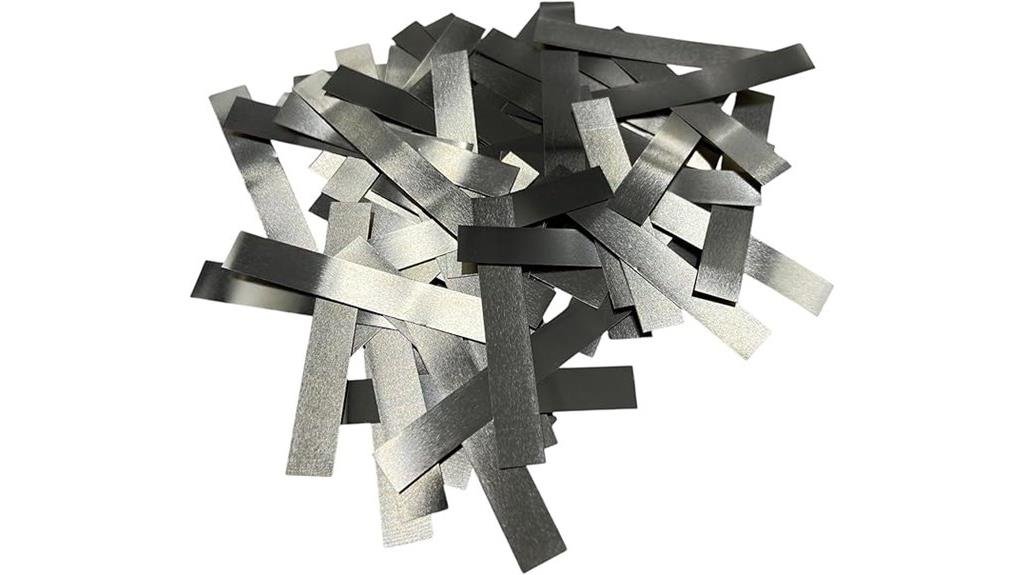
The 50pcs nickel-plated steel strip pack is presented as a budget-friendly option for DIY battery work, offering strips 0.1 mm thick, 7 mm wide, 45 mm long, made from SPCC low-carbon steel with nickel plating for corrosion resistance. The report notes good weldability, low contact resistance, short weld times, but limited flex life under repeated bending. What trade-offs should builders weigh when choosing between cost, weld performance, and durability?
Key Takeaways
- Pack contains 50 nickel-plated SPCC steel strips, 0.1 mm×7 mm×45 mm, part GD-01-7mm-45mm-50PCS.
- Good spot-welding performance on 18650 cells, with short weld times and low burn risk reported.
- Nickel plating improves corrosion resistance but steel core gives lower conductivity than pure nickel.
- Not ideal for high-current or frequent bending applications due to limited flex life and conductivity.
- Affordable alternative to pure nickel tabs; performance depends on weld settings and equipment.
Product Specifications and Materials
Specifications for the 50pcs Nickel-plated Steel Strip are concise and aimed at DIY battery work: each strip measures 0.1 mm thick, 7 mm wide, and 45 mm long (1.84 inches), and the pack contains 50 pieces with a total weight of approximately 0.317 ounces.
The reviewer notes material properties: SPCC low-carbon steel with nickel plating both sides. Dimensional accuracy is suitable for tab alignment, consistent thickness and length.
Reviewer notes SPCC low‑carbon steel, nickel‑plated both sides; dimensions accurate for tab alignment, consistent thickness and length.
Q: What should the builder consider?
A: Compatibility with spot welders, sheet rigidity, and plating quality.
Practical points: quantity, package size, and part number GD-01-7mm-45mm-50PCS.
Performance and Welding Experience
Having noted the strip dimensions, material, and plating, the review now examines how those characteristics affect real-world spot welding performance and handling.
The reviewer reports reliable welding efficiency: 0.1mm thickness and 7mm width allow low-resistance joins on 18650 cells with short weld times, fewer burns, consistent nuggets.
Strip durability is reasonable; nickel plating resists corrosion though base SPCC steel limits flex life under repeated bending.
Practical notes: weld power settings, electrode size, contact time.
Q: Any limitations? A: Yes — not pure nickel, avoid extreme currents.
Q: Who benefits? A: DIY builders wanting affordable, consistent tab links.
Buying Considerations and Customer Feedback
How should a buyer weigh cost, material, and intended use when choosing the 50pcs nickel-plated steel strips? A concise assessment helps those seeking liberation from poor choices.
Price comparison matters: packs cost less than pure nickel tabs but use SPCC nickel-plated steel (0.1mm x 7mm x 45mm), lower conductivity.
Price-wise they’re cheaper than pure nickel tabs, but these SPCC nickel‑plated steel strips (0.1×7×45mm) conduct less.
Question: is application versatility required? If welding 18650, 21700, 26650, use these for spot welders; for maximum conductivity choose pure nickel.
Considerations: pack quantity (50), weight (0.317 oz), return policy (30-day), welding efficiency, and rated 4.5/5 from 11 reviews.
Frequently Asked Questions
Are These Strips Safe for Use in High-Current E-Bike Packs?
No; they are not ideal for high current applications. The reviewer notes limited conductivity and steel core risks, so for e bike safety one should choose pure nickel or thicker copper alternatives to guarantee reliable, liberated power delivery.
Can They Be Cut or Bent Without Damaging the Plating?
Yes; with careful cutting techniques and gentle bending methods, the plating mostly endures—cut with sharp shears, score and snap, bend slowly to avoid flaking; freedom requires precision, restraint, and deliberate, empowered handling.
Do They Cause Galvanic Corrosion With Other Metals?
They can promote galvanic corrosion with dissimilar metals if electrolyte present. Advisers recommend corrosion prevention techniques and mindful metal compatibility concerns; users seeking liberation should isolate, coat, or choose compatible metals to avoid coupling.
Are They Heat-Resistant During Prolonged Soldering?
They tolerate brief soldering but not prolonged exposure; envision a strip glowing then warping. At typical soldering temperature they risk plating damage; limited heat dissipation means practitioners seeking freedom should prefer controlled, rapid joins or alternative materials.
Do They Comply With Transportation Regulations for Batteries?
No — they do not guarantee battery shipping compliance standards by themselves; the detached observer notes that compliance depends on full pack design, labeling, and carrier rules, so users must verify regulations are met for liberated transport.
Conclusion
Conclusion:
The 50pcs nickel-plated steel strips are a compact, cost-effective solution for 18650 pack building: 0.1 mm thick, 7 mm wide, 45 mm long, nickel-plated SPCC steel. Do they weld quickly and yield low-resistance joints? Yes—short weld times, reliable electrical contact. What are the trade-offs? Limited flex life under repeated bending, lower ductility than pure nickel. In short, efficient for welded series/parallel links, practical for most DIY battery assemblies.