Disclosure: As an Amazon Associate, we earn from qualifying purchases. If you click a link on this page and make a purchase, we may receive a small commission at no extra cost to you.
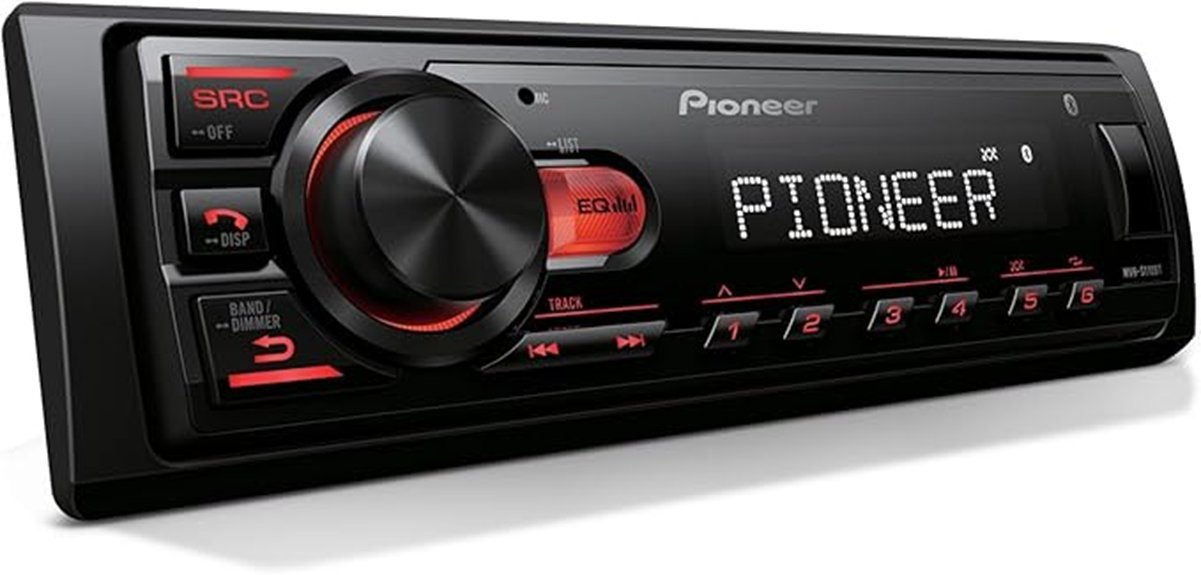
Replacing an older factory stereo can get complicated when your dashboard has limited space or you simply want Bluetooth without paying for a touchscreen receiver. The Pioneer MVH-S110BT keeps things simple with a shallow single-DIN chassis, Bluetooth 5.4, AM/FM radio, front USB playback, and physical controls. Its biggest strengths are compact installation and straightforward audio features, while its main limitations are the basic 2-band EQ, 1V preout, and lack of Apple CarPlay or Android Auto. This review helps you decide whether those tradeoffs make sense for your car and listening habits.
Quick Verdict
Rating: 8.4/10, Recommended with caveats
Best For: Drivers who want a compact, affordable single-DIN Bluetooth receiver without touchscreen features.
Bottom Line: The MVH-S110BT gives you a shallow chassis, reliable basic connectivity, USB audio, AM/FM radio, and enough built-in power for typical factory-replacement speakers. Skip it if you need CarPlay, Android Auto, extensive EQ control, SiriusXM support, or a stronger preamp section for a more advanced audio build.
| Specification | Detail |
|---|---|
| Brand | Pioneer |
| Model | MVH-S110BT |
| Product Type | Single-DIN mechless digital media receiver |
| Chassis Dimensions | 178 × 50 × 79 mm (7 × 2 × 3-1/8 in) |
| Weight | Approximately 0.45 kg (1 lb) |
| Bluetooth | Bluetooth 5.4 with hands-free calling and wireless audio streaming |
| Maximum Amplifier Output | 50 W × 4 channels |
| Continuous Output | 22 W × 4 channels |
| Speaker Load | 4 ohms, with 4 to 8 ohms allowable |
| Equalizer | 2-band graphic EQ with bass and treble adjustment |
| USB | Front Type-A USB input |
| USB Audio Formats | FLAC, WAV, MP3, and WMA |
| Radio | AM/FM tuner |
| RCA Preout | 2-channel, 1V |
| Microphone | Built-in Bluetooth microphone in the receiver grille |
| Apple CarPlay / Android Auto | Not supported |
| SiriusXM | Not supported |
| Remote Control | Optional remote support listed by Pioneer |
| Warranty | One-year limited warranty in the U.S. and Canada, subject to Pioneer warranty terms |
What Is the Pioneer MVH-S110BT?
The Pioneer MVH-S110BT is a single-DIN digital media receiver designed for drivers who want Bluetooth, USB playback, and traditional AM/FM radio without a CD mechanism or touchscreen. Its short 79 mm chassis depth is especially useful in dashboards where a full-depth receiver can leave little room for wiring.
You still get the everyday functions most basic stereo replacements need: Bluetooth calling, wireless audio streaming, front USB playback, physical controls, bass and treble adjustment, and a built-in four-channel amplifier. Pioneer also uses red backlit controls, which can make the buttons easier to identify during night driving.
Key Takeaways
- The 79 mm-deep chassis is much shallower than many traditional head units, which can make cable management easier in cramped dashboards.
- The amplifier is rated at 50 W × 4 maximum and 22 W × 4 continuous, so the 50-watt figure should not be treated as RMS output.
- Bluetooth 5.4 supports hands-free calls and wireless audio, while the front USB input supports FLAC, WAV, MP3, and WMA playback.
- The 2-band EQ is easy to use but much less flexible than receivers with 10-band or 13-band equalizers.
- There is no Apple CarPlay, Android Auto, SiriusXM support, or touchscreen interface.
Who Should Buy It?
Best For
- Drivers replacing an older single-DIN radio who mainly need Bluetooth, USB, and AM/FM.
- Vehicles with limited space behind the dashboard where a shallow 79 mm chassis is useful.
- Buyers using factory or moderately efficient aftermarket speakers without a complicated amplifier system.
Skip If
- You want Apple CarPlay, Android Auto, navigation, a touchscreen, or a backup-camera display.
- You need advanced tuning controls or stronger preamp outputs for a more complex amplified system.
- SiriusXM integration is a requirement for your setup.
Before You Buy: A single-DIN opening does not guarantee plug-and-play installation. Check the 178 × 50 × 79 mm chassis dimensions and confirm whether your vehicle also needs a dash kit, wiring harness, antenna adapter, or steering-wheel-control interface.
Design, Fitment, and Display
The main physical advantage of the MVH-S110BT is its shallow chassis. At 79 mm deep, it leaves more room behind the receiver for harnesses and adapters than many traditional CD-equipped stereos. That can be especially helpful in older cars, compact dashboards, and installations where factory wiring takes up much of the cavity.
The front panel uses a traditional layout with a rotary volume control, physical source buttons, a simple display, and red backlit controls. You do not get a large screen or touch interface, but physical buttons can be easier to operate by feel while driving.
Pioneer specifically advises buyers to check dimensions and depth rather than relying only on a vehicle fitment guide. You should also verify the mounting kit and wiring requirements for your exact year, make, model, and factory audio system.
Pro Tip: Check the space needed by your wiring harness and adapters as well as the receiver itself. A shallow stereo helps, but bulky factory connectors can still make the final few centimeters of installation difficult.
Sound Quality and Performance
The MVH-S110BT’s built-in MOSFET amplifier is rated at 50 W × 4 maximum output. The more useful continuous-power specification is 22 W × 4 channels. That distinction matters because maximum output is not the same as continuous RMS-style listening power.
For a straightforward factory-speaker replacement system, 22 watts per channel can provide useful everyday volume without requiring an external amplifier. Results still depend heavily on your speakers, their efficiency, installation quality, cabin noise, and correct wiring polarity.
Sound adjustment is intentionally simple. The receiver uses a 2-band graphic equalizer centered on bass and treble rather than the more detailed multi-band EQ found on higher-tier head units. You can also use loudness compensation for fuller sound at lower listening levels.
The result is best described as practical rather than audiophile-focused. You have enough control to correct basic tonal balance, but buyers building a system around external amplifiers, component speakers, or detailed DSP tuning may find the 2-band EQ and 1V preout restrictive.
Connectivity, Features, and Controls
Bluetooth 5.4 gives you the two functions most drivers expect from a modern basic receiver: hands-free calling and wireless music playback. Supported Bluetooth profiles include HFP for calling, A2DP for audio streaming, and AVRCP for compatible playback controls.
The microphone is built into the receiver’s front grille, so you should speak toward the head unit during calls. Call quality can still depend on dashboard position, road noise, window position, and cabin acoustics.
The front USB connection adds another useful playback option. The receiver supports FLAC, WAV, MP3, and WMA, giving you a practical way to keep a local music library in the car without relying entirely on your phone’s Bluetooth connection.
You also get a standard AM/FM tuner. What you do not get is equally important: Pioneer does not list Apple CarPlay, Android Auto, SiriusXM, iDatalink Maestro, or a camera input for this model.
Installation and Setup Tips
Start by confirming that your vehicle accepts a single-DIN receiver and identifying any installation parts required by the factory radio system. Some vehicles need only a harness and dash kit, while amplified factory systems can require additional integration hardware.
- Confirm the receiver dimensions before removing your existing stereo.
- Match the wiring harness to your exact vehicle rather than cutting factory wiring when an appropriate adapter is available.
- Follow Pioneer and vehicle instructions when working around the electrical system.
- Verify speaker polarity if bass sounds unusually weak after installation.
- Test Bluetooth calls, AM/FM reception, USB playback, balance, and fader before fully reinstalling dash trim.
Pioneer’s manual also cautions against leaving a USB device protruding directly from the front of the receiver where it could be struck. Using an appropriate short USB cable can reduce that risk when the connected device would otherwise stick out into the cabin.
Compatibility and Safety
The receiver is intended for a conventional automotive electrical system and supports 4-ohm speakers, with 4 to 8 ohms listed as allowable. Do not assume every factory premium-audio system can connect directly, because vehicles with factory amplifiers or proprietary data systems may require an interface.
Keep your listening level low enough that you can still hear traffic, warning signals, and activity around your vehicle. For installation, follow the Pioneer documentation and the instructions supplied with any vehicle-specific harness or interface. If your factory audio system is complex or you are unsure about power and speaker wiring, professional installation is the safer option.
How It Performs in Real Use
For Daily Commuting
The simple control layout is well suited to basic daily driving. Once your phone is paired, you can use Bluetooth for calls and streaming without adding a screen or phone-specific dashboard interface. The physical controls also reduce the need to navigate touchscreen menus for common functions.
For Older Cars With Tight Dash Space
This is where the 79 mm chassis can be particularly useful. A shallow receiver leaves more room for the wiring harness, antenna connection, and any adapter modules needed behind the dash. It does not guarantee compatibility, but it reduces one common installation problem.
For USB Music Libraries
If you prefer carrying music on a USB drive, support for FLAC, WAV, MP3, and WMA gives you more format flexibility than a Bluetooth-only receiver. USB playback can also be useful when you want music available without consuming phone battery or mobile data.
For an Upgraded Speaker System
The built-in 22 W × 4 continuous output is suitable for many basic speaker upgrades, but there are limits. If your goal is very high volume, a subwoofer-focused build, or stronger external amplification, you may eventually want a receiver with more advanced crossover, EQ, and preamp capabilities.
Pros and Cons
Pros
- Very shallow 79 mm chassis simplifies many tight-dashboard installations.
- Bluetooth 5.4 supports hands-free calling and wireless audio streaming.
- Front USB supports FLAC, WAV, MP3, and WMA playback.
- 22 W × 4 continuous built-in output is adequate for many everyday speaker systems.
- AM/FM tuner, physical controls, and simple EQ keep operation straightforward.
Cons
- The 2-band EQ offers limited tuning compared with receivers using 10-band or 13-band equalizers.
- The 1V 2-channel preout is modest for buyers planning an advanced external-amplifier system.
- No Apple CarPlay, Android Auto, SiriusXM integration, touchscreen, or camera input.
Is It Worth the Price?
The MVH-S110BT makes the most sense as a budget-oriented single-DIN upgrade. You are paying for the core functions many older vehicles lack: Bluetooth calling, wireless audio, USB playback, modern file support, and a compact chassis from an established car-audio brand.
Its value becomes weaker if you already know you want extensive audio tuning, multiple high-voltage preouts, smartphone projection, satellite-radio integration, or a touchscreen. In that case, paying more for a higher-tier receiver could save you from replacing the head unit again later.
For a simple daily-driver installation, however, the combination of shallow fitment, useful media support, and straightforward controls gives it strong value for the right buyer.
How It Compares to Alternatives
The Pioneer MVH-S230BT is worth comparing if you want another compact Pioneer receiver with Bluetooth and USB but prefer a stronger 2V preout and features such as Advanced Sound Retriever. It uses the same basic 50 W × 4 maximum and 22 W × 4 continuous amplifier ratings, so the main differences are in connectivity and audio-control features rather than a major jump in built-in speaker power.
The Sony DSX-A415BT is another useful comparison if phone connectivity and tuning flexibility matter more. Sony lists dual-phone Bluetooth connectivity, a 10-band EQ, front USB and AUX, and 4 × 55 W maximum output. The Pioneer MVH-S110BT remains attractive when your priority is a very simple, shallow single-DIN receiver rather than a longer feature list.
Frequently Asked Questions
Does the Pioneer MVH-S110BT include an AM/FM radio tuner?
Yes. The MVH-S110BT includes both AM and FM radio reception in addition to Bluetooth and USB playback. That makes it a complete basic replacement for a conventional radio rather than a Bluetooth-only controller.
Can steering-wheel-control adapters be used with it?
Do not assume universal steering-wheel-control compatibility. Pioneer’s current specifications do not advertise a built-in steering-wheel interface for this model, so your vehicle may require a compatible third-party interface. Confirm support for your exact vehicle and receiver before ordering an adapter.
Does it support simultaneous dual-phone Bluetooth pairing?
Pioneer’s current MVH-S110BT materials confirm Bluetooth calling and audio streaming but do not advertise simultaneous dual-phone operation as a feature. If two active phones are essential to you, choose a receiver that explicitly lists dual Bluetooth connection support.
Does it offer remote control or app-based control?
Pioneer lists remote control as an optional feature for the MVH-S110BT, so the original claim that remote operation is unavailable is not accurate. The receiver does not support Apple CarPlay or Android Auto, and you should not buy it expecting a touchscreen-style smartphone integration experience.
What warranty period does Pioneer provide?
Pioneer documentation states a one-year limited warranty for the MVH-S110BT in the U.S. and Canada. Coverage depends on Pioneer’s warranty terms, purchase conditions, and documentation, so keep your receipt and review the warranty supplied with the unit.
Will the Pioneer MVH-S110BT fit my car?
It uses a single-DIN chassis measuring about 178 × 50 × 79 mm, but physical DIN size is only part of fitment. Your vehicle may also need a dash kit, antenna adapter, wiring harness, or factory-amplifier interface, so verify those parts before purchase.
Does the Pioneer MVH-S110BT play CDs?
No. This is a mechless digital media receiver, so it does not contain a CD mechanism. Your main listening sources are Bluetooth, front USB, and AM/FM radio.
What USB audio formats does it support?
The front USB input supports FLAC, WAV, MP3, and WMA audio. Pioneer does not guarantee operation with every USB mass-storage device, so use a compatible drive and follow the storage and file-system guidance in the owner’s manual if playback problems occur.
The Bottom Line
The Pioneer MVH-S110BT is a strong choice when you need a compact single-DIN stereo with Bluetooth, USB music playback, AM/FM radio, and simple physical controls. Its shallow chassis and 22 W × 4 continuous built-in amplifier suit straightforward daily-driver upgrades, but buyers who need CarPlay, Android Auto, advanced EQ, SiriusXM, or a stronger preamp section should move to a more capable receiver.