Disclosure: As an Amazon Associate, we earn from qualifying purchases. If you click a link on this page and make a purchase, we may receive a small commission at no extra cost to you.
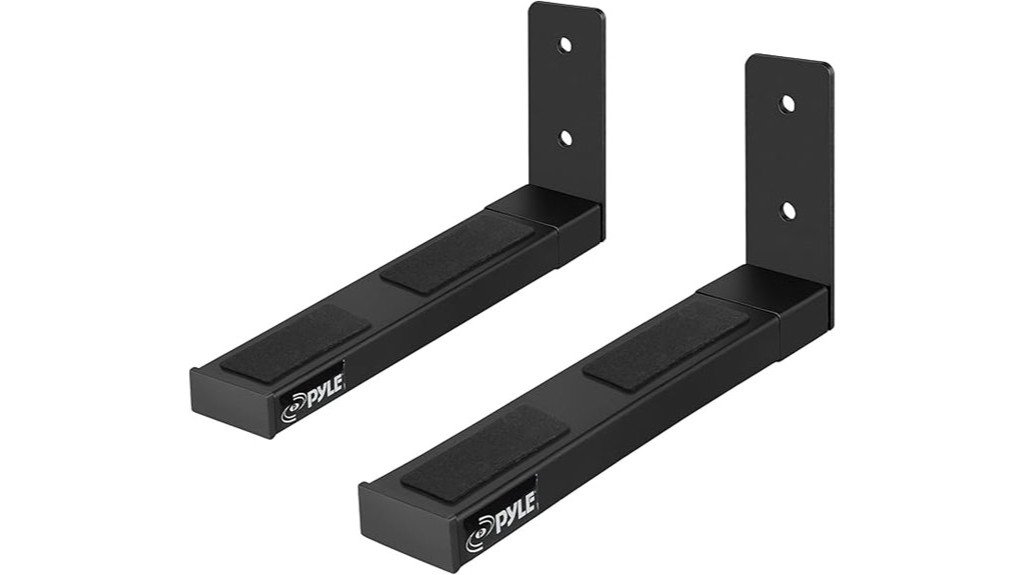
A heavy center-channel speaker needs more than a convenient place below your TV. Its wall brackets must fit the cabinet, hold the weight, and attach to a sound surface. The Pyle PSTNDW17 Adjustable Speaker Wall Mount Brackets offer two steel support arms with 6.7 to 11.8 inches of adjustable depth and a published 110 lb load rating. They are worth considering for larger speakers and soundbars, but the lack of tilt or swivel and the need for secure wall fixing can rule them out for some rooms. This review explains the verified specs, fit checks, and installation risks before you buy.
Quick Verdict
Verdict: Recommended with fit and installation caveats.
Best For: Home theater owners who need adjustable-depth support for a heavy center-channel speaker or soundbar.
Bottom Line: The PSTNDW17 pairs a high published load rating with useful depth adjustment. It does not aim your speaker, and the installation is only as secure as the wall, fasteners, and speaker placement.
| Specification | Detail |
|---|---|
| Brand | Pyle |
| Model | PSTNDW17 |
| Product type | Adjustable speaker and soundbar wall-mount brackets |
| Quantity | 2 independent bracket arms, one pair |
| Material | Engineered steel |
| Color | Black |
| Mount design | Wall-mounted support arms with adjustable depth |
| Advertised max speaker load | 110 lb (50 kg) for the bracket system; not per arm |
| Adjustable distance from wall | 6.7 to 11.8 in |
| Single bracket dimensions | 7.1 × 3.9 × 1.6 in (manufacturer-listed dimensions) |
| Compatible equipment | Soundbars and center-channel speakers; other speakers only after fit checks |
| In the box | 2 speaker brackets and mounting hardware |
| Published manufacturer warranty | 1 year; confirm terms and seller coverage |
| Installation consideration | Wall structure, compatible fasteners, bracket spacing, and speaker stability all need checking |
| Audio adjustments | Depth extension; no advertised swivel or tilt mechanism |
What Is the Pyle PSTNDW17 Speaker Wall Mount System?
The Pyle PSTNDW17 is a pair of separate, wall-mounted support arms made from engineered steel. Each bracket supports part of a single soundbar or speaker cabinet. You set the spacing on the wall to suit the equipment, then adjust how far the arms project into the room. Pyle lists a maximum speaker load of 110 lb and a black finish.
Unlike a full-width shelf, these brackets leave an open space between the supports. That helps you position the arms under suitable contact points, but it also means the speaker must sit securely on both supports. The manufacturer lists each bracket at 7.1 × 3.9 × 1.6 inches and the adjustable arm distance at 6.7 to 11.8 inches. These are different measurements, so use the latter when checking the wall-to-speaker reach.
Review method: This is a specifications-based buying assessment, not a hands-on load test or acoustic measurement. The product details were checked against Pyle’s product listing and its published model information. Real-world performance depends on the speaker, wall, and installation.
Who Should Buy It?
Best For
- A home theater with a broad, heavy center-channel speaker that has stable underside contact points.
- A soundbar setup that needs adjustable wall clearance below a TV.
- A room where a suitable structural wall can accept two properly spaced brackets.
Skip If
- You need tilt, swivel, or a clamp that holds the speaker from the sides.
- You cannot reach a suitable structural mounting surface with both brackets.
- Your speaker has a rounded, uneven, or unstable underside that cannot sit safely on open arms.
Before You Buy: The advertised 110 lb capacity is not permission to use drywall anchors alone or to place any speaker on the arms. Confirm the wall structure, compatible mounting hardware, cabinet contact points, and stable weight distribution. Ask a qualified installer when the wall or load is in doubt.
Key Features and Performance Breakdown
Engineered Steel Build and 110 lb Load Rating
Pyle specifies engineered steel and a maximum speaker weight capacity of 110 lb for the bracket system. That is a higher published rating than many mounts intended for small satellites. It gives you a reason to consider the PSTNDW17 for a large center channel, provided the complete installation meets the load requirements.
A load rating does not tell you how much a particular wall can hold. Fastener type, wall construction, arm extension, and cabinet balance also matter. There is no independent deflection or long-term fatigue test presented here, so claims of zero sagging or guaranteed stability would go too far.
6.7 to 11.8 Inches of Adjustable Depth
The adjustable arms let you place a cabinet closer to the wall or bring it forward. That can help you clear TV trim, speaker cables, or a rear-facing port. Measure the full cabinet depth and leave room for connectors and ventilation recommended by the speaker maker.
Do not assume more extension improves sound. Rear-port clearance affects some speakers, but the right distance depends on the cabinet design and the room. Greater extension also puts the load farther from the wall, so secure installation becomes especially important.
Independent Arms and Speaker Compatibility
The two supports can be positioned at separate points on the wall. This is useful when your soundbar or center channel is wide, but it does not guarantee compatibility with every speaker. Each contact area should be flat, stable, and clear of vents, controls, feet, or connectors.
The manufacturer describes the mounts for soundbars and center-channel speakers. Bookshelf speakers and studio monitors may also be candidates if their shape and the mounting method suit the design. For a small satellite with a keyhole or threaded mounting point, a dedicated speaker mount may be more appropriate.
What Is Included and What You May Still Need
The standard PSTNDW17 package contains two brackets and mounting hardware. Pyle’s user guide also identifies depth-fixing screws and an EVA contact pad among the parts. Check the box contents before drilling, since seller bundles and mounting surfaces may differ.
You may need fasteners chosen for your specific structural wall, plus a drill, level, measuring tape, suitable bits, and a way to locate studs. Do not assume that every supplied anchor is suitable for every wall or for a heavy load.
Pro Tip: Before you drill, place the speaker on a level surface and mark two stable support zones on its underside. Then compare those marks with the stud or anchor locations. This helps you find a bracket spacing that supports the cabinet without blocking ports or feet.
How It Performs in Real Use
The following are setup-based assessments from the bracket design and published dimensions, not claims of direct product testing.
Under a Wall-Mounted TV
A center channel below a TV often needs to clear the TV’s lower edge and any hanging cables. The adjustable reach gives you room to position the speaker front near the screen plane. The main check is speaker balance: both brackets should support the cabinet at suitable points, not just its ends.
With a Long Soundbar
Independent brackets can work well under a long, flat-bottomed soundbar because their spacing is not fixed by a single shelf. However, some soundbars are made to hang from rear mounting holes rather than rest on a support. Follow the soundbar maker’s mounting instructions if that is the case.
In a Home Office or Small Studio
Wall support can free desk space and place a compatible monitor at a better height. The lack of swivel or tilt is a tradeoff if you need precise aiming. With separate left and right studio speakers, also confirm whether each unit can be supported using the intended bracket configuration rather than dividing one pair without approval.
In a Busy Living Room
Moving a speaker off a cabinet may reduce the chance of casual bumps. A wall-mounted unit still needs a secure resting position and sensible cable routing, especially where children or pets can reach it. Do not treat the brackets as a protective enclosure or an anti-tip restraint.
Installation Safety and Materials
These are load-bearing metal brackets. Their strength is useful only when the wall and connections are suitable. Ordinary hollow-wall plastic anchors are not an appropriate shortcut for a heavy speaker. For stud walls, masonry, or another wall type, use fasteners rated for the substrate and follow Pyle’s instructions and the fastener manufacturer’s guidance.
Check for concealed electrical cables and plumbing before drilling. Make sure both arms are level, and tighten the depth-fixing screws before adding the speaker. The mounting points must keep the cabinet stable, even if someone brushes against it or a cable is moved. Where you cannot confirm the wall construction or mounting load, use a qualified installer.
Inspect the supports from time to time for loose screws, movement, damaged pads, or shifting cabinet position. Pyle publishes a one-year warranty for PSTNDW17, but coverage depends on the warranty terms and seller. Confirm those details before purchase.
Installation Guidelines and Placement Tips
Use this checklist to plan the placement before you put weight on the wall.
- Measure the cabinet. Record its weight, depth, flat contact zones, and any rear cable or port clearance.
- Find a suitable wall structure. Check the stud locations or masonry condition. Do not choose bracket spacing based only on the desired look.
- Mark both bracket positions. Use a level and measuring tape so the arms support the cabinet evenly.
- Select suitable fasteners. Follow the product guide and the hardware manufacturer’s instructions for your wall type.
- Fix and lock the arms. Tighten the brackets and depth screws as directed, then check the assembly before adding equipment.
- Set the speaker in place. Make sure it rests securely, does not rock or slide, and has space for cables and ventilation.
- Recheck after use. Look for movement or loose parts, especially after equipment or wiring changes.
Placement note: Aim to place the center-channel speaker close to the TV’s centerline without covering its drivers or ports. Because these brackets do not offer a published tilt adjustment, set the height carefully before drilling.
Pros and Cons
Pros
- Manufacturer-rated 110 lb speaker capacity for the bracket system.
- Adjustable 6.7 to 11.8 inch wall distance.
- Two independent arms allow flexible spacing for compatible cabinets.
- Engineered steel construction and mounting hardware included.
- Works as an alternative to using media console or desk space.
Cons
- No advertised tilt or swivel for fine speaker aiming.
- Open support arms may not safely fit rounded or uneven cabinets.
- Secure installation requires the right wall, fasteners, and bracket spacing.
Is It Worth the Price?
The PSTNDW17 is worth considering when you need strong, adjustable-depth support rather than a decorative shelf or a full-motion mount. Its value comes from the published 110 lb capacity, two-arm layout, and adjustable reach. These are useful features for a speaker that is too heavy or deep for a small satellite mount.
Compare the current asking price with the cost of the required wall hardware and, if needed, professional installation. A cheaper bracket is not a saving if it cannot fit your speaker or wall. Likewise, this model is not the best value if you need to tilt the speaker toward your seats or clamp it securely from the sides.
How It Compares to Alternatives
The B-Tech BT15 is another two-arm center-speaker mount with adjustable depth. Its published maximum is 33 lb, compared with Pyle’s 110 lb, so it suits a different weight range. The B-Tech BT77 uses padded side clamps with tilt and swivel, making it worth comparing for a compatible bookshelf speaker when aiming and grip matter more than open-arm support. Its published maximum load is 55 lb.
The PSTNDW17 stands out for its higher published capacity and 6.7 to 11.8 inch depth adjustment. It is a better match for a stable, heavy center-channel cabinet than for a speaker that needs active angle adjustment. Always compare dimensions, installation requirements, and ratings under the manufacturers’ stated conditions.
Frequently Asked Questions
What is the maximum weight capacity of the Pyle PSTNDW17?
Pyle rates the bracket system for a speaker weighing up to 110 lb (50 kg). Treat that as the overall advertised limit, not 110 lb per individual arm. The wall, fasteners, and final layout must also support the load.
How far do the arms extend from the wall?
Pyle specifies an adjustable wall distance of 6.7 to 11.8 inches. Measure your speaker depth, rear connections, and any TV clearance before choosing an arm position.
Does the box contain two brackets or four?
The standard PSTNDW17 is sold as one pair with two bracket arms and mounting hardware. Do not confuse it with the separately named PSTNDW17X2 package, and check the seller’s quantity before ordering.
Can these brackets hold a curved soundbar?
Possibly, but only if the cabinet has two stable, flat support areas that rest securely on the arms. Measure contact points and the center of gravity rather than assuming all curved designs will fit.
Can I mount the brackets on drywall without studs?
Do not depend on ordinary plastic drywall anchors for a heavy speaker. Use a suitable structural substrate and fasteners approved for that substrate, and consult a qualified installer if the wall construction is uncertain.
Do the Pyle brackets swivel or tilt?
The published PSTNDW17 features adjustable depth, not a stated tilt or swivel mechanism. Choose a different mount if you need to aim the speaker after installation.
Will these mounts work for a bookshelf speaker or studio monitor?
They may work when the cabinet is stable on two support arms and both supports can be fixed securely to the wall. Check the footprint, weight, rear ports, wiring clearance, and the manufacturer’s mounting guidance before use.
What is the most common setup mistake to avoid?
Do not assume a high weight rating makes any wall or placement safe. Check stud locations, bracket spacing, speaker balance, arm locking screws, and the wall hardware before placing your equipment.
The Bottom Line
The Pyle PSTNDW17 is a sensible option when you have a heavy, flat-bottomed soundbar or center-channel speaker and a suitable structural wall. Its key strengths are the 110 lb published rating and adjustable support depth; skip it if you need tilt, swivel, or a clamp-style hold. Check cabinet fit and wall hardware before buying, because those details matter more than the weight rating alone.
Ready to Buy?
Confirm your speaker dimensions and wall type, then check the current product details on Amazon.