
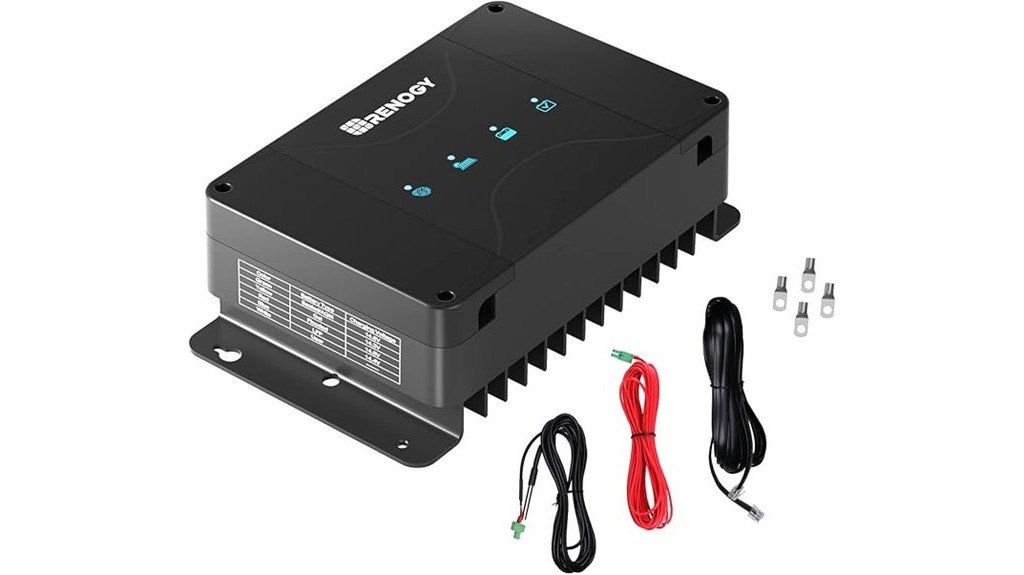
The Renogy 12V 50A DC-to-DC charger is presented as a compact, high-efficiency charging solution for vehicles and off-grid systems, offering up to 99% MPPT efficiency, dual-input (solar and alternator), and 50A output capacity; it charges a 1 kWh battery in roughly two hours, supports lead-acid and lithium chemistries, and includes app monitoring, multiple protections, and a two-year warranty. How well does it perform in real-world installs, what wiring and cooling considerations matter, and is it worth the cost?
Key Takeaways
- Compact, robust 12V 50A DC-DC charger with removable covers and soft-start for safe vehicular/off-grid charging.
- MPPT solar input plus alternator support enables simultaneous dual-input charging to shorten recharge times.
- High efficiency: up to ~99% MPPT tracking and about 94% conversion for effective battery charging.
- Multi-stage charging supports Gel, AGM, Flooded, and Lithium batteries with temperature and overcurrent protections.
- App/Bluetooth monitoring and RS485 option, easy 15-minute installation, two-year warranty covering defects.
Key Features and Specifications
When choosing a DC-to-DC charger, practical specifications matter more than marketing claims; the Renogy 12V 50A DC to DC with MPPT combines compact dimensions, robust protection, and multiple input options to meet common vehicle and off-grid needs.
The reviewer notes size: 9.6 x 5.7 x 3 in, 3.13 lb, removable side covers, and soft start circuitry.
What inputs are available? Solar (MPPT) and alternator with simultaneous charging.
How does it compare? Product comparisons emphasize multi-stage charging, battery type support (Gel, AGM, Flooded, Lithium), and thorough protections.
User experience benefits from app monitoring, quick installation, two-year warranty.
Charging Performance and Efficiency
Although designed for vehicle and off-grid use, the Renogy 12V 50A DC‑to‑DC charger emphasizes charging performance through precise MPPT tracking and high conversion efficiency.
It reaches up to 99% MPPT tracking efficiency and about 94% conversion efficiency, enabling a 1 kWh battery to be fully charged in roughly 2 hours under ideal solar conditions.
How fast is charging speed in practice? Expect near-rated currents when alternator or solar inputs are ample; simultaneous dual-input charging shortens total time.
Expect near-rated currents with ample alternator or solar input; using both inputs together shortens overall charging time.
Efficiency comparison: losses are low versus many rivals.
Practical note: thermal management and correct wiring preserve peak performance.
Design, Installation, and Build Quality
A compact, thoughtfully arranged enclosure defines the Renogy 12V 50A DC‑to‑DC charger’s physical design: it measures 9.6 x 5.7 x 3 inches, weighs 3.13 lbs, and fits easily into tight engine bays or under-seat compartments.
The unit pairs user friendly design with robust construction; removable side covers protect terminals, and labeled ports simplify wiring. Installation is straightforward for competent DIYers, with integrated connections for solar, starter, and house batteries, and clear mounting points.
- Mounting: four holes, compact footprint, accessible terminals.
- Wiring: color-coded, plug-in style, minimal splicing.
- Maintenance: dust-resistant fins, replaceable covers.
Safety, Protection, and Warranty
Safety features are front and center on the Renogy 12V 50A DC‑to‑DC charger, delivering layered protection that suits vehicular and off‑grid use.
It offers safety mechanisms including battery isolation, over‑voltage, over‑current, reverse polarity, reverse current, temperature and overheat protection.
What practical limits? Input soft‑start helps prevent inrush damage; dimensions 9.6 x 5.7 x 3 inches keep heat manageable, weight 3.13 lbs aids mounting choices.
How reliable is support? Warranty coverage is two years, covering defects and functional failures under normal use.
Users should confirm installation clearances and ventilation for peak output conditions.
Monitoring, Connectivity, and Cost Savings
Begin by examining how the Renogy 12V 50A DC‑to‑DC charger lets users monitor system health, configure settings, and cut operating costs through solar‑first logic.
It offers smart monitoring via an app and BT‑2 dongle, or RS485 for fleet integration, showing voltages, current, and temperature; the 9.6 x 5.7 x 3 in unit reports state-of-charge and faults.
Connectivity options include Bluetooth and wired RS485, enabling remote updates and alerts.
How much can one save? Renogy estimates over $300/year in reduced alternator run-time and fuel.
Renogy estimates you can save more than $300 per year by cutting alternator run time and fuel use
Practical tip: allow 15 minutes for setup with foolproof terminals.
- App status: live volts, amps, temp
- Wired: RS485 fleet data logging
- Savings: solar-first reduces alternator use
Frequently Asked Questions
Will This Charger Work With a 24V House Bank?
No; the unit is 12V compatibility only and cannot directly charge a 24V house bank. To use it, the system would require a DC-DC step-down/up converter, which would affect overall charging efficiency and complexity.
Can It Charge Two Different Battery Chemistries Simultaneously?
A van owner tested simultaneous charging: the charger balanced a starter AGM and a lithium house bank sequentially. It cannot independently tailor multi-chemistry stages; charging efficiency and battery compatibility depend on correct mode selection and wiring.
Is a Dc-To-Dc Charger Compatible With Smart Alternators?
Yes; the device supports smart alternator compatibility. It manages variable voltage outputs, preserving charging efficiency via MPPT and soft-start controls, preventing alternator load issues while optimizing battery charging across multiple chemistries.
Can I Mount It Inside a Sealed Cabinet Without Ventilation?
No; it requires ventilation due to heat dissipation. He notes cabinet installation must allow airflow or external mounting to prevent overheating, preserve protections and warranty, and guarantee reliable performance during multi-stage charging.
What Accessories Are Required for Marine Installation?
Required accessories include marine wiring sized for 50A, a dedicated fuse or DC breaker, corrosion‑resistant battery terminal connectors, heat‑shrink seals, chassis grounding kit, waterproof conduit, and a Bluetooth/RS485 monitor for remote supervision.


