Disclosure: As an Amazon Associate, we earn from qualifying purchases. If you click a link on this page and make a purchase, we may receive a small commission at no extra cost to you.
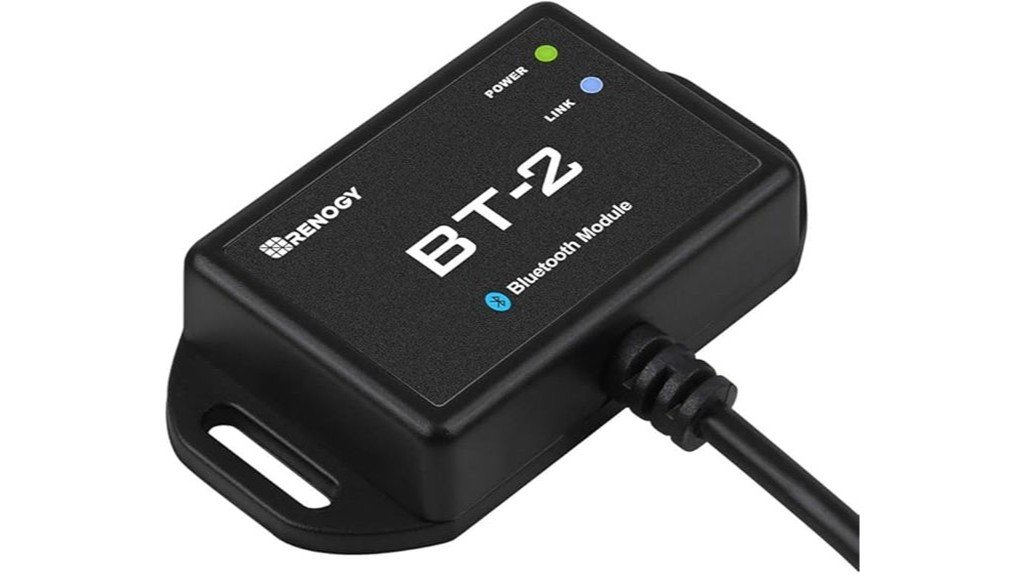
Monitoring off-grid solar systems manually often requires squatting next to charge controllers in tight RV compartments or outdoor utility sheds. The Renogy BT-2 Bluetooth Module solves this hassle by sending live system diagnostics directly to your smartphone. By plugging into compatible Renogy charge controllers and smart batteries via an RJ45 port, it lets you check solar production and battery state from up to 82 feet away. This review breaks down its compatibility, performance range, app functionality, and setup limits to help you decide if it fits your off-grid power configuration.
Quick Verdict
Rating: 8.5/10 — Recommended for Renogy RS485 Users
Best For: RVers, camper van owners, and off-grid solar operators using Renogy RS485 gear who want wireless data access.
Bottom Line: The BT-2 provides reliable short-range telemetry for compatible Renogy devices via the DC Home app. While physical obstacles reduce signal range, its low power draw and simple plug-and-play connection make it an essential tool for daily energy tracking.
| Specification | Detail |
|---|---|
| Brand | Renogy |
| Model | BT-2 (RBT100-BT-2) |
| Communication Protocol | RS485 |
| Port Interface | RJ45 Communication Port |
| Wireless Protocol | Bluetooth 4.2 |
| Communication Distance | Up to 82 ft (25 m) line-of-sight |
| Input Voltage | 5V–12V (Powered directly via RJ45 port) |
| Standby Power Consumption | Less than 0.04W |
| Operating Power Consumption | Less than 0.05W |
| Companion Application | Renogy DC Home App (iOS & Android) |
| Weather Resistance | Non-waterproof (Indoor or protective compartment use only) |
| Compatible Components | Rover Elite MPPT Controllers, Smart Lithium Batteries, Dual DC-DC Chargers, Select Pure Sine Wave Inverters |
What Is the Renogy BT-2 Bluetooth Module?
The Renogy BT-2 is an external Bluetooth transmitter designed to add wireless telemetry to Renogy solar controllers, battery chargers, and lithium power banks. Unlike older models that used RS232 protocols, the BT-2 uses an RS485 communication bus connected through a standard RJ45 port. This allows higher data transmission speeds and broader hardware compatibility across modern Renogy components.
Once plugged into your master solar component, the module draws tiny amounts of power directly from the host device’s data port. It broadcasts a localized Bluetooth 4.2 signal to your smartphone, turning the Renogy DC Home app into a mobile control center. You can view real-time solar generation, monitor battery state of charge, check error logs, and adjust charging parameters without needing a physical multi-meter or hardwired LCD display screen.
Who Should Buy It?
Best For
- RVers and camper van owners with Renogy RS485 charge controllers or smart lithium batteries.
- Off-grid cabin builders who want remote battery status checks without opening utility cabinets.
- Users who want to customize battery voltage thresholds directly from their phone.
Skip If
- You own older Renogy controllers that require RS232 6-pin RJ12 ports (use the BT-1 module instead).
- You need long-range remote monitoring from miles away (requires a Wi-Fi or cellular gateway).
- You require a waterproof module for unprotected outdoor mounting.
Key Feature Breakdowns
Bluetooth 4.2 Signal and Wireless Range
The BT-2 utilizes Bluetooth 4.2 technology, offering a maximum theoretical signal range of 82 feet (25 meters) in open space. In real-world installations inside an RV or camper van, steel framing, interior cabinetry, and aluminum sidewalls will reduce effective range to roughly 30 to 50 feet. However, this is still plenty of range to check system health from the driver’s seat, dining lounge, or adjacent campsite setup.
RS485 Architecture and RJ45 Port Design
Understanding port compatibility is crucial before purchase. The BT-2 connects using an RJ45 port and communicates using the RS485 protocol. This distinguishes it from the older BT-1 module, which uses an RS232 protocol with an RJ12 port. The RS485 interface allows multi-device networking capabilities on supported hardware, providing faster data refresh rates when reading solar voltage, amperage, and wattages on your phone screen.
Ultra-Low Standby Power Consumption
Off-grid electrical systems must minimize parasite power draws. The BT-2 features an energy-efficient chip that consumes less than 0.04 watts in standby mode and under 0.05 watts during active data transmission. Operating continuously 24 hours a day consumes less than 1.2 watt-hours daily. This negligible draw means you can leave the module connected permanently without worrying about draining your auxiliary battery bank during long storage periods.
DC Home App Real-Time Diagnostics
By pairing the module with Renogy’s free DC Home app (available for iOS and Android), you unlock comprehensive system monitoring. The dashboard displays historical solar generation graphs, live battery charge percentages, load output status, and real-time fault alerts. Advanced users can also modify battery profile settings, switching between AGM, Gel, Flooded, and custom Lithium charge voltages with a few taps.
Before You Buy: Double-check your hardware port type before buying. The BT-2 only fits devices with an RS485 RJ45 port (like the Rover Elite MPPT series and Smart Lithium batteries). If your controller features an RS232 RJ12 port (like the standard Rover PG series), buy the BT-1 module instead.
How It Performs in Real Use
Daily Solar Charge Tracking
During daylight hours, opening the DC Home app provides instant visibility into solar array performance. You can monitor input voltage and incoming current from your solar panels to confirm maximum power point tracking (MPPT) efficiency. If shade falls across a solar panel, the real-time drop in wattage registers immediately on the app, helping you reposition portable panels for maximum output.
Overnight Battery Monitoring
At night, the BT-2 provides vital insight into your battery bank’s state of charge and discharge rates. Instead of guessing how much capacity remains after running lights, refrigeration, or diesel heaters, the app reports live battery voltage and current consumption. This allows you to adjust power usage before hitting low-voltage disconnect thresholds.
System Diagnostic Troubleshooting
If your charge controller enters a error state due to over-temperature, over-voltage, or short-circuit conditions, the BT-2 transmits specific warning codes to the app screen. Rather than deciphering flashing LED light codes on the hardware unit itself, the app displays plain-language error explanations, significantly speeding up field troubleshooting.
Setup, Placement, and Usage Tips
Setting up the BT-2 is simple, but following correct mounting guidelines prevents common connection issues:
- Plugin Sequence: Connect the RJ45 cable to the communication port of your powered Renogy device first. The status LED on the BT-2 will illuminate once it receives 5V–12V power from the port.
- App Pairing: Enable Bluetooth and Location services on your smartphone before launching the DC Home app. Tap “Add Device,” select “Bluetooth Module,” and select your BT-2 from the scanned list.
- Placement Strategy: Mount the module as high as possible inside your vehicle or electrical compartment. Avoid placing it directly inside sealed metal junction boxes, which block Bluetooth signals.
Pro Tip: If your phone fails to detect the BT-2 during initial setup, ensure your phone’s Location permissions are granted for the DC Home app. Android and iOS both require location services enabled to discover nearby Bluetooth Low Energy (BLE) peripheral devices.
Safety and Environmental Care
The Renogy BT-2 module is not waterproof or weather-resistant. It carries no IP water-ingress rating and should never be exposed to direct rain, road spray, or heavy condensation. Always install the module inside a dry interior compartment, weatherproof battery box, or sealed utility cabinet.
When routing the RJ45 communication cable, keep it clear of hot engine components, sharp metal edges, and high-voltage AC wiring to prevent signal interference or physical insulation damage.
Pros and Cons
Pros
- Plug-and-play installation requires no external power wiring or batteries.
- Ultra-low power draw (<0.05W) will not drain off-grid battery banks.
- Provides full app control for custom lithium parameter configurations.
- RS485 protocol delivers rapid data updates and multi-device support.
Cons
- Signal range drops noticeably when transmitting through metallic RV walls.
- Lacks waterproofing; restricted to interior or sheltered mounting.
- Incompatible with older Renogy RS232 controllers.
Is It Worth the Price?
Priced as an affordable add-on accessory, the Renogy BT-2 delivers immense practical value for anyone managing an off-grid solar installation. Compared to purchasing and mounting dedicated flush-mount LCD display panels, the BT-2 is less expensive, requires no cutting into interior walls, and provides far richer historical data graphs through the DC Home mobile interface.
It represents a smart buy for RVers, van lifers, and boat owners who want complete oversight of their energy storage without spending hundreds on complex third-party monitoring networks. The convenience of checking battery health from your bed or camp chair easily justifies the modest cost.
How It Compares to Alternatives
When selecting a monitoring solution for Renogy equipment, compare these options:
- Renogy BT-2 vs. Renogy BT-1: The primary difference is the communication bus. The BT-1 uses RS232 via an RJ12 port, while the BT-2 uses RS485 via an RJ45 port. Choose based strictly on your host device’s hardware port.
- Renogy BT-2 vs. Hardwired LCD Meters (e.g., RMS-CTRL): Hardwired meters offer dedicated, fixed displays that require physical wiring through walls. The BT-2 offers wireless flexibility and deeper data logging via your smartphone without invasive panel cutting.
- Renogy BT-2 vs. Renogy Communication Hub: The Renogy Hub allows multi-device management across both RS232 and RS485 devices simultaneously, whereas a single BT-2 connects directly to one communication port or networked daisy-chain bank.
Frequently Asked Questions
What Renogy products are compatible with the BT-2 module?
The BT-2 module is compatible with Renogy devices equipped with an RS485 communication bus and RJ45 port. Compatible models include Rover Elite MPPT Solar Charge Controllers, Smart Lithium Iron Phosphate Batteries, Dual Input DC-DC MPPT Battery Chargers, and select Pure Sine Wave Inverters.
What is the difference between the Renogy BT-1 and BT-2 modules?
The main difference is the communication protocol and connector interface. The BT-1 uses an RS232 protocol with an 6-pin RJ12 connector, whereas the BT-2 uses an RS485 protocol with an 8-pin RJ45 connector. Check your device manual or port label to select the correct module.
How far does the Bluetooth signal reach?
The module features a maximum open-field range of up to 82 feet (25 meters). In real-world applications where the signal must pass through RV walls, cabinetry, or metal battery enclosures, expect an effective operating range of 30 to 50 feet.
Is the Renogy BT-2 module waterproof?
No, the BT-2 is not waterproof or water-resistant. It must be installed in a dry location sheltered from rain, condensation, and splashing water to maintain safe operation.
Can multiple phones connect to the BT-2 simultaneously?
No, the BT-2 establishes a single point-to-point Bluetooth connection. Only one smartphone running the DC Home app can connect to the module at a time. Disconnect the app on one device before attempting to pair with another.
Does the BT-2 drain my auxiliary battery overnight?
No. The BT-2 draws less than 0.04 watts in standby mode. This parasitic consumption is negligible and will not impact your battery bank’s capacity, even during long-term vehicle storage.
What should I do if the module loses Bluetooth connection?
If connection drops, check that you are within the 82-foot signal range and verify the RJ45 cable is firmly seated. You can soft-reset the module by unplugging the RJ45 cable for 10 seconds and plugging it back in to force a fresh Bluetooth handshake.
Do I need cell service or Wi-Fi to monitor my system?
No internet connection is required for basic local monitoring. The DC Home app connects directly to the BT-2 using local Bluetooth signals, making it fully functional in remote off-grid locations without cellular coverage.
The Bottom Line
The Renogy BT-2 Bluetooth Module simplifies off-grid energy management by delivering essential battery and solar metrics directly to your mobile device. Its ultra-low power consumption, RS485 data architecture, and simple plug-and-play setup make it a top upgrade for compatible Renogy solar systems. While you must protect it from moisture and account for wall obstacles, it provides outstanding convenience and oversight for any solar-powered RV, van, or cabin.