Disclosure: As an Amazon Associate, we earn from qualifying purchases. If you click a link on this page and make a purchase, we may receive a small commission at no extra cost to you.
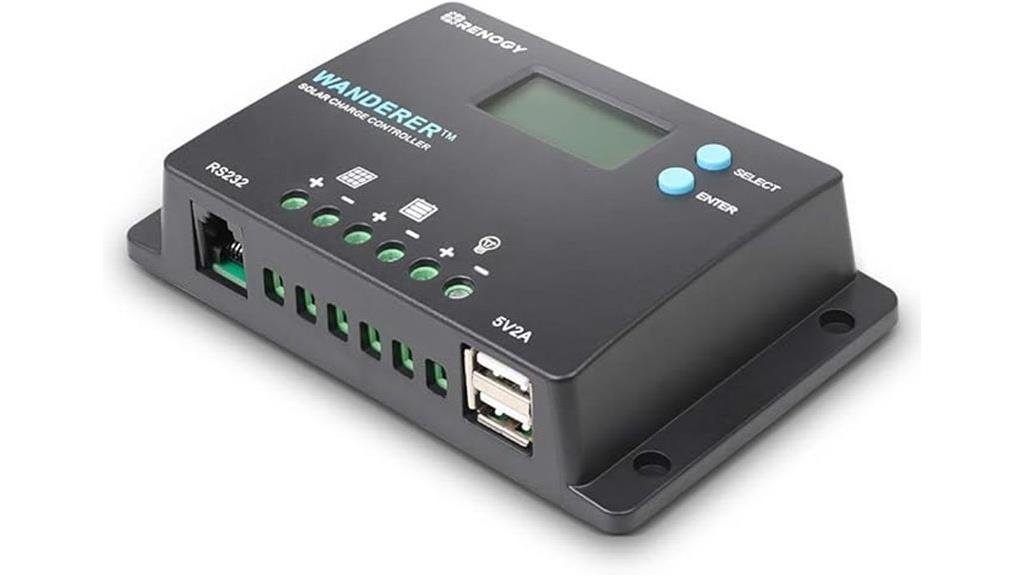
Choosing a solar charge controller is not just about matching the price to your budget. You need the right current rating, solar-panel capacity, and charging settings to protect your battery. The Renogy Wanderer 10A PWM Solar Charge Controller offers a simple way to manage smaller 12V and 24V off-grid systems, with an LCD display, selectable battery profiles, and optional Bluetooth monitoring. However, its 10A rating and PWM design make it a better fit for modest solar arrays than larger or more complex installations.
Quick Verdict
Rating: Recommended with caveats
Best For: Small RV, cabin, camper, and off-grid solar systems with compatible 12V or 24V batteries.
Bottom Line: The Wanderer 10A gives you useful battery settings, a built-in display, and basic DC load control without requiring an MPPT controller. Its main drawbacks are limited charging capacity, lower energy harvest than MPPT in some setups, and an enclosure that needs protection from water.
Key Takeaways
- 10A charging capacity: Renogy lists maximum solar-panel input ratings of 130W for 12V systems and 260W for 24V systems.
- Battery compatibility: Supports sealed AGM, Gel, Flooded, and compatible lithium battery settings. Non-lithium system voltage is detected automatically.
- Four-stage PWM charging: Includes Bulk, Boost, Float, and Equalization functions, with charging behavior determined by battery type.
- Useful monitoring: A backlit LCD displays system information. An RS232 port supports optional Bluetooth monitoring with a compatible BT-1 module.
- Compact design: Measures approximately 4.7 × 3.0 × 1.1 inches and weighs about 0.27 lb.
- Important limitation: The manual specifies an IP20 enclosure. Install it in a dry, protected location rather than exposing it to rain or splashes.
Key Features and Specifications
The Wanderer 10A focuses on the controls most small solar systems need. Before choosing it, compare your solar-panel output, battery chemistry, wiring, and connected loads with the limits below.
| Specification | Detail |
|---|---|
| Brand | Renogy |
| Model | Wanderer 10A |
| Product type | PWM solar charge controller |
| System voltage | 12V/24V, automatic detection for non-lithium batteries |
| Rated charge current | 10A |
| Maximum PV power | 130W at 12V; 260W at 24V |
| Maximum PV voltage | 50V DC, using Renogy’s published product-page limit |
| Battery types | Sealed/AGM, Gel, Flooded, and compatible lithium profiles |
| Charging method | PWM with Bulk, Boost, Float, and supported Equalization modes |
| Display | Backlit LCD |
| Connectivity | RS232; optional BT-1 Bluetooth module |
| USB output | 5V, up to 2A |
| Load terminal | Up to 10A DC |
| Self-consumption | Less than 10mA, per Renogy’s product specifications |
| Terminal wire size | Up to 12 AWG |
| Dimensions | Approximately 4.7 × 3.0 × 1.1 inches |
| Weight | Approximately 0.27 lb (122g) |
| Enclosure rating | IP20 in Renogy’s technical manual |
| Operating temperature | -25°C to 45°C (-13°F to 113°F) |
| Package contents | One Wanderer 10A controller in the standard controller-only package |
| Best application | Small off-grid solar charging and low-power DC loads |
What Is the Renogy Wanderer 10A?
The Renogy Wanderer 10A is a solar charge controller that sits between your solar panels and battery. It regulates charging to help prevent overcharging while allowing you to select a suitable charging profile.
It uses pulse-width modulation (PWM) rather than maximum power point tracking (MPPT). PWM is a practical choice for smaller, well-matched panel and battery systems. However, it cannot convert surplus panel voltage into extra charging current the way an MPPT controller can.
The controller also includes a display, USB charging output, and programmable DC load terminals. Those features make it useful for basic campsite lighting, battery maintenance, and other low-power off-grid needs.
Before You Buy: Check both the solar-panel wattage and its open-circuit voltage (Voc). Renogy rates this controller for up to 130W at 12V or 260W at 24V. Its product page lists a 50V DC input limit. The controller is also not waterproof, so you must provide a dry installation location.
Charging Performance and Battery Care
Charging performance is one of the biggest reasons to choose a particular solar controller. The Wanderer 10A can regulate up to 10A of charging current, but the actual current depends on sunlight, panel output, battery voltage, and the charging stage.
How Four-Stage PWM Charging Works
The controller uses four charging stages for supported battery types:
- Bulk: Uses available panel current to charge a battery that needs more energy.
- Boost: Holds a controlled charging voltage as the battery approaches a fuller charge.
- Float: Uses a lower voltage to maintain supported lead-acid batteries.
- Equalization: Applies a controlled higher-voltage charge for suitable flooded lead-acid batteries.
Not every battery uses all four stages. In particular, you should not apply flooded-battery equalization settings to AGM, Gel, or lithium batteries unless the battery manufacturer explicitly permits them.
Charging Voltage Settings by Battery Type
Renogy’s published manual lists different charging values for each battery profile. The following examples are for a 12V nominal system at 25°C. They are not universal settings for every battery.
| Battery type | Boost | Float | Equalization |
|---|---|---|---|
| Gel | 14.2V | 13.8V | Not used |
| Sealed/AGM | 14.6V | 13.8V | Not used |
| Flooded | 14.6V | 13.8V | 14.6V |
| Lithium/LFP | 14.2V default, adjustable | Not used | Not used |
For a 24V system, you must use the correct 24V battery profile and confirm the settings in your controller’s manual. Never copy the 12V voltages directly into a 24V setup.
How Long Does It Take to Charge a Battery?
A 10A controller can deliver at most 10Ah during one hour of charging at its rated current. For example, replacing 50Ah of battery capacity would require at least five hours at a constant 10A, before accounting for charging losses and reduced current near full charge.
Real charging often takes longer because solar output changes throughout the day. A 100Ah battery also does not always need 100Ah replaced. The amount of energy missing from the battery matters more than its total rated capacity.
Battery Compatibility and Lithium Settings
For sealed AGM, Gel, and Flooded batteries, the Wanderer can automatically recognize a 12V or 24V system after you connect the battery correctly.
Lithium systems require more care. You must manually select the lithium profile, nominal system voltage, and a charging voltage allowed by the battery manufacturer. The supported lithium profile is intended for compatible lithium iron phosphate (LiFePO4/LFP) applications; do not assume it suits every lithium chemistry.
Follow your battery manufacturer’s charging limits, including any low-temperature charging restrictions. A compatible battery management system (BMS) remains important.
Installation, Build Quality, and Durability
Compact Design and Mounting
At approximately 4.7 inches long, 3.0 inches wide, and 1.1 inches deep, the Wanderer fits inside many small electrical cabinets. Its light weight also makes mounting easier.
However, the unit still needs ventilation. Renogy’s installation guidance calls for at least 6 inches (150mm) of clearance above and below the controller to support cooling.
Mount it on a secure vertical surface away from direct sunlight, excessive heat, and moisture. Do not install it in a sealed compartment with flooded batteries, where gases can accumulate.
Wiring and Installation Steps
The most important installation rule is to connect the battery before connecting the solar panels. The controller needs battery power to establish its operating conditions.
- Confirm your panel’s voltage, current, and wattage fit the controller’s limits.
- Turn off or isolate power before handling any wiring.
- Mount the controller in a clean, ventilated, dry location.
- Choose correctly rated cables and overcurrent protection based on the manufacturer’s instructions.
- Connect the battery to the correct terminals, checking polarity carefully.
- Set the correct battery profile and system voltage when required.
- Connect the solar-panel wiring with the correct polarity.
- Check the display for charging information and any error messages.
Renogy specifies terminal capacity up to 12 AWG. This is a terminal size limit, not a recommendation to use the same wire for every cable length.
Pro Tip: Measure the complete cable run before buying wire. Long runs increase voltage drop, even on a small 10A system. Keep connections short where practical, and select cable size and fuses from the Renogy manual rather than guessing from the controller’s current rating alone.
Enclosure Protection and Long-Term Care
The technical manual identifies the enclosure as IP20. That means you should not treat this controller as splash-resistant or waterproof.
For boats, outdoor sheds, and exposed RV installations, mount the unit inside a suitable dry compartment. Check that the enclosure still allows the required ventilation.
Maintenance is straightforward. Inspect cables for wear, look for discolored or loose connections, and keep the controller dry and free from excessive dust. Always isolate power before touching terminals.
Load Management, Monitoring, and Connectivity
LCD Display and System Information
The Wanderer 10A includes a backlit LCD that can show battery voltage, solar-panel voltage, charging current, load current, operating modes, and error information.
You can use the SELECT and ENTER controls to move through display screens and adjust supported settings. This makes it easier to identify a low battery or charging issue without buying a separate monitoring display.
Load Control for Lights and Small Devices
The controller has a load output rated up to 10A DC. Its programmed modes can help you operate compatible lighting and other simple low-power loads.
| Mode | Function | Typical use |
|---|---|---|
| Automatic | Turns load on after solar production stops and off when production resumes | Night lighting |
| Timer | Runs for a selected 1 to 14 hours after solar production stops | Timed evening lights |
| Manual | Allows load switching using the controller | Simple DC accessories |
| 24-hour | Keeps the load enabled subject to controller protections | Suitable always-on DC loads |
The load output follows battery-system voltage. If you have a 24V battery bank, you must not connect equipment designed only for 12V directly to that output.
Avoid using the small load terminals for high-power inverters, large motors, or devices with high startup current. Such equipment needs its own suitable battery connection and protection.
Bluetooth Monitoring and USB Charging
The built-in RS232 communication port supports remote monitoring through a compatible Renogy BT-1 Bluetooth accessory. With the module and supported Renogy app, you can view system information without standing next to the controller.
The standard controller-only package should not be assumed to include the BT-1. Check the selected bundle before ordering.
A 5V/2A USB output is also available for compatible small devices. It is useful for light USB charging, but it is not a substitute for a higher-power USB-C charging system.
How It Performs in Real Use
The following use cases describe what you can reasonably expect from the published specifications. They are practical setup examples, not claims from an independent field test.
1. Small RV or Camper Battery Charging
With a compatible 12V battery and a solar panel within the controller’s limits, the Wanderer can help replace energy used by lights, small fans, and other modest electrical loads.
A typical 100W nominal 12V solar panel is a sensible size to evaluate. However, actual output still depends on the panel’s operating voltage, sunlight, and battery charging stage.
If you want to power a refrigerator, inverter, and several larger appliances, you need to calculate daily energy use before assuming a 10A controller will be enough.
2. Weekend Cabin or Garden Shed
For a small cabin or garden shed, the timed load modes can be useful for lighting after sunset. The LCD helps you check battery voltage and charging activity during visits.
The main concern is location. A humid, leaking, or poorly ventilated enclosure can expose the controller to conditions beyond its IP20 protection.
3. Boat or Marine Battery Maintenance
The Wanderer may fit a small boat’s auxiliary solar setup when the electrical system is compatible. Its compact dimensions help where mounting space is limited.
It is not a waterproof marine controller. Keep it away from direct spray, condensation, and bilge moisture. A marine electrician should check the full installation if you are unsure about wiring, grounding, or battery compatibility.
4. Portable Solar and Backup Power
For portable solar charging, the low self-consumption and built-in display are useful features. You can check charging status without relying on a separate device.
However, a PWM controller does not get the same energy advantage from higher-voltage panels that an MPPT controller may provide. Portable systems that use high-voltage panels or need faster energy recovery may benefit from MPPT instead.
Installation Safety and Compatibility
A solar charge controller handles live DC power, so correct sizing and installation matter. Even a 10A controller can be damaged by reversed wiring, excess voltage, poor connections, or unsuitable battery settings.
- Check panel Voc: Make sure the panel’s open-circuit voltage, including the effect of cold conditions, stays within the permitted limit.
- Use correct fusing: Follow the manufacturer’s wiring and fuse recommendations for your installation.
- Respect terminal limits: Never force oversized wire into the controller’s terminal block.
- Match battery chemistry: Select charging settings allowed by your battery manufacturer.
- Protect lithium batteries: Use the appropriate BMS and low-temperature charging safeguards.
- Provide ventilation: Do not block the space needed around the controller.
- Keep it dry: Do not expose the IP20 enclosure to rain, spray, or standing water.
Renogy’s manual also states that the controller has no user-serviceable internal parts. Do not open its housing to attempt circuit repairs.
Pros, Cons, and Who It’s Best For
Who Should Buy It?
Best For
- RV and camper owners using a small, compatible 12V solar array.
- Cabin owners who want basic battery charging and timed DC lighting.
- Off-grid users who prefer an LCD controller with simple monitoring and selectable charging profiles.
Skip If
- Your planned solar array exceeds the controller’s 10A or rated PV input limits.
- You need MPPT conversion for higher-voltage panels or improved energy harvest.
- Your installation location exposes the controller directly to rain or splashing water.
Pros and Cons
Pros
- Supports compatible 12V and 24V battery systems.
- Offers separate AGM, Gel, Flooded, and lithium settings.
- Backlit LCD provides useful operating and error information.
- Programmable 10A DC load output supports simple lighting control.
- Small, lightweight design with optional Bluetooth monitoring and USB output.
Cons
- The 10A charge limit leaves little room for a larger solar array.
- PWM does not offer the voltage-conversion benefits of MPPT.
- IP20 protection requires dry mounting, and Bluetooth needs a compatible accessory.
Is It Worth the Price?
The Renogy Wanderer 10A sits in the budget-friendly part of the solar charge controller market. Its value comes from giving you a display, multiple battery profiles, simple load control, and optional Bluetooth connectivity without the added complexity of an MPPT unit.
You get the most value when your solar setup is small and your panel voltage is a good match for your battery system. For a 12V setup built around a modest panel, the controller may provide everything you need.
However, the lowest controller purchase cost is not always the lowest long-term system cost. If a larger MPPT controller could recover meaningfully more energy from your array or support future expansion, paying more upfront may make sense.
How It Compares to Alternatives
The Renogy Wanderer Li 30A PWM is worth comparing if you need greater charging current for a compatible 12V system. It provides a higher current rating, but it remains a PWM controller and has different panel-voltage limits.
The Renogy Rover Li 20A MPPT is a more capable alternative for buyers who need MPPT charging, more panel capacity, or greater flexibility with solar-panel voltage. The Wanderer 10A makes more sense when your system is modest and a lower-cost PWM design meets your needs.
Frequently Asked Questions
Can the Renogy Wanderer 10A handle a 200W solar panel?
Renogy lists 130W as the maximum PV input for a 12V system and 260W for a 24V system. A 200W panel is therefore above the published 12V limit but within the 24V wattage limit if the panel’s electrical characteristics also meet the controller’s requirements. Check voltage and current, not just watts.
Does the Wanderer 10A automatically detect lithium batteries?
No. Automatic 12V/24V system-voltage recognition applies to non-lithium batteries. For a compatible lithium battery, you must manually choose the lithium profile, system voltage, and appropriate charging voltage.
Is the Renogy Wanderer 10A waterproof?
No. The technical manual lists an IP20 enclosure rating. You should install the controller in a protected, dry, ventilated location rather than exposing it directly to weather or water spray.
Can you use multiple Wanderer controllers with the same battery bank?
Multiple charge controllers can be used in appropriately designed systems, but compatibility is not guaranteed by simply connecting them together. Each controller needs suitable panel inputs, battery settings, wiring, and protection. Ask Renogy or a qualified solar installer to confirm your proposed layout before connecting multiple units to one battery bank.
Is there a physical on/off switch for the USB port?
The controller does not list a dedicated USB on/off switch among its controls. USB availability depends on the controller’s powered operating state. If you need independently switched USB power, consider a separate compatible USB charging outlet with its own switch.
Does it support external temperature sensors or calibration?
The referenced Wanderer 10A specifications list temperature compensation but do not identify a dedicated external temperature-sensor connection or user calibration feature. If your battery setup requires an external sensor, confirm compatibility with Renogy before buying. Do not rely on temperature compensation as a replacement for a lithium battery’s low-temperature charging protection.
Does it include a warranty, and how long should it last?
Renogy’s current Wanderer 10A product information describes a two-year material and workmanship warranty. Confirm the terms for your exact seller, product version, and region before ordering. Service life depends on electrical loading, ventilation, moisture exposure, and installation quality, so a fixed lifespan cannot be guaranteed.
Can you replace internal fuses or the LCD screen?
Renogy’s manual states that the controller has no user-serviceable internal parts. External system fuses are separate components and should be inspected or replaced only with correctly rated parts. For a damaged LCD or internal fault, contact Renogy support instead of opening the controller.
How This Review Was Prepared
This review uses Renogy’s published Wanderer 10A specifications, its charge-controller documentation, and the identified Amazon product listing. Specifications and charging settings were checked against manufacturer information. The real-world examples explain suitable applications based on those specifications; they are not presented as hands-on test results.
Actual charging performance depends on your panel, battery, wiring, installation, and weather. Product details may change between revisions, so confirm the specifications for your exact controller before purchase or installation.
The Bottom Line
The Renogy Wanderer 10A PWM Solar Charge Controller is recommended with caveats for small 12V and 24V off-grid systems where simple battery charging, LCD monitoring, and basic load control are enough. Its main strengths are ease of use and useful charging options, while its 10A limit, PWM design, and need for dry mounting make it less suitable for larger or exposed installations. Choose it for a modest, compatible solar setup, but consider a higher-capacity MPPT controller if you need more charging power or future expansion.