Disclosure: As an Amazon Associate, we earn from qualifying purchases. If you click a link on this page and make a purchase, we may receive a small commission at no extra cost to you.
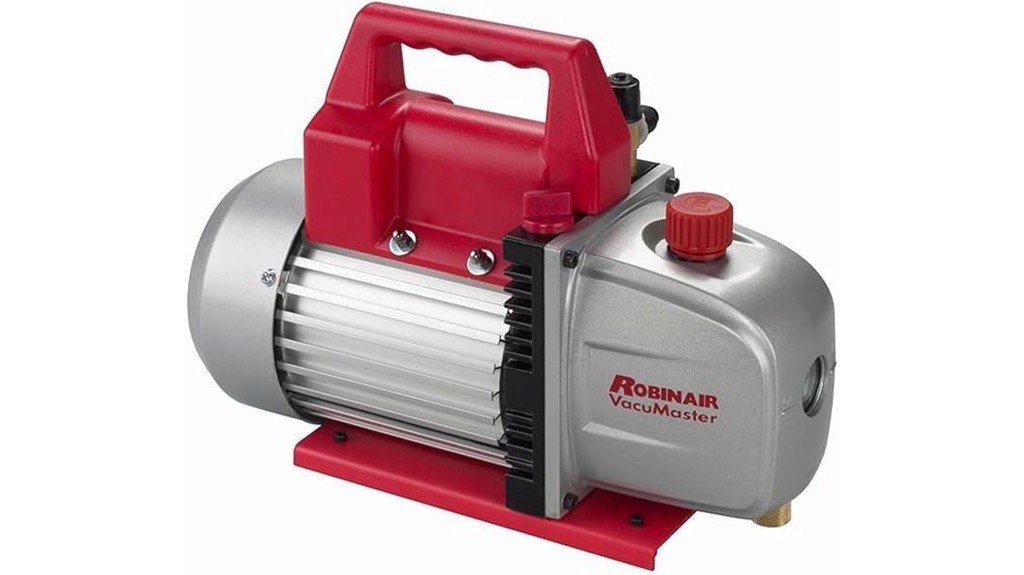
A vacuum pump can look powerful on paper yet evacuate slowly when its flow rate, hose setup, oil condition, or refrigerant compatibility does not match the job. The Robinair 15500 VacuMaster combines a 5 CFM free-air displacement rating with a two-stage rotary vane design and a factory rating of 35 microns. It suits HVAC-R and compatible automotive A/C service where you need a portable, maintenance-friendly pump instead of a basic single-stage model. Its main limits are its 115V-only power requirement, 28-pound weight, regular oil-care needs, and lack of approval for A4L or other flammable refrigerants.
Quick Verdict
Rating: 8/10, recommended with caveats
Best For: HVAC-R technicians, fleet-service users, and automotive A/C technicians working on compatible nonflammable refrigerant systems.
Bottom Line: The Robinair 15500 offers useful 5 CFM performance, a two-stage pump design, flexible intake connections, and straightforward oil service. Choose another model if you need 220V operation, A4L refrigerant approval, a lighter pump, or more airflow for faster work on high-volume systems.
Key Takeaways
- The Robinair 15500 is a two-stage rotary vane vacuum pump with 5 CFM free-air displacement and a 35-micron factory rating.
- Its current manufacturer specifications list a 1/3 HP motor, 115V/60 Hz power, 7.5 oz oil capacity, and a six-foot power cord.
- The pump includes 1/4-inch MFL and 3/8-inch ACME intake connections plus a 3/8-inch FFL to 1/2-inch ACME adapter.
- The sight glass, top oil-fill port, and angled drain make frequent oil checks and changes easier.
- It is not approved for ammonia, lithium bromide, A4L refrigerants, or other flammable refrigerants.
Key Specifications and Design Features
| Specification | Detail |
|---|---|
| Brand | Robinair |
| Model | 15500 VacuMaster |
| Product Type | A/C and refrigeration vacuum pump |
| Pump Design | Two-stage rotary vane |
| Free-Air Displacement | 5 CFM |
| Factory Micron Rating | 35 microns |
| Motor | 1/3 HP, thermally protected |
| Power | 115V/60 Hz |
| Oil Capacity | 7.5 oz (220 mL), based on the current manufacturer page |
| Intake Connections | 1/4-inch MFL and 3/8-inch ACME |
| Included Adapter | 3/8-inch FFL to 1/2-inch ACME adapter |
| Dimensions | 10 inches high × 5 inches wide × 13 inches long |
| Weight | 28 lb (12.2 kg) |
| Power Cord | 6 ft (1.8 m) |
| Body Material | Die-cast aluminum |
| Approval | CSA, as listed by Robinair |
| Warranty | One year, subject to Robinair’s current terms |
| Compatible System Types | A/C-R systems using compatible CFC, HCFC, and HFC refrigerants |
| Important Exclusions | Not for ammonia, lithium bromide, A4L, or other flammable refrigerants |
Robinair has produced more than one revision of the VacuMaster design. Older manuals may show different oil capacity, dimensions, or weight figures. Use the specifications on the data plate and the instructions supplied with your individual pump when they differ from current online information.
What Is the Robinair 15500 VacuMaster?
The Robinair 15500 is a service vacuum pump designed to remove air and moisture from compatible air-conditioning and refrigeration systems before charging or completing repair work. Its two-stage rotary vane mechanism is built to reach a deeper vacuum than a comparable single-stage pump.
The 5 CFM rating places it between small pumps intended for occasional residential or passenger-vehicle jobs and larger 8 or 10 CFM shop pumps. Robinair lists applications that include rooftop A/C systems, tractor-trailers, buses, and other compatible A/C-R equipment.
The pump also focuses on field maintenance. You can see the oil through the sight glass, refill it through the top port, and drain it through an angled valve near the bottom of the reservoir.
Before You Buy: The 15500 is a 115V/60 Hz pump and is not approved for A4L or other flammable refrigerants. Do not use it on an R-1234yf or other flammable-refrigerant system unless Robinair specifically approves that application.
Who Should Buy It?
Best For
- HVAC-R technicians who want a two-stage 5 CFM pump for routine service and evacuation work.
- Fleet and automotive A/C users servicing compatible nonflammable refrigerant systems.
- Buyers who value accessible oil maintenance, multiple intake connections, and a carry handle.
Skip If
- You need 220V operation or equipment approved for A4L and flammable refrigerants.
- You want a lightweight pump for rare, small-system jobs.
- You need higher airflow, an isolation valve, or other advanced features found on larger shop pumps.
Performance and Evacuation Capability
The 5 CFM specification describes the pump’s free-air displacement, not a guaranteed evacuation time. System volume, hose diameter, core restrictions, moisture, ambient temperature, oil condition, and leaks can all change how long a job takes.
The two-stage design is the more important feature when you need a deep vacuum. The first stage lowers system pressure, while the second stage supports deeper pull-down than a basic single-stage design.
The 35-micron figure is also a factory pump rating. It does not mean every connected system will immediately reach 35 microns. Your reading depends on the system, measurement point, gauge accuracy, hose setup, seals, and oil condition.
Build Quality and Portability
The die-cast aluminum body helps control weight while providing a rigid pump housing. Finned surfaces help release heat, and non-skid feet reduce movement on a bench, floor, or service platform.
At 28 pounds, the Robinair 15500 is portable but not especially light. The molded handle makes job-site transport easier, though you may still prefer a protective crate or case when moving it between vehicles or buildings.
An intake screen helps stop debris from entering the pumping chamber. Robinair also uses exhaust filtration to separate oil vapor from the exhaust flow, although normal operation may still produce heat, odor, and some vapor.
Fittings and Connection Options
The pump provides 1/4-inch MFL and 3/8-inch ACME intake connections. Robinair also lists a 3/8-inch FFL to 1/2-inch ACME adapter, giving you several ways to connect compatible service hoses.
These fittings do not guarantee that the pump will connect directly to every manifold, hose, or vehicle. Check your hose ends, manifold ports, refrigerant type, and any required core-removal tools before starting the job.
A restrictive or leaking hose setup can make a capable pump appear slow. Use clean, vacuum-rated hoses and keep unused ports capped to limit contamination and leakage.
Oil Maintenance and Usability
Oil quality directly affects how deeply a rotary vane pump can pull. Moisture and contaminants collected during evacuation can enter the oil, reducing sealing performance inside the pump.
Robinair recommends high-vacuum pump oil and advises changing the oil after each use for maximum performance. The sight glass helps you check the running oil level, while the angled drain and top fill port simplify replacement.
Do not substitute automotive engine oil or another general lubricant. Oil made for high-vacuum pumps has the viscosity and vapor-pressure characteristics needed for deep evacuation.
Oil level also matters. Too little oil can reduce vacuum performance, while too much may cause oil to discharge from the exhaust. Follow the fill procedure and level marks in the manual supplied with your pump.
Pro Tip: Check the oil before every job and replace it when it becomes cloudy, dark, or contaminated. Fresh high-vacuum pump oil is often the first fix when pull-down performance becomes slower than normal.
Setup Tips Before First Use
- Confirm the pump revision. Compare the data plate and supplied manual with the current online specifications before adding oil.
- Use a grounded outlet. Connect the 115V pump to a correctly grounded circuit and avoid damaged or undersized extension cords.
- Place it on a level surface. A level position helps you read the sight glass correctly and reduces the chance of an oil spill.
- Check hose compatibility. Match your manifold, vacuum hoses, adapters, and refrigerant system before opening any valves.
- Recover refrigerant first. A vacuum pump evacuates a recovered system. It is not a refrigerant-recovery machine.
- Use a micron gauge. Measure the system vacuum with a suitable gauge instead of relying only on operating time or manifold readings.
- Cap open ports after shutdown. Keeping ports covered helps prevent dirt and moisture from entering the pump.
How It Performs in Real Use
For HVAC-R Service Work
The 5 CFM flow rate provides a practical middle ground for residential and light-commercial service. You get more pumping capacity than Robinair’s smaller 1.5 or 3 CFM VacuMaster models without moving to a heavier 8 or 10 CFM unit.
For Compatible Automotive A/C Service
The carry handle, standard intake connections, and 115V power requirement suit garage and fleet-service environments. Confirm the refrigerant first because the 15500 is not approved for R-1234yf, A4L, or other flammable refrigerants.
For Rooftop and Fleet Systems
Robinair lists rooftop A/C systems, tractor-trailers, and buses among the pump’s intended applications. Actual evacuation speed will still depend on system volume, access points, hose conductance, moisture, and leak condition.
For Repeated Shop Use
The oil sight glass and angled drain become valuable when you use the pump frequently. They make it easier to inspect and replace contaminated oil between jobs, which supports more consistent performance.
Compatibility and Safety
Robinair lists the 15500 for compatible A/C-R systems using CFC, HCFC, and HFC refrigerants with mineral, ester, alkylbenzene, or PAG lubricants. The manufacturer specifically excludes ammonia, lithium bromide, A4L refrigerants, and other flammable refrigerants.
Recover refrigerant through approved equipment before connecting the vacuum pump. Starting evacuation while a system remains under high pressure can damage the pump and create a safety risk.
The pump housing and motor can become hot during operation. Keep the unit away from combustible materials, maintain ventilation around the fins, and avoid touching hot surfaces.
Use safety glasses and follow the equipment manual, refrigerant requirements, local regulations, and the system manufacturer’s service procedure. Refrigerant recovery, charging, and electrical work may require trained or certified personnel.
Pros and Cons
Pros
- Two-stage design supports deeper evacuation than a comparable single-stage pump.
- 5 CFM flow rate suits many HVAC-R, fleet, and compatible automotive A/C jobs.
- Multiple intake connections and an included adapter improve hose compatibility.
- Sight glass, top fill port, and angled drain simplify regular oil service.
- Cast-aluminum housing, cooling fins, non-skid feet, and handle support field use.
Cons
- Not approved for A4L, R-1234yf, or other flammable refrigerants.
- 115V/60 Hz operation limits use in regions or shops that require 220V equipment.
- The 28-pound pump requires frequent oil care and does not list a carrying case in the standard package.
Is It Worth the Price?
The Robinair 15500 sits in the mid-range service-tool category. Its value comes from the two-stage design, 5 CFM airflow, multiple fittings, repairable components, and maintenance layout rather than extra digital controls or a complete service kit.
It offers the most value when you perform recurring HVAC-R, fleet, refrigeration, or compatible automotive work. Regular users are more likely to benefit from the easier oil changes and higher airflow compared with a small occasional-use pump.
It is not the best value for one minor repair, A4L refrigerant service, or work that requires 220V power. You must also budget for suitable hoses, a micron gauge, fresh vacuum-pump oil, and any job-specific adapters.
How It Compares to Alternatives
The Robinair 15150 is worth comparing when you need a smaller 1.5 CFM two-stage pump for passenger cars, domestic refrigeration, or lighter workloads. It weighs less but gives up evacuation speed and has a higher factory micron rating.
The Robinair 15501 is the closer option for regions requiring a 220V, 50 Hz version of a 5 CFM VacuMaster. For more airflow, the Robinair 15800 moves up to 8 CFM but is larger, heavier, and more expensive to operate and transport.
The 15500 makes the most sense when 115V power, 5 CFM airflow, a two-stage design, and simple oil maintenance match your normal service work.
Frequently Asked Questions
Does the Robinair 15500 include a carrying case and oil?
A carrying case is not listed as part of the standard package. Oil inclusion has varied across listings and product revisions, so check the seller’s package details and inspect the supplied manual before first use.
Can you use it on R-1234yf automotive A/C systems?
No. Robinair states that the pump is not for A4L or other flammable refrigerants. R-1234yf requires service equipment specifically approved for that refrigerant.
Can the Robinair 15500 run from a 220V outlet?
The 15500 is specified for 115V/60 Hz power. Do not connect it directly to 220V. Compare the Robinair 15501 or another manufacturer-approved voltage-compatible model instead of relying on an improvised converter setup.
How often should you change the vacuum-pump oil?
Robinair recommends changing the oil after each use for maximum performance. You should also replace it whenever it becomes cloudy, dark, contaminated, or unable to support normal pull-down performance.
What fittings come with the Robinair 15500?
The current manufacturer specifications list 1/4-inch MFL and 3/8-inch ACME intake connections. They also list a 3/8-inch FFL to 1/2-inch ACME adapter.
Why might the pump fail to reach a deep vacuum?
Dirty oil, an incorrect oil level, leaking hoses, loose adapters, a damaged seal, moisture, or a system leak can prevent deep pull-down. Check the oil and connection setup before assuming the pump has failed.
Does the 35-micron rating guarantee a 35-micron system reading?
No. It is the pump’s factory rating under controlled conditions. The reading on a connected system also depends on system condition, gauge placement, hose restriction, leaks, moisture, and oil quality.
What warranty does Robinair provide?
Robinair currently lists a one-year warranty and describes a no-hassle replacement program for qualifying purchases in the United States and Canada. Keep your proof of purchase and review the current regional terms before relying on coverage.
The Bottom Line
The Robinair 15500 VacuMaster is a strong choice when you need a serviceable 115V two-stage pump with 5 CFM airflow, flexible fittings, and straightforward oil maintenance. It best suits HVAC-R, fleet, and compatible nonflammable automotive A/C work.
Skip it if you need A4L refrigerant approval, 220V operation, very low weight, or more airflow from a larger shop pump. Its main strength is dependable, maintenance-friendly evacuation capability, while its main limitation is the need to match its voltage and refrigerant restrictions carefully.
Ready to Buy?
Check the latest price, package contents, and product details before you decide.