Disclosure: As an Amazon Associate, we earn from qualifying purchases. If you click a link on this page and make a purchase, we may receive a small commission at no extra cost to you.
Small repair jobs can become frustrating when your welder is too heavy to move or too large for a crowded workbench. The Saker Portable Welding Machine focuses on mobility, with 110V input, a listed 20–120A range, and support for 3/32- to 1/8-inch electrodes. Its 3.3 lb body and compact footprint suit short DIY repairs, but the available product information does not confirm an exact duty cycle or rated material thickness. This review helps you decide whether its portability and simple controls outweigh those limits.
Quick Verdict
Rating: 7.5/10
Best For: DIY users who need a compact 110V stick welder for short, light repair jobs.
Bottom Line: The Saker welder offers useful portability, a broad listed amperage range, and support for common small stick electrodes. It is less suitable for long fabrication sessions because the exact duty cycle, output accuracy, and rated material capacity are not clearly documented.
Key Takeaways
- The listed 110V input makes the welder practical for locations with a suitable household circuit.
- Its 20–120A range and five-level control are designed for light stick-welding tasks rather than production work.
- It supports 3/32- to 1/8-inch (2.5–3.2 mm) electrodes, but electrodes are not included.
- The 3.3 lb body and 9.8 x 9.45-inch footprint are the main reasons to choose it.
- Cooling vents and overheating protection add reassurance, although the exact duty cycle is not confirmed.
Key Specifications
| Specification | Detail |
|---|---|
| Brand | Saker |
| Listing identifier | Amazon ASIN B0DMNKPP2F |
| Product type | Portable inverter stick welder |
| Input voltage | 110V |
| Listed output range | 20–120A |
| Output control | Five-level adjustment knob |
| Electrode support | 3/32 to 1/8 inch (2.5–3.2 mm) |
| Inverter technology | IGBT |
| Arc-start feature | Hot-start assistance |
| Body weight | Approximately 3.3 lb |
| Body footprint | Approximately 9.8 x 9.45 inches |
| Packaged size and weight | About 14.81 x 12.29 x 4.85 inches and 6.89 lb |
| Cooling | 360-degree ventilation |
| Protection | Overheating protection |
| Best use | Short DIY repairs, practice, and light fabrication |
| Package note | Welding electrodes are not included |
What Is the Saker Portable Welding Machine?
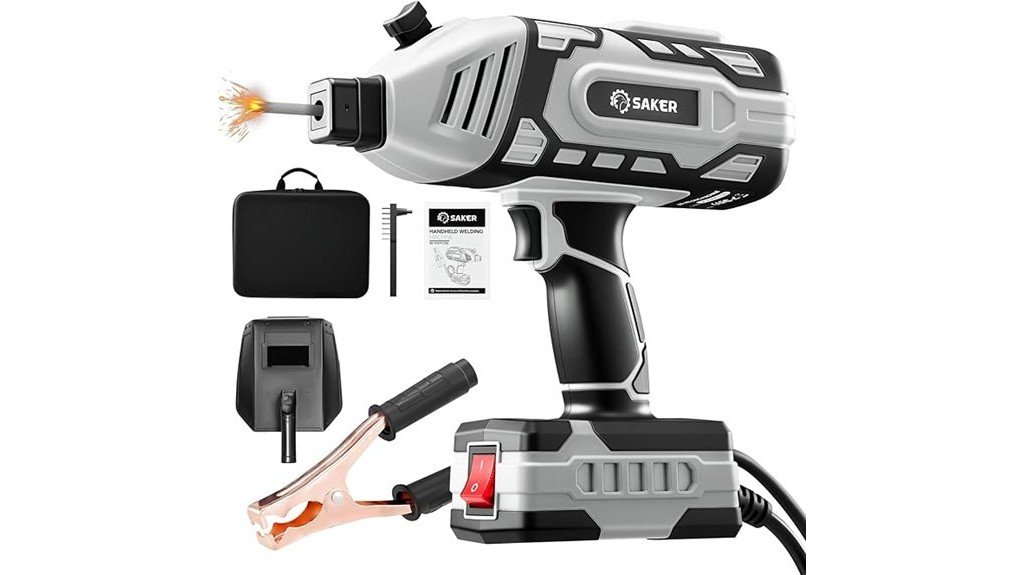
The Saker Portable Welding Machine is a small 110V inverter stick welder built for users who value easy transport and simple controls. Instead of a large bench-style cabinet, it uses a compact handheld body with an integrated handle and a five-level output knob.
Its listed 20–120A output and 3/32- to 1/8-inch electrode range place it in the light-duty category. That combination can fit small steel repairs, brackets, practice beads, and occasional maintenance work, but it should not be treated as a substitute for a higher-duty shop welder.
Who Should Buy It?
Best For
- DIY users who need a welder that is easy to carry between small jobs.
- Beginners practicing basic stick-welding technique on suitable scrap steel.
- Home workshops with limited storage space and access to a suitable 110V outlet.
Skip If
- You need long, continuous welds or production-level output.
- You need a documented duty-cycle chart or verified material-thickness rating.
- You want digital amperage control, dual-voltage input, or advanced process options.
Before You Buy: Confirm the live listing, included accessories, warranty terms, and electrical requirements before ordering. The available source information does not verify the exact duty cycle, output accuracy, or maximum rated steel thickness.
Output and Electrode Compatibility
The welder lists a 20–120A range and supports 3/32- to 1/8-inch electrodes. That gives you room to match the rod size and current setting to a light repair, although the five-level knob provides less precision than a digital amperage display.
The supported electrode range is useful for common small stick-welding tasks, but you still need the correct electrode type for the base metal and position. Since rods are not included, budget for suitable electrodes and verify the recommended amperage on their packaging.
Hot Start and Controls
Hot-start assistance is designed to make arc initiation easier by providing extra starting energy. This can reduce sticking when you strike the electrode, which is helpful when you are learning or working in an awkward position.
The five-level knob keeps operation simple, but it also means settings are less exact than a numbered digital control. You may need to test on scrap material and adjust one level at a time until the arc feels stable.
Design, Portability, and Build Quality
Portability is the Saker welder’s clearest advantage. The body weighs about 3.3 lb and occupies roughly 9.8 x 9.45 inches, so it is easier to store in a small workshop, vehicle compartment, or job box than a conventional cabinet welder.
The compact housing includes an accessible handle and controls. That makes one-handed carrying practical, but the complete working setup will weigh more once you add leads, electrodes, safety gear, and any storage case.
Cooling, Safety, and Reliability
The unit lists 360-degree ventilation and overheating protection. Those features help manage heat, but they do not remove the need to pause between welds, keep the vents clear, and avoid operating the machine in an enclosed hot space.
The exact duty cycle is not confirmed in the available information. Treat the welder as an intermittent-use tool, watch for thermal shutdown, and allow it to cool before continuing. Always use suitable eye, face, hand, and body protection, and follow the product manual and local electrical requirements.
How It Performs in Real Use
For Quick Home Repairs
The compact body and 110V input make the machine convenient for short repairs near a suitable outlet. It should be most useful for small brackets, light steel items, and brief tack or bead work where portability matters more than sustained output.
For Mobile and Tight-Space Work
At about 3.3 lb, the welder is easy to move around a garage, farm building, or maintenance area. Its small footprint also helps when bench space is limited, although you still need safe clearance around the vents and enough room to manage the cables.
For Beginner Practice
Hot-start assistance and a simple five-level knob reduce setup complexity. Beginners should still practice on clean scrap steel, learn correct rod angle and travel speed, and avoid treating the output scale as a precise amperage reading.
For Longer Fabrication Sessions
This is where the Saker is less convincing. Without a verified duty-cycle chart, it is difficult to predict how long it can weld at higher settings before cooling is required. Buyers planning repeated long beads or daily fabrication should consider a larger welder with documented thermal performance.
Setup Tips Before First Use
- Check the electrical supply: Confirm that your outlet, circuit, extension lead, and generator setup meet the manufacturer’s instructions.
- Choose the correct electrode: Match the rod type and diameter to the base metal, weld position, and current range.
- Prepare the joint: Remove paint, rust, oil, and loose scale from the weld area and ground-clamp contact point.
- Start conservatively: Test on scrap at a lower setting, then increase one level at a time if the rod sticks or the arc feels weak.
- Protect airflow: Keep every vent clear and place the welder where sparks and grinding dust cannot collect inside the housing.
- Pause when needed: Stop if the machine becomes unusually hot or enters thermal protection, then allow full cooling before restarting.
Pro Tip: Keep a small set of labeled scrap pieces near your workbench. Test each electrode and knob setting on matching scrap before welding the actual part.
Pros and Cons
Pros
- Very light 3.3 lb body for transport and storage.
- Compact 9.8 x 9.45-inch footprint suits small work areas.
- Listed 20–120A range covers several light-duty stick-welding settings.
- Supports 3/32- to 1/8-inch electrodes.
- Hot-start assistance and overheating protection improve usability.
Cons
- Exact duty cycle and rated material thickness are not clearly documented.
- Five-level control is less precise than a digital amperage display.
- Electrodes are not included, and warranty details require confirmation.
Is It Worth the Price?
The Saker Portable Welding Machine offers the most value when you need a compact, entry-level stick welder for occasional repairs. Its light body, 110V input, hot-start aid, and supported electrode range give it a practical feature set for a small workshop or portable tool kit.
It is less compelling if you judge value by continuous output, precise current control, or detailed technical documentation. Before buying, compare the live price with larger digital inverter welders that publish a clear duty cycle and include more accessories.
How It Compares to Alternatives
A conventional 110V digital inverter stick welder is usually heavier, but it may offer a numbered amperage display, longer duty-cycle documentation, and more precise adjustment. A dual-voltage 120/240V welder may suit thicker material and future workshop growth, although it costs more and takes up more space.
The Saker makes the most sense when low weight and compact storage matter more than advanced controls. Buyers who weld frequently should compare it with a larger machine that publishes full output, duty-cycle, and warranty specifications.
Frequently Asked Questions
Are welding electrodes included with the Saker welder?
No. The source article states that electrodes are not included. You will need to buy rods that match the supported 3/32- to 1/8-inch range, the base metal, and the intended weld position.
What electrode sizes does it support?
The listed range is 3/32 to 1/8 inch, or about 2.5 to 3.2 mm. The correct rod type and setting still depend on the metal, joint, and electrode manufacturer’s guidance.
What is the duty cycle?
The exact duty cycle is not confirmed in the available product information. Plan for short, intermittent welds, monitor heat, and allow the machine to cool whenever thermal protection activates.
Can a beginner use this portable welder?
Its hot-start aid and five-level control can make initial setup easier. You still need welding instruction, correct protective equipment, safe ventilation, and practice on scrap before working on a critical joint.
Can it run from a generator?
The source article does not provide a verified generator wattage or power-quality requirement. Use a generator only when its output and grounding meet the welder manufacturer’s instructions, and confirm the requirement with the seller if the manual is unclear.
Can it weld stainless steel?
Light stainless work may be possible with a compatible stainless electrode and correct technique, but this capability is not independently verified for the exact listing. Confirm material compatibility in the manual before relying on it for a stainless project.
Does it include a manufacturer warranty?
The available article does not confirm a specific warranty term. Check the current Amazon listing and seller information before ordering, especially if warranty coverage or replacement-part availability is important to you.
The Bottom Line
The Saker Portable Welding Machine is worth considering when you need a light, compact 110V stick welder for short DIY repairs and practice. Skip it for long fabrication sessions or critical work that requires a verified duty cycle, precise digital control, and documented material capacity.
Ready to Buy?
Check the latest price, included accessories, and product details before you decide.