Disclosure: As an Amazon Associate, we earn from qualifying purchases. If you click a link on this page and make a purchase, we may receive a small commission at no extra cost to you.
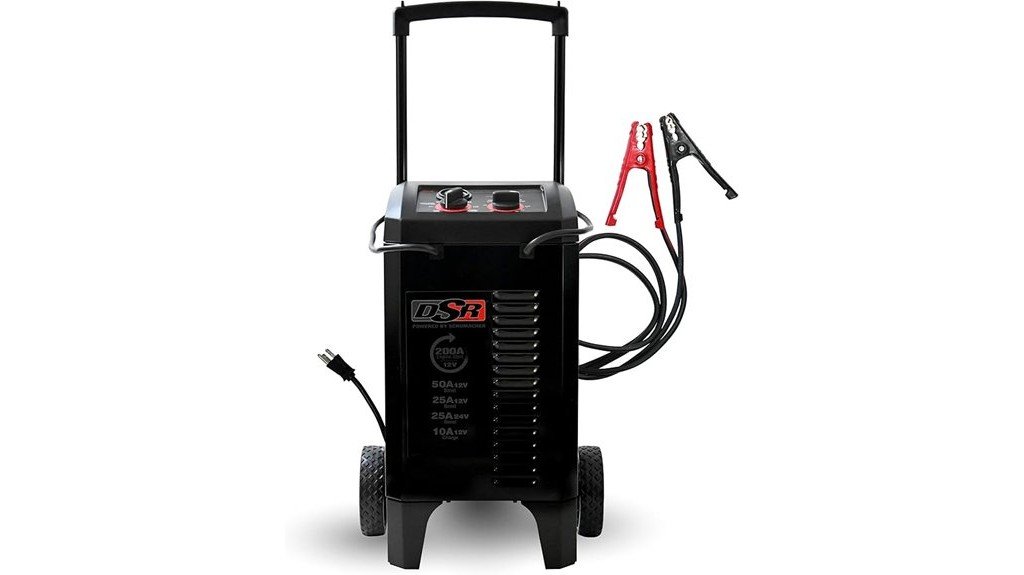
A dead truck or equipment battery can stop a full workday, but not every charger is built for a busy garage. The Schumacher Electric DSR ProSeries DSR140 combines manual 12V and 24V charging with a 200A engine-start setting for 12V vehicles. It offers the power and control experienced operators may want, but it requires correct battery selection, active monitoring, and safe clamp handling. This review explains where the DSR140 performs well, where its manual design creates extra responsibility, and who should choose a different charger.
Quick Verdict
Rating: 8.4/10 · Recommended with Manual-Control Caveats
Best For: Professional mechanics, fleet garages, farms, and experienced DIY users who need 12V/24V lead-acid charging plus strong 12V engine-start assistance.
Bottom Line: The DSR140 delivers useful high-output charging modes, a 200A 12V engine-start function, and a durable wheeled metal case. Its manual timer and lack of automatic float maintenance mean you must stay involved throughout the charging process.
| Specification | Detail |
|---|---|
| Brand | Schumacher Electric |
| Model | DSR ProSeries DSR140 |
| Product Type | Manual wheeled battery charger and engine starter |
| AC Input | 120V AC |
| Output Voltage | 12V and 24V |
| Engine Start | 200A at 12V |
| Boost Modes | 50A at 12V, 25A at 12V, and 25A at 24V |
| Charge Mode | 10A at 12V |
| Controls | Manual rate selector, 135-minute timer, and analog ammeter |
| Battery Types | Standard flooded lead-acid, AGM, gel, and supported deep-cycle batteries |
| Cable Reach | 12 feet total, including a 6-foot AC cord and 6-foot output cables |
| Output Cable Gauge | 6-gauge |
| Construction | Metal case, compact wheels, retractable handle, and front cable storage |
| Dimensions | 12.25 in D x 11.88 in W x 23.5 in H |
| Weight | 30.3 lb |
| Safety Listings | UL and ULC |
| Warranty | One-year manufacturer warranty |
| Included | DSR140 charger/engine starter and owner’s manual |
What Is the Schumacher DSR ProSeries DSR140?
The Schumacher DSR140 is a shop-style, AC-powered battery charger mounted in a metal wheeled case. Instead of relying on an internal jump-pack battery, it plugs into a grounded 120V outlet and sends current through heavy 6-gauge output cables. The front controls let you choose a charging or boost rate, set the timer, and watch current draw on an analog ammeter.
Its main advantage is range. You can use the DSR140 for 12V standard, AGM, gel, and compatible deep-cycle batteries, and you can also charge or boost supported 24V lead-acid systems at 25A. The 200A engine-start setting is limited to 12V batteries, so this model is not a 24V engine starter.
The DSR140 is intended for operators who understand battery voltage, battery chemistry, charge rates, and safe connection order. It gives you more direct control than an automatic maintainer, but it also places more responsibility on you to select the correct setting and stop charging at the right time.
Before You Buy: The 200A engine-start mode is for 12V systems only. The DSR140 is also a manual lead-acid charger, not a lithium charger or an unattended float maintainer. You must select the correct voltage and rate, monitor the battery, and follow the owner’s manual during every session.
Who Should Buy It?
Best For
- Professional and fleet garages: The wheeled case, analog meter, and high-output modes suit repeated shop use.
- Farm and equipment owners: The 12V/24V charging range can cover mixed lead-acid fleets without requiring two basic chargers.
- Experienced home mechanics: Manual controls make sense when you want direct control and are comfortable calculating charge time.
Skip If
- You want unattended maintenance: This model does not provide automatic multi-stage float charging for seasonal storage.
- You need lithium support: It is designed for supported lead-acid battery types, not LiFePO4 vehicle batteries.
- You need 24V engine starting: The 24V setting supports 25A boosting, while the 200A engine-start mode is 12V only.
Key Features and Feature-by-Feature Performance
200A 12V Engine-Start Assistance
The highest-output setting supplies up to 200A for cranking a vehicle with a weak 12V battery. This is useful for cars, SUVs, trucks, and other 12V vehicles when a lower charging rate would take too long. The charger must remain connected to a battery during engine-start use, and the owner’s manual limits each cranking attempt to five seconds followed by a three-minute rest.
This setting is best treated as short-term starting assistance, not a substitute for diagnosing a battery, starter, alternator, or fuel problem. If the engine turns but does not start, continued cranking can overheat the starter and will not correct the underlying fault.
Four Useful Charging and Boost Settings
The DSR140 includes a 10A 12V charge setting, 25A boost settings for both 12V and 24V batteries, and a 50A boost setting for 12V batteries. That range gives you a slower option for routine 12V charging and faster options for adding energy to a depleted battery before an engine-start attempt.
The correct rate depends on battery size, state of charge, chemistry, and the battery manufacturer’s instructions. Higher current can reduce waiting time, but it also demands closer monitoring. Small batteries and batteries with unknown condition should not automatically be placed on the highest setting.
Manual Timer and Analog Ammeter
The 135-minute timer controls how long the charger operates. When the selected time expires, charging stops. The analog ammeter shows how much current the battery is drawing, and the reading generally falls as the battery accepts charge.
This system is simple and direct, but it is not automatic battery management. You still need to estimate the required charging time, observe the meter, check the battery, and stop if the battery becomes hot, vents excessively, or shows signs of damage.
Pro Tip: Before selecting a rate, find the battery’s voltage, amp-hour rating or reserve capacity, and manufacturer charging guidance. Start with the lowest appropriate rate when battery condition is uncertain, then use the ammeter and calculated charge time instead of guessing.
Metal Case, Wheels, and 12-Foot Reach
The DSR140 uses a sturdy metal case with compact wheels and a retractable handle. At about 30.3 pounds, it is not a trunk-sized charger, but you can roll it between service bays or store it upright against a garage wall. Front-mounted storage helps keep clamps and cables off the floor.
The 6-foot AC cord and 6-foot output cables provide 12 feet of total reach. This reduces the need to place the charger beside the battery, which is helpful because the manual instructs you to keep the charger as far from the battery as the DC cables allow.
Compatibility and Safety
The DSR140 is designed for supported 12V and 24V lead-acid batteries, including standard flooded, AGM, gel, and appropriate deep-cycle batteries. It should not be used on lithium batteries, dry-cell household batteries, frozen batteries, or any battery with a cracked case, heavy leakage, or unknown voltage.
Lead-acid batteries can release explosive gas while charging. Use the charger in a well-ventilated area, keep sparks and flames away, wear eye protection, and connect the negative clamp to the vehicle chassis or engine block as directed for most negative-ground vehicles. Do not operate the charger in rain, snow, or a closed space with restricted airflow.
The charger requires a properly grounded 120V outlet. Schumacher advises against using an extension cord unless it is necessary. If you must use one, follow the owner’s manual table for the charger’s input rating and cord length rather than choosing a gauge by guesswork.
How to Use It Correctly
- Confirm the battery: Check that it is a supported lead-acid type and identify whether it is 12V or 24V.
- Inspect the area: Work in a dry, well-ventilated location. Keep the charger away from the battery, moving engine parts, fuel lines, sparks, and flames.
- Turn controls off: Set the timer to OFF and unplug the AC cord before attaching or removing clamps.
- Connect safely: Follow the manual’s positive and negative connection sequence for an installed or removed battery. Never allow the clamps to touch.
- Select the rate: Choose the voltage and current recommended for the battery. Do not assume the highest rate is always the best rate.
- Set and monitor the timer: Watch the ammeter and battery throughout charging. Stop if the battery overheats, leaks, swells, or vents heavily.
- Disconnect in order: Turn the timer off, unplug AC power, then remove the chassis clamp before the battery-terminal clamp when charging an installed battery.
- Store it dry: Clean corrosion from the clamps, coil the cords neatly, and store the charger unplugged in an upright indoor location.
How It Performs in Real Use
1. Busy Shop Work with 12V Cars and Trucks
For a garage that regularly handles weak 12V batteries, the DSR140 offers more flexibility than a small maintainer. You can use 10A for routine charging, 25A or 50A to add energy faster, and the 200A setting for short engine-start attempts. The wheels and cable storage also make it easier to move between vehicles than a fixed bench charger.
2. Charging 24V Farm or Commercial Equipment
The 25A 24V boost setting is useful when your equipment uses a supported 24V lead-acid system. It can add charge to a depleted battery bank without switching to a separate 24V-only charger. However, the DSR140 does not provide a 200A 24V start mode, so it is not the right choice when your main need is direct high-amperage starting of 24V machinery.
3. Recovering a Deeply Discharged Lead-Acid Battery
Manual controls can be helpful when an automatic charger refuses to begin because battery voltage is unusually low. Still, a battery that has fallen to an extreme voltage may be sulfated, internally damaged, frozen, or unsafe. The DSR140 can supply current, but it cannot confirm that the battery is healthy or worth recovering. Inspect and test questionable batteries before applying a high boost rate.
4. Seasonal Storage and Occasional Home Use
The DSR140 can charge a battery before storage, but it is not designed to remain connected for months as an automatic float maintainer. For a weekend car, motorcycle, lawn equipment battery, or stored boat battery, a smaller automatic maintainer may be easier and safer. The DSR140 earns its space when high-output charging and shop use matter more than unattended convenience.
Pros and Cons
Pros
- Strong 12V starting support: The 200A engine-start setting can assist weak 12V vehicle batteries.
- 12V and 24V charging flexibility: Multiple rates cover a wider range of lead-acid systems.
- Direct manual control: The timer, selector, and analog meter give experienced users clear control.
- Shop-ready construction: The metal case, wheels, handle, and 6-gauge cables suit regular garage use.
- Useful working reach: The two 6-foot cords provide 12 feet between the outlet and battery connection area.
Cons
- Needs active supervision: It does not automatically manage multi-stage charging or long-term float maintenance.
- No lithium charging: The supported battery range is limited to compatible lead-acid chemistries.
- No 200A start at 24V: Buyers who need high-current 24V engine starting must choose a different model.
Check Current Price on Amazon →
Is It Worth the Price?
The DSR140 sits in the professional wheel-charger category rather than the compact consumer-maintainer category. Its value comes from the combination of 12V and 24V charging, several current settings, a 200A 12V engine-start function, heavy cables, and a mobile metal case.
It is worth considering when vehicle downtime costs more than the floor space the charger occupies. A fleet shop, farm, repair business, or multi-vehicle owner can use its broader charging range regularly. A home user who only maintains one 12V battery may get better value from a lighter automatic charger with float mode and reverse-hookup protection.
How It Compares to Alternatives
The Schumacher FR01535 is a simpler 12V manual wheel charger with a 150A engine-start setting, so it may be enough if you never service 24V batteries. The Schumacher SC1352 offers automatic 12V/24V charging and engine-start capability at both voltages, making it a better fit when you prefer digital guidance, automatic charging, and 24V starting support.
The DSR140 makes the most sense when you want professional manual controls, 12V/24V charging flexibility, and strong 12V engine-start assistance without paying for features you may not use. Choose an automatic model instead when ease of use and unattended maintenance matter more than direct control.
Frequently Asked Questions
Can the Schumacher DSR140 start a 24V vehicle or machine?
No. The 200A engine-start setting is specified for 12V batteries. The unit supports a 25A boost setting at 24V, but buyers who need direct 24V engine-start assistance should choose a model designed for that function.
Can it charge lithium or LiFePO4 vehicle batteries?
No. The DSR140 is intended for supported lead-acid batteries, including standard, AGM, gel, and appropriate deep-cycle types. Use a charger with a dedicated lithium charging profile for LiFePO4 batteries.
Can I leave the DSR140 connected as a battery maintainer?
No. It uses a manual timer and does not provide automatic long-term float maintenance. Charge under supervision, disconnect when the session is complete, and use an automatic maintainer for months-long storage.
How long can I use the 200A engine-start setting?
The owner’s manual calls for cranking for no more than five seconds. If the engine does not start, wait three minutes before trying again so the charger, battery, and starter can recover.
Does the DSR140 automatically protect against reversed clamps?
Do not assume automatic reverse-hookup protection. The official DSR140 information emphasizes manual operation, correct polarity, and following the connection sequence in the owner’s manual. Keep the charger off and unplugged while attaching or removing clamps.
What extension cord should I use?
Schumacher recommends avoiding an extension cord unless it is necessary. When one is required, use a grounded cord in good condition and match its wire gauge to the charger’s input rating and cord length using the table in the owner’s manual.
Can the DSR140 charge a battery below two volts?
The manual includes a special cold-weather or below-two-volt procedure before cranking, but extremely low voltage can also indicate a damaged battery. Inspect the battery, follow the manual exactly, and have the battery tested when its condition is uncertain.
Can I use it outdoors or charge a boat battery onboard?
Do not expose the charger to rain or snow. The manual also states that a marine battery should be removed and charged on shore unless you use equipment specifically designed for onboard marine charging.
The Bottom Line
The Schumacher DSR ProSeries DSR140 is a strong choice for experienced mechanics, farms, and garages that need manual 12V/24V lead-acid charging plus 200A starting assistance for 12V vehicles. Skip it if you need lithium charging, automatic storage maintenance, or high-current 24V engine starting, because its biggest strength is direct manual control and that control requires careful supervision.