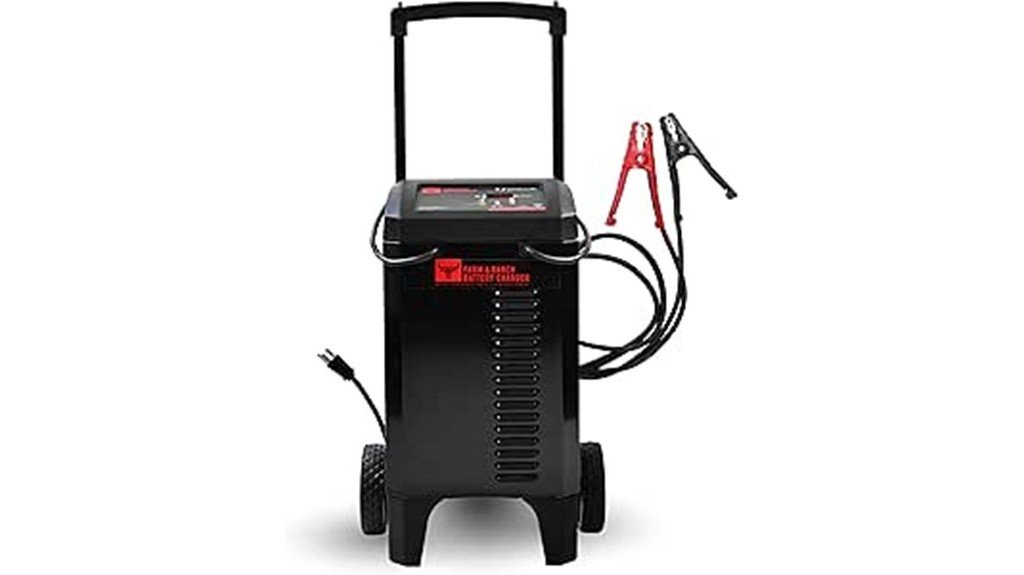
The Schumacher Electric Farm & Ranch Charger is presented as a heavy‑duty battery solution for 6V and 12V systems, offering 50A boost, 250A engine start, and multi‑stage charging for AGM and deep‑cycle batteries. It combines solid‑core wheels, steel construction, and a 30.1 lb weight with dimensions that affect portability. What are the real-world charge times, safety features, and trade‑offs for workshop versus field use?
Key Takeaways
- Powerful 50A boost and 250A peak engine-start recover deeply discharged 12V batteries quickly for farm and shop use.
- Automatic multi-stage charging with 6A–2A trickle and float mode prevents overcharging and maintains battery health.
- Includes desulfation recondition mode and bad-battery detection to revive or diagnose struggling batteries.
- Robust steel case, solid-core wheels, and retractable handle make it portable and durable for garage or barn environments.
- At 30.1 lb and 10×12.5×23.38 inches, it’s bulky but offers strong value for frequent heavy-duty users; mixed user rating 3.9/5.
Key Features and Technology
The Schumacher Farm & Ranch FR01336 combines several practical technologies into a single unit, offering smart charging, engine-start capability, maintenance modes, and reconditioning in one wheeled package.
It blends smart technology with user convenience, delivering automatic multi-stage charging, reverse polarity protection, and a desulfation recondition mode.
What are the dimensions and weight? 10 x 12.5 x 23.38 inches, 30.1 pounds.
How portable is it? Solid-core wheels, retractable handle, 6-foot power cord.
Key features:
- 250A engine start (12V)
- 50A boost
- 6A–2A charge/maintain
- float monitoring
- bad-battery detection
- heavy-duty steel case.
Performance and Charging Capabilities
Performance and charging capacity are central to evaluating the Schumacher Farm & Ranch FR01336, and this wheeled unit delivers a clear, application-focused set of capabilities.
It balances charging efficiency with robust performance metrics: 50A boost, 6A/2A charge/maintain, and 250A engine start for 12V. What can the user expect? Reliable multi-stage charging, desulfation reconditioning, and automatic float monitoring.
- Fast boost: 50-amp for quick recovery.
- Maintenance: 6A to 2A smart trickle charging.
- Starting: 250A peak for 12V engines.
- Compatibility: 6V/12V, AGM, gel, deep-cycle.
Practical takeaway: measurable output, clear rates, predictable results.
Design, Build Quality, and Portability
Having established how the unit performs under load and during charging cycles, attention shifts to how it is built and moved around the shop or farm.
The reviewer notes practical design aesthetics—functional color, clear labels, compact footprint (10 x 12.5 x 23.38 in)—and robust build materials: heavy-duty steel case, solid-core wheels, retractable handle.
Portability assessment: 30.1 lb weight, wheeled trolley eases 50–100 ft moves, 6 ft power cord limits reach.
Q: Is it workshop-friendly?
A: Yes, for garage or barn use. Consider floor clearance, storage space, and lift points when transporting long distances.
Battery Compatibility and Safety Protections
Compatibility and safety matter most when a charger lives in a busy shop or on a farm, and the Schumacher FR01336 addresses both with clear specs and built-in protections.
It supports 6V and 12V systems and common battery types: standard, AGM, gel, deep-cycle, plus reconditioning.
Which safety mechanisms protect users and equipment?
- Auto voltage detection and multi-stage charging for 6A–2A float maintenance.
- Reverse polarity protection and bad-battery detection to prevent damage.
- Smart trickle charge with float mode to avoid overcharging long-term.
- 50A boost and 250A start functions with internal processor control for safe high-current use.
Pros, Cons, and Value Assessment
Balance is key when evaluating the Schumacher FR01336, and this first look lays out where the unit excels and where buyers should pause: it delivers a robust 250A engine-start capability for 12V systems, a 50A boost charge, and a 6A–2A multi-stage/float charging range, all housed in a 30.1 lb steel chassis with solid-core wheels and a 6 ft power cord—practical for barn or shop use—but it also carries trade-offs in size, weight (10 x 12.5 x 23.38 in), and a mixed user satisfaction score (3.9/5 from 150 ratings).
Balance is key: a rugged 250A starter with versatile charging—great for shops, bulky and mixed reviews.
Pros:
- Powerful start, 50A boost, reconditioning.
- Durable steel case, wheels, 6 ft cord.
Cons:
- Heavy 30.1 lb, bulky dimensions.
- Some customer feedback cites reliability and complexity.
Value assessment:
- Who benefits? Farmers, shops needing 250A start and multi-mode charging.
- Who should consider alternatives? Occasional users wanting lighter, simpler units based on user experience.
Frequently Asked Questions
Can This Unit Charge Multiple Batteries Simultaneously?
No, it cannot charge multiple batteries simultaneously. The unit focuses on single-battery operation; its charging efficiency and battery compatibility (6V/12V, AGM, gel, deep-cycle) optimize individual battery maintenance and reconditioning.
Is There a Built-In Battery Level Indicator or Display?
No—no built-in display; only status lights indicate condition. The unit whispers battery life cues through LEDs rather than a gauge, so users infer charging speed and state from indicator patterns and multistage LED feedback.
How Loud Is the Unit During Operation?
The unit is relatively quiet; operating noise is low during normal charging with occasional increased sound levels when the fan or boost mode runs. Users report modest hums and brief fan spikes, not overly disruptive for shop use.
Are Replacement Cables or Parts Sold Separately?
Yes. 30.1-pound unit parts are available separately; the manufacturer offers replacement parts and cables. The detached observer notes replacement parts and cable compatibility depend on model specifics and warranty channels for ordering genuine components.
Does It Require Periodic Maintenance or Calibration?
No periodic calibration is required; the device self-regulates. Periodic maintenance tips include inspecting cables, cleaning terminals, checking for corrosion, ensuring vents are clear, and storing indoors. Calibration frequency is effectively zero under normal use.