Disclosure: As an Amazon Associate, we earn from qualifying purchases. If you click a link on this page and make a purchase, we may receive a small commission at no extra cost to you.
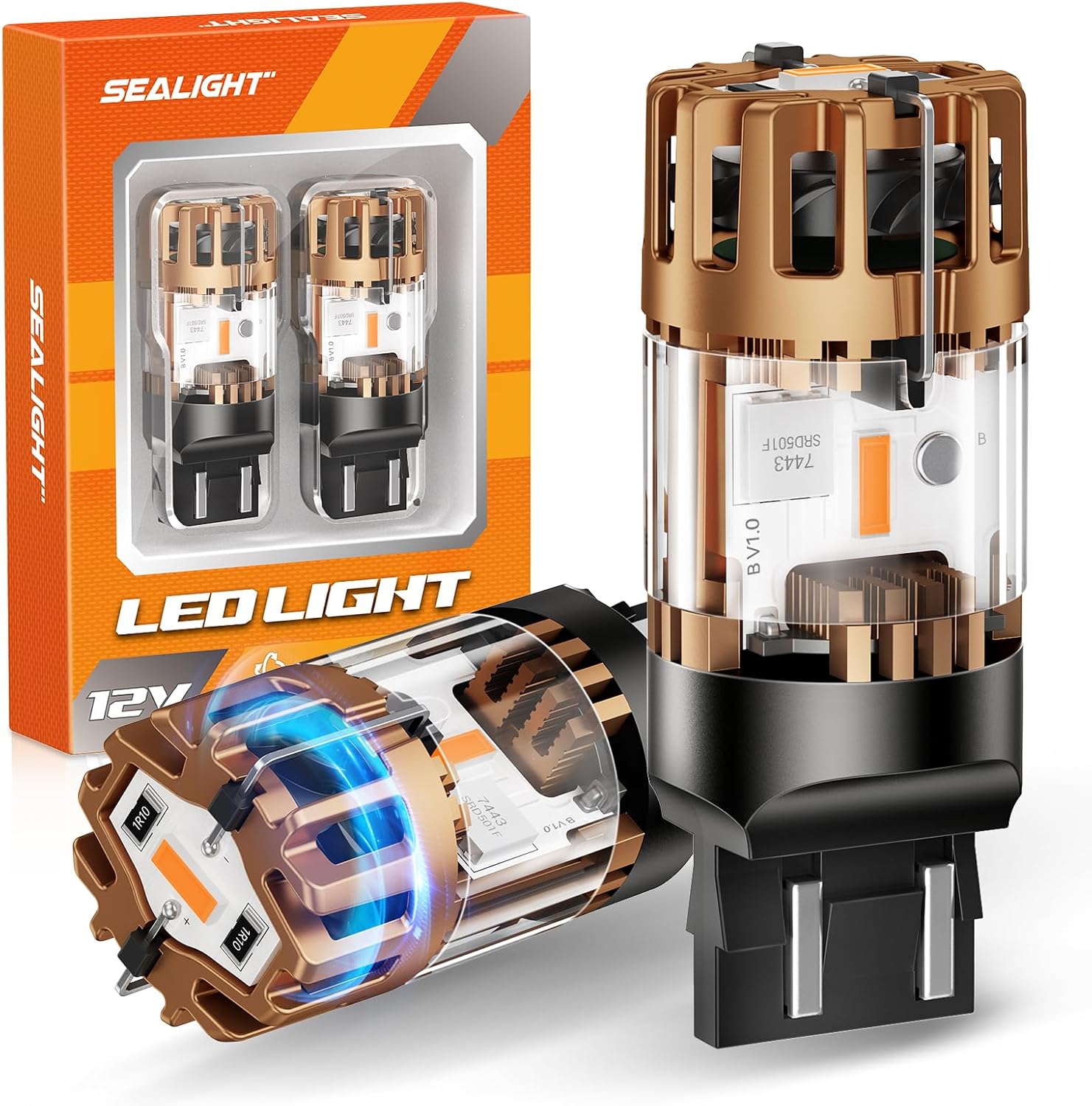
Replacing a factory turn-signal bulb with an LED sounds simple, but socket type, housing space, bulb color, and hyperflash can turn a quick upgrade into a frustrating job. The SEALIGHT 7443/7440 Amber LED Bulb combines built-in resistors, active cooling, and support for several T20-style sockets. Its claimed output is high, but fitment and vehicle electronics still need careful checking. This review helps you decide whether the brighter amber signal and plug-in design outweigh those compatibility limits.
Quick Verdict
Rating: 8.3/10, Recommended with caveats
Best For: Drivers replacing compatible amber 7440, 7443, 7444, or related T20 turn-signal bulbs.
Bottom Line: The SEALIGHT bulb offers strong claimed output, built-in CAN-BUS support, and broad socket compatibility. You still need to confirm the bulb function, available housing space, and your vehicle’s electrical behavior before buying.
Key Specifications
| Specification | Detail |
|---|---|
| Brand | SEALIGHT |
| Model | 7443 LED Bulb Amber |
| Manufacturer part number | 7118LTL16F1US |
| Product type | Amber automotive LED turn-signal bulb |
| Light source | Third-generation 1860 LED chips |
| Claimed output | 3,600 lumens per bulb |
| Listed power | 32 watts per bulb |
| Color | Amber |
| Socket references | T20, 7440, 7440NA, 7441, 7443, 7443NA, 7444, 7444NA, 992, W21W, and WY21W |
| Socket design | Designed for CK and standard sockets |
| CAN-BUS design | Advanced driver with built-in resistor |
| Cooling | Full-aluminum body and 12,000 RPM cooling fan |
| Claimed lifespan | Up to 60,000 hours |
| Listed dimensions | 3.15 x 2.76 x 1.18 inches |
| Listed item weight | 2.08 ounces |
| Package note | The listing title states a pack of two; confirm the selected package before ordering |
| Best use | Compatible front or rear amber turn-signal positions |
What Is the SEALIGHT 7443/7440 Amber LED Bulb?
The SEALIGHT 7443/7440 is a fan-cooled amber LED bulb intended for compatible automotive turn-signal positions. It uses an aluminum body, third-generation 1860 LED chips, an integrated driver, and a built-in resistor designed to reduce hyperflash and dashboard errors.
The listing describes it as compatible with both CK and standard sockets across several T20 bulb references. That broad list is useful, but a matching bulb number alone does not confirm fitment. Your lamp function, connector layout, housing depth, and vehicle electronics must also match.
This product makes the most sense when you want a brighter-looking amber signal without immediately adding an external decoder or resistor. It is not a universal replacement for every lamp that happens to use a 7440- or 7443-shaped base.
Key Takeaways
- The manufacturer claims 3,600 lumens and 32 watts per bulb.
- Built-in resistors and advanced drivers are designed to reduce hyperflash and dashboard errors.
- The aluminum housing and 12,000 RPM fan actively manage heat.
- Both CK and standard socket designs are listed as compatible.
- The amber color is intended for compatible turn-signal applications, not every brake, tail, reverse, or daytime-running-light position.
- Vehicle-specific fitment and housing clearance still require manual checking.
Who Should Buy It?
Best For
- Drivers whose owner’s manual specifies a compatible amber 7440, 7443, 7444, or related T20 bulb.
- Vehicles where a built-in resistor may simplify an LED turn-signal conversion.
- Buyers who have enough room for a larger fan-cooled LED housing.
Skip If
- Your vehicle requires a different bulb color, base, connector, or lamp function.
- Your turn-signal housing has very limited space behind the socket.
- You want a passive bulb without a cooling fan or built-in resistive load.
Before You Buy: Do not rely only on Amazon’s vehicle-fitment tool or the number printed on an old bulb. Confirm the required bulb number, signal color, CK or standard socket layout, lamp function, and available housing space in your owner’s manual or service information.
Brightness and Signal Visibility
SEALIGHT lists each bulb at 3,600 lumens and 32 watts. Those figures suggest a strong amber output, but they are manufacturer listing claims rather than independent laboratory measurements. Actual visibility depends on your reflector design, lens condition, voltage, viewing angle, and lamp placement.
The 1860 LED chips are positioned to provide light around the bulb rather than from one narrow point. This design can help fill a factory reflector, although an LED and a halogen filament do not place light in exactly the same way. A bright bare bulb does not always produce a perfectly even signal through every housing.
After installation, view the signal from the front, rear, and side in daylight and darkness. The light should remain clearly amber, evenly distributed, and easy to distinguish from nearby running or brake lamps.
CAN-BUS Support and Hyperflash Control
The built-in resistor and driver are designed to make the bulb behave more like the electrical load expected from a factory incandescent bulb. This may prevent rapid flashing, warning messages, or bulb-out alerts in many vehicles without extra wiring.
CAN-BUS behavior is never completely universal. Some vehicles monitor resistance, current, pulse width, or lamp temperature differently. You may still see hyperflash or an error even when the physical socket fits correctly.
Do not install an external load resistor automatically. Test the bulbs first. If your vehicle still reports an error, confirm the correct solution with the bulb seller, vehicle service information, or a qualified automotive electrician.
Aluminum Build and Active Cooling
The bulb uses a full-aluminum body and a 12,000 RPM fan to move heat away from the LED chips and driver. Active cooling is useful because the integrated resistor and high-output electronics create more heat than a basic low-power LED marker bulb.
The fan also adds size and a moving component. A tight dust cap, shallow reflector, or nearby wiring can block airflow or prevent the bulb from seating fully. Check that the socket locks into place and that no wire touches the fan area.
SEALIGHT claims a lifespan of up to 60,000 hours. Treat that figure as a rated maximum rather than a guaranteed service interval. Heat, moisture, vibration, housing ventilation, and frequent signal cycles can affect actual life.
How It Performs in Real Use
Daytime Turn Signaling
The high claimed output should suit drivers who want a more noticeable amber flash in bright conditions. Performance still depends on the factory lens and reflector. A faded, cloudy, or damaged lens can limit the benefit of a brighter bulb.
Night Driving
At night, the amber signal should appear crisp and immediate when the vehicle electronics accept the bulb correctly. Excessive glare or an uneven hotspot can occur in some reflector designs, so inspect the lamp from normal road-viewing angles after dark.
Hazard-Flasher Use
Built-in resistors create heat while the signals operate. Long hazard-flasher sessions place a heavier thermal demand on the bulb than an occasional lane-change signal. Keep the lamp housing correctly sealed and avoid handling the bulb immediately after extended use.
Cold, Wet, or Rough Conditions
The listing’s technical details describe the bulb as waterproof, but no specific IP rating is stated. The bulb still depends on your factory socket seal, lamp housing, dust cap, and wiring condition. Replace damaged seals rather than expecting the bulb to waterproof a leaking housing.
Installation Tips and Vehicle Compatibility
Start by switching off the lights and ignition. Allow the existing bulb to cool, then access the socket according to your owner’s manual. Avoid pulling directly on the wires or forcing a socket that does not release easily.
- Confirm that the original bulb reference matches a socket listed for the SEALIGHT bulb.
- Check whether your vehicle uses a CK or standard socket configuration.
- Compare the new bulb’s rear housing with the available space around the socket and dust cap.
- Insert the bulb fully without twisting or pressing against the cooling fan.
- Test the left signal, right signal, hazard lights, and dashboard indicators.
- Check for hyperflash, bulb-out warnings, flickering, poor contact, or uneven light distribution.
- Reinstall every seal, cap, and connector before driving.
Pro Tip: Test one side before replacing both bulbs. You can compare the LED with the original bulb, confirm the flash rate, and identify a compatibility problem before completing the second side.
Common Installation Mistakes to Avoid
- Assuming every 7443 position uses the same color or electrical function.
- Closing a dust cap against the fan or rear housing.
- Leaving a socket seal loose after installation.
- Adding external resistors before checking whether the built-in design already works.
- Testing only the hazard lights instead of checking both individual turn signals.
- Ignoring an intermittent dashboard warning or unusual flash rate.
Compatibility and Safety
Use this amber bulb only where your vehicle specifies an amber turn-signal lamp or another legally permitted amber function. Do not assume it is suitable for a red brake or tail lamp, a white reverse lamp, or a daytime-running-light position simply because the base can fit.
Lighting laws and inspection rules vary by location. Your replacement should preserve the required color, visibility, flash rate, and lamp function. Consult a qualified installer when you are unsure about wiring, socket configuration, external resistors, or local compliance.
Built-in and external resistors can become hot. Keep wiring, plastic trim, seals, and other heat-sensitive materials clear of any added electrical component. Do not modify the vehicle harness without the correct instructions and tools.
Pros and Cons
Pros
- High claimed amber output of 3,600 lumens per bulb.
- Built-in resistor may prevent hyperflash without extra wiring.
- Designed for both CK and standard socket configurations.
- Aluminum body and active fan provide dedicated heat management.
- Supports several commonly used 7440, 7443, 7444, and T20 references.
Cons
- CAN-BUS and hyperflash compatibility cannot be guaranteed for every vehicle.
- The fan-cooled housing may not fit a shallow or tightly sealed lamp assembly.
- The 60,000-hour lifespan and lumen output are listing claims, not independent test results.
Is It Worth the Price?
The SEALIGHT bulb offers strong value when your vehicle accepts its socket design and built-in resistor without extra parts. You receive a pair-oriented listing, active cooling, an aluminum body, and broad T20 compatibility in one package.
You get the most value when the conversion works as a direct replacement. The value drops if you need extra resistors, wiring changes, a different dust cap, or repeated fitment troubleshooting.
It is worth considering when your priority is a bright amber signal and a cleaner installation than a separate resistor setup. A simpler passive LED or standard incandescent bulb may be better if you value compact size and minimal electronic complexity.
How It Compares to Alternatives
AUXITO and LASFIT offer competing amber 7440/7443 LED turn-signal bulbs with built-in anti-hyperflash designs. OXILAM also sells fan-cooled amber options with similar socket coverage. Exact dimensions, electrical behavior, output claims, and socket restrictions differ between models.
The SEALIGHT version stands out for its claimed 3,600-lumen output, CK and standard socket support, and active cooling. Compare alternatives when your housing has limited depth, your vehicle has a known CAN-BUS issue, or you prefer a different cooling design.
Frequently Asked Questions
Will the SEALIGHT bulb fit every 7440 or 7443 socket?
No. A matching bulb number does not confirm housing clearance, lamp function, connector layout, or vehicle electronics. Check your owner’s manual and compare the physical space before ordering.
Does it prevent hyperflash without an external resistor?
The bulb includes a built-in resistor and driver designed to prevent hyperflash in most compatible installations. Some vehicles may still require another solution because monitoring systems differ.
Does it work with both CK and standard sockets?
SEALIGHT lists the bulb as compatible with both socket configurations. You should still verify your connector and lamp function because wiring arrangements can vary between vehicles.
Can I use this amber bulb as a brake light or daytime running light?
Use it only when your vehicle specifies an amber bulb for that exact position and function. Do not replace a required red brake bulb or white running light merely because the socket appears similar.
Will the cooling fan be audible?
The listing describes the 12,000 RPM fan as quiet, but no independent sound measurement is provided. Any fan noise will usually be less noticeable once the bulb is enclosed in the lamp housing.
Should I install an additional load resistor?
Test the built-in resistor first. Add another component only when your vehicle still shows hyperflash or a warning and the recommended fix has been confirmed by the seller or a qualified installer.
What should I check immediately after installation?
Check both turn signals, the hazard lights, dashboard indicators, flash rate, color, and light distribution. Also confirm that the socket is locked, the fan has clearance, and every housing seal is secure.
How many bulbs are included, and what warranty applies?
The product title states that the listing is for a pack of two, but you should confirm the selected package before checkout. A fixed manufacturer warranty term is not clearly stated, so review the current seller and Amazon return information before purchasing.
The Bottom Line
The SEALIGHT 7443/7440 Amber LED Bulb is a practical choice when your vehicle needs a compatible amber turn signal and has enough space for its fan-cooled housing. Its main strengths are high claimed output, built-in hyperflash control, and broad socket support, while uncertain vehicle-specific compatibility remains the main limitation.
Buy it after confirming your bulb function, socket layout, housing clearance, and local lighting requirements. Skip it when you need a different color, a smaller passive bulb, or guaranteed error-free operation on a sensitive electrical system.
Ready to Buy?
Check the latest product details and confirm compatibility before you decide.