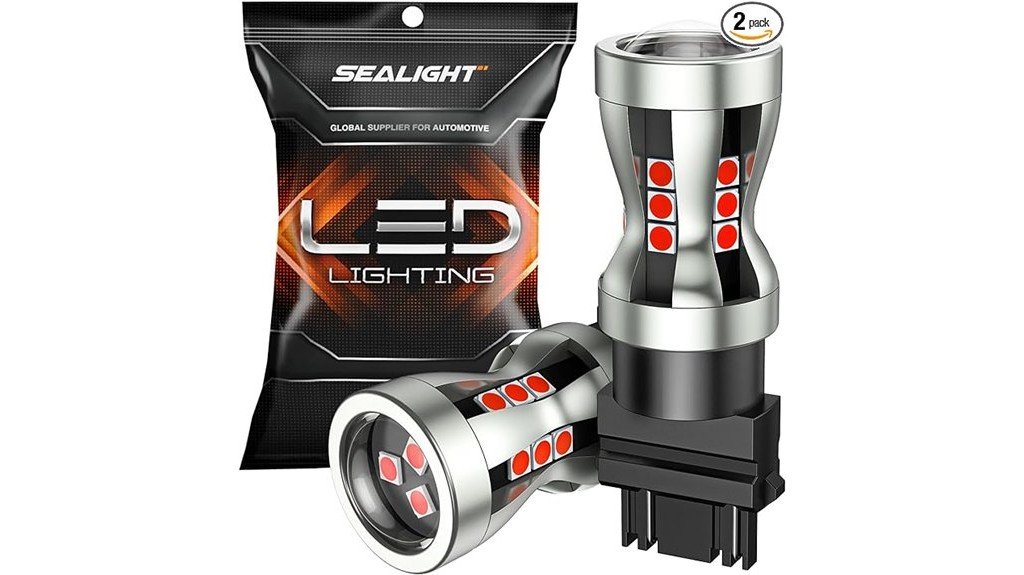
SEALIGHT’s LED brake light bulbs aim to upgrade stop-light performance with 2,600 lumens nominal output, peaks near 3,000 lumens, 360° omnidirectional beam, and aircraft‑grade aluminum housing rated for 50,000 hours. This review outlines specs, beam pattern, fitment tips, and thermal management, offering installation notes, compatibility checks, and real-world brightness comparisons. How do they perform on different housings and cars, and are there fitment caveats worth knowing?
Key Takeaways
- SEALIGHT 3157 LED brake bulbs deliver about 2600 lumens each, peaking near 3000 LM — 5–9× brighter than stock halogens.
- 360° omnidirectional beam provides even coverage with minimal black spots and controlled glare.
- Aircraft-grade aluminum housing and 360° chip layout enable effective heat dissipation and a 50,000-hour rated lifespan.
- Plug-and-play non-polarity design fits most 3156/3157/3056 sockets; verify socket type and housing clearance before purchase.
- Potential issues: some vehicles may show CAN-bus strobing or require decoders, and return window is 30 days.
Key Specifications and What’s in the Box
One concise package delivers two SEALIGHT 3157 LED brake light bulbs, each rated at 2600 lumens and measuring approximately 5.5 x 4 x 1.2 inches, with a unit weight of 1.44 ounces.
The reviewer lists key features: 360° omnidirectional lighting, aircraft-grade aluminum heat sink, 50,000-hour life rating, non-polarity plug-and-play design.
Package contents are simple: two LED bulbs, basic instruction sheet.
What should the buyer consider? Compatibility with 3157/3156-style sockets, potential need for decoders on special models.
Practical note: confirm socket size in the vehicle manual before installation to avoid returns.
Brightness, Beam Pattern, and Real-World Performance
Brightness and beam shape are central to how SEALIGHT’s 3157 LED brake bulbs perform in daily driving, and the numbers back up their claims: each bulb is rated at 2600 lumens (with peak output up to ~3000 LM under ideal conditions) and uses a 9W chip with 360° omnidirectional coverage.
How bright are they?
– Brightness comparison: they outpace typical 1157 halogens (≈300–500 LM) by roughly 5–9x.
What about beam dispersion and real-world use?
- Beam dispersion: even 360° spread, minimal black spots, controlled glare.
- Practical note: 50,000-hour life, aircraft-grade aluminum heat dissipation.
Installation, Compatibility, and Fitment Tips
Several practical steps make installing SEALIGHT 3157 LED brake bulbs straightforward for most vehicles.
The article offers clear installation instructions and a compatibility checklist: measure socket type, confirm 1:1 base match, test polarity, and verify clearance within a 5.5 x 4 x 1.2 inch housing.
Fitment tips include reviewing the vehicle manual, noting possible decoder needs for CAN-bus systems, and allowing 5 minutes per bulb for plug-and-play non-polarity insertion.
Q: Will adapters be needed?
A: Only for special sockets outside 3156/3056/4156 families.
Check lens depth, wiring access, and secure seating to avoid vibration.
Durability, Heat Management, and Lifespan
Durability is a key factor when evaluating the SEALIGHT 3157 LED brake bulbs, and this section examines construction, thermal design, and expected service life with practical detail the reader can use. The aluminum alloy housing, 5.5 x 4 x 1.2 in footprint, and 1.44 oz weight suggest robust build, enhanced heat dissipation efficiency and resistance to vibration. Rated life: 50,000 hours; longevity expectations align with heavy-duty use. Practical questions: Will heat shorten output? Answer: aircraft-grade alloy and 360° chip layout reduce hotspot risk.
| Component | Measurement | Role |
|---|---|---|
| Housing | 5.5x4x1.2 in | Thermal sink |
| Weight | 1.44 oz | Vibration resistance |
| Rated life | 50,000 hr | Service estimate |
| Brightness | 2600 lm | Output stability |
Pros, Cons, and Value Assessment
Value assessment starts with clear, measurable strengths: the SEALIGHT 3157 LED brake bulbs deliver 2,600 lumens (with peak output up to 3,000 lm) from a 9W chip, feature a 360° omnidirectional beam pattern, and use an aircraft-grade aluminum alloy housing measuring 5.5 x 4 x 1.2 inches and weighing 1.44 ounces, which together support efficient heat dissipation and vibration resistance.
Pros: brighter output, 50,000-hour life, easy plug-and-play fit, durable housing.
Cons: possible CAN-bus strobe on some vehicles, check socket compatibility, 30-day return window.
How does value hold up? Consider performance comparison, customer feedback.
- Brightness
- Fitment
- Reliability
- Cost-effectiveness
Frequently Asked Questions
Do These Bulbs Require CANBUS Adapters for My Car?
One owner compared fitting them to swapping a guitar string: straightforward. They generally do not need canbus compatibility adapters for standard bulb installation, though certain vehicles with sensitive systems may still require a decoder or adapter.
Are They Road-Legal in All States/Countries?
No; road legality varies by state regulations and country laws. The product’s compliance depends on local vehicle lighting standards and inspections. Buyers should verify regional regulations and consult vehicle authorities to confirm legal use before installation.
Do They Work With Motorcycle Tail Light Sockets?
Yes; the reviewer notes motorcycle compatibility is possible if socket fitment matches common 3156/3157 types. Visualize a snug plug-and-play swap; however, some motorcycles may need a decoder for hyper-flashing or error codes.
Is Night Driving Glare an Issue for Following Drivers?
No, excessive glare is unlikely; night visibility concerns are addressed by 360° omnidirectional output and aluminum heat management. Proactive glare reduction techniques like proper alignment, resistors or decoders, and checking legal intensity mitigate potential discomfort for following drivers.
Can They Be Used as Turn Signal Bulbs Instead?
Yes; the bulbs can serve as turn signals. A lighthouse repurposed as a buoy warns differently. He notes potential compatibility issues and that higher brightness levels may require resistors or decoders to prevent hyperflashing or error codes.