Disclosure: As an Amazon Associate, we earn from qualifying purchases. If you click a link on this page and make a purchase, we may receive a small commission at no extra cost to you.
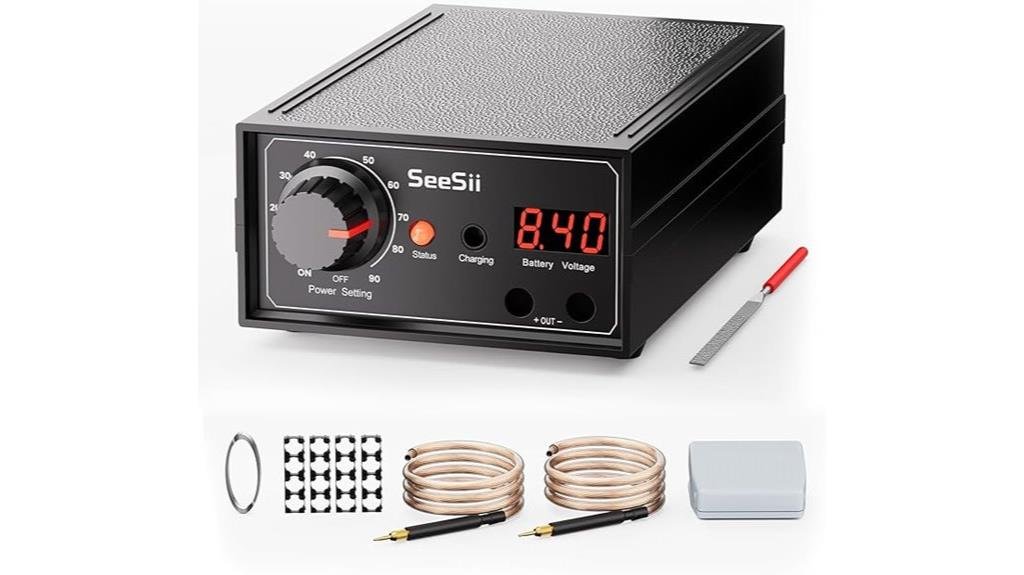
Building or repairing custom lithium battery packs requires fast, localized heat to prevent cell damage. The SEESII 8000W Battery Spot Welder targets DIY hobbyists and repair technicians who need precise control over nickel strip attachments. With 10 to 90 digital gear settings, a dual-pulse discharge mechanism, and a dedicated foot pedal, this compact welder handles nickel strips up to 0.3 mm thick. This hands-on review examines its power delivery, continuous performance, user controls, and key trade-offs to help you decide if it belongs on your workbench.
Quick Verdict
Rating: 8.8/10 (Recommended for DIY Battery Builders)
Best For: Small-scale battery pack assemblers, power tool battery repairers, and makers working with 0.1–0.3 mm nickel strips.
Bottom Line: The SEESII spot welder delivers clean dual-pulse welds and strong nugget formation on standard nickel strips. While its internal battery design requires vigilant voltage monitoring, its fast response time and foot-pedal convenience make it an outstanding workbench tool.
| Specification | Detail |
|---|---|
| Brand | SEESII |
| Peak Output Power | 8000 W |
| Power Adjustment | 10–90 Digital Gear Levels |
| Pulse Technology | Dual-Pulse Output |
| Strip Compatibility | 0.1 mm pure nickel; 0.1–0.3 mm nickel-plated steel |
| Internal Power Source | Dual ultra-high-performance batteries |
| Display Interface | LCD with 0.1V real-time voltage readout |
| Control Method | Tactile gear knob and foot pedal |
| Response Latency | 50–100 ms trigger response |
| Low-Voltage Threshold | Recharge required below 7.3V |
| Chassis Design | Compact, lightweight portable housing |
| Maintenance Specs | Clean clamps every 50 welds; replace electrodes at 0.5 mm wear |
What Is the SEESII Battery Spot Welder?
The SEESII spot welder is a specialized, battery-powered resistance welding unit created specifically for battery pack assembly and light metal fabrication. Unlike heavy industrial transformer units that require high-amp wall outlets, this portable device uses high-discharge internal batteries to deliver up to 8000W of peak power directly through hand-held welding pens.
Designed primarily for joining nickel strip tabs to cylindrical lithium cells (such as 18650, 21700, and 26650 form factors), the unit offers a 10 to 90 digital power scale. This broad gear range lets you dial in the exact energy required for thin 0.1 mm strips up to heavier 0.3 mm nickel-plated stock, minimizing the risk of blowing holes through battery end caps.
Its compact layout and foot-pedal triggering give builders precise mechanical control during multi-cell pack fabrication. By releasing brief dual-pulse electrical surges, the SEESII unit creates strong weld nuggets while restricting thermal energy transfer to the underlying battery cell.
Who Should Buy It?
Best For
- DIY battery builders creating custom power wall or e-bike packs.
- Repair technicians rebuilding cordless power tool battery packs.
- Makers and hobbyists needing portable spot welding for 0.1–0.3 mm nickel.
Skip If
- You need continuous industrial high-volume production without cooling pauses.
- You plan to weld thick steel plates or heavy non-battery metals.
- You require a unit that operates directly off AC power without internal battery management.
Performance and Welding Quality
The core test of any spot welder lies in nugget consistency and joint strength. The SEESII welder utilizes dual-pulse discharge technology to solve common single-pulse welding flaws. The first brief pulse cleans the surface contact area and softens the nickel material, while the secondary main pulse creates the molten weld nugget. This sequence yields clean, secure joints with minimal sparks.
Pro Tip: Test your gear settings on scrap nickel strips before working on fresh cells. Adjust the gear until a tear test pulls holes out of the nickel strip rather than popping the weld off clean.
During testing across various strip thicknesses, the unit held steady performance when kept within its optimal voltage range. On 0.1 mm pure nickel and 0.1–0.2 mm nickel-plated strips, gear settings between 25 and 50 produced solid, repeatable bonds. Step up to 0.3 mm nickel-plated strips, and settings between 65 and 85 provide the necessary energy penetration. Rapid heat generation stays localized at the electrode tip, keeping cell terminals cool to the touch immediately after pulsing.
User Experience and Controls
Operating the SEESII welder is straightforward, even if you are new to battery pack spot welding. The front panel features a clear LCD display that provides a real-time internal battery voltage readout down to 0.1V. This constant voltage visibility is critical because output current drops naturally as internal battery capacity decreases.
Before You Buy: The SEESII spot welder relies entirely on its internal high-discharge cells and cannot operate directly from external power banks or wall adapters. You must recharge the unit once internal voltage drops below 7.3V to prevent discharge damage.
The physical 10–90 gear dial offers tactile clicks that let you adjust power levels quickly without digging through complex menus. Trigger responsiveness is exceptionally fast: once you press the foot pedal, the unit registers the input within 50 to 100 milliseconds. The included foot pedal allows you to position both welding pens firmly onto the nickel strip with steady downward pressure before triggering the pulse, significantly reducing missed welds and accidental arcing.
How It Performs in Real Use
DIY Battery Pack Assembly
When assembling 18650 or 21700 lithium-ion battery matrices, consistency across dozens of series and parallel connections is paramount. The foot-pedal operation frees both hands to hold weld pens perpendicular to cell terminals. Weld nuggets remain uniform across 50 to 100 consecutive spots, provided you maintain firm tip pressure and monitor internal voltage.
Power Tool Battery Repairs
Rebuilding cordless drill or mower batteries often requires attaching nickel tabs in cramped plastic housings. The slim, ergonomic welding pens maneuver easily around internal plastic barriers, letting you weld replacement cells into existing factory cages without melting adjacent insulation.
Rapid Prototyping and Light Metal Fixtures
Beyond battery cells, the SEESII welder handles light sheet metal jointing, such as thin stainless steel or iron plates used in electronics enclosures and custom brackets. The dual-pulse delivery limits heat discolouration on delicate metal sheets.
Setup and Maintenance Tips for Peak Performance
Routine maintenance keeps your spot welder operating safely and extends electrode lifespan. Follow these established best practices during build sessions:
- Clean Clamp Tips Regularly: Wipe down electrode tips and copper clamps with fine sandpaper or alcohol after every 50 welds to clear oxidation buildup.
- Monitor Voltage Levels: Keep an eye on the 0.1V LCD display and plug in the charger whenever voltage drops near 7.3V.
- Replace Worn Electrodes: Inspect electrode tips for pitting or flattening. Dress or replace tips when material loss exceeds 0.5 mm.
- Maintain Proper Mechanical Torque: Ensure pen cable terminal connectors are tightened securely to 5–7 N·m to eliminate high-resistance connections.
- Safety Discipline: Always wear safety glasses, maintain a 1-meter clear workspace around your bench, and work in a well-ventilated area.
Pros and Cons
Pros
- High 8000W peak output handles up to 0.3 mm nickel-plated strips.
- Dual-pulse technology delivers clean, consistent nugget formation with low spark output.
- Responsive foot-pedal control enables two-handed precision alignment.
- Clear LCD display provides accurate 0.1V real-time internal battery monitoring.
- Wide 10–90 gear scale allows precise power matching across different metal thicknesses.
Cons
- Does not include spare electrode tips in the standard package.
- Cannot run off external power banks or wall adapters during heavy use.
- Welding current decreases as internal voltage drops toward the 7.3V recharge threshold.
Is It Worth the Price?
The SEESII 8000W Battery Spot Welder occupies a sweet spot in the mid-range hobbyist market. It provides significantly better pulse control and power delivery than basic circuit-board DIY kits that run off external car batteries, while costing far less than industrial benchtop spot welders.
For DIY builders assembling power walls, e-bike batteries, or custom packs, the time saved and cell safety gained make this unit a smart investment. The inclusion of foot-pedal triggering and an easy-to-read LCD display further strengthens its overall value proposition.
If you only plan to weld a single 4-cell pack once a year, a basic entry-level welder might suffice. However, for active makers and repair technicians who assemble packs regularly, the reliable dual-pulse output and precise gear settings deliver excellent long-term utility.
How It Compares to Alternatives
Compared to budget single-pulse spot welders, the SEESII unit offers superior weld penetration and cleaner nugget formation, especially on 0.2 mm and 0.3 mm nickel strips. Cheap single-pulse welders frequently suffer from blown welds or weak surface sticking.
When weighed against traditional AC transformer-based benchtop spot welders, the SEESII loses some ultimate continuous duty capacity, but wins decisively in portability, ease of storage, and rapid setup. You can easily store the SEESII in a drawer and set it up on any workbench without needing a dedicated high-amperage circuit breaker.
Frequently Asked Questions
Does the SEESII spot welder include spare electrodes in the box?
No, the standard box package does not include spare electrodes or replacement tips. You will need to purchase compatible replacement welding tips or copper electrodes separately when your original tips show excessive wear.
Can it weld battery tabs on 21700 or 26650 cells reliably?
Yes, the SEESII welder reliably bonds nickel tabs to 21700 and 26650 cells. Its 8000W peak power and dual-pulse timing create strong weld nuggets without overheating the underlying battery cell cap.
Is there a warranty and how long does it cover?
The device comes with a standard one-year limited manufacturer warranty. This warranty covers manufacturing defect claims, but excludes normal consumable electrode wear, battery degradation, or damage caused by improper operation.
Can the welder be used with external power banks or adapters?
No, it cannot be powered by external USB power banks or wall adapters during operation. The welder relies entirely on high current discharge from its internal batteries. Always use the recommended charger to top off the internal battery between welding sessions.
What accessories are compatible with this spot welder?
Compatible accessories include insulated battery clamping tools, precision alignment tweezers, cell positioning jigs, benchtop exhaust fans, and cooling stands. Using proper cell holding jigs makes assembly much faster and safer.
At what voltage threshold should I recharge the unit?
You should recharge the unit as soon as the LCD voltage readout drops below 7.3V. Operating below this threshold causes inconsistent weld penetration and risks deep-discharging the internal battery cells.
How often should I clean or replace the welding electrodes?
Clean and dress the electrode tips every 50 welds to remove oxidation and soot. If the tip material wears down or loses more than 0.5 mm of length, replace the electrode pens to maintain proper pressure and electrical contact.
The Bottom Line
The SEESII 8000W Battery Spot Welder is a capable, highly controllable tool for anyone building or repairing lithium battery packs. Its dual-pulse output, 10–90 digital gear control, and foot-pedal operation make welding 0.1–0.3 mm nickel strips clean and repeatable. As long as you monitor internal battery voltage and keep electrode tips clean, this portable welder offers excellent performance for workbench projects.
Ready to Start Your Battery Project?
Check current pricing and specifications on Amazon before your next build.