Disclosure: As an Amazon Associate, we earn from qualifying purchases. If you click a link on this page and make a purchase, we may receive a small commission at no extra cost to you.
Building or repairing cylindrical battery packs requires more control than a soldering iron can provide, but a large bench welder is not practical for every workspace. The SEESII Battery Spot Welder combines a handheld design, an OLED control screen, 80 power levels, and a listed 800 A peak output for joining thin metal tabs to common cylindrical cells. Its portability is appealing for hobby projects and occasional repairs, yet the lack of a verified continuous-duty rating means you should treat it as a light-duty tool. This review explains its practical limits, compatible materials, setup needs, safety concerns, and likely value.
Quick Verdict
Rating: Recommended with caveats
Best For: Hobbyists and mobile technicians making occasional tab welds on common cylindrical cells.
Bottom Line: The 80-level control range, dual-pulse operation, OLED feedback, and USB-C charging give you useful flexibility in a compact tool. It is less suitable for production work because the article does not provide a verified duty-cycle rating, battery capacity, or long-term electrode-life figure.
Key Specifications
| Specification | Detail |
|---|---|
| Brand | SEESII |
| Product type | Rechargeable handheld battery spot welder |
| Listed peak output | Up to 800 A |
| Power adjustment | 80 levels |
| Welding modes | Automatic and manual, with dual-pulse output |
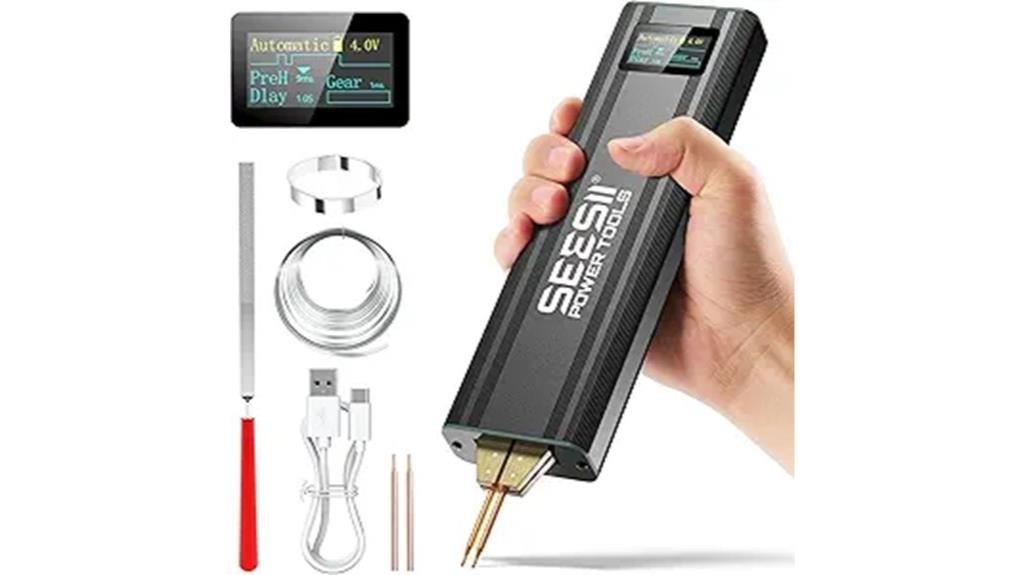
| Display | OLED showing mode, power, preheat, delay, and weld progress |
| Listed sheet range | 0.1 to 0.2 mm nickel, stainless steel, or iron sheet |
| Cell formats named | 18650, 26650, and 32650; the source article also lists NiMH and Ni-Cd pack work |
| Charging | USB-C rechargeable |
| Listed battery endurance | About 800 welds per charge under moderate use; actual results depend on settings and material |
| Listed housing materials | ABS housing, silicone grip, and brass contact components |
| Listed weight | Approximately 620 g |
| Safety functions listed | Overcurrent protection, overcharge protection, low-voltage lockout, and visible fault indicators |
| Accessories named | Two 5 m nickel rolls, cleaning file, and USB-C charging support; confirm the current package contents before ordering |
What Is the SEESII Battery Spot Welder?
The SEESII is a self-contained spot welder made for attaching thin tabs to cylindrical battery cells. Instead of heating a large area for several seconds, it delivers short pulses through two contact points. That approach can reduce the amount of heat transferred into a cell when you use the correct strip, pressure, and power setting.
The main controls are built around an OLED display and 80 selectable output levels. You can use automatic triggering for repeated work or manual operation when you want more control over timing. Its dual-pulse design adds a preheat stage before the main weld pulse, which can help you get more repeatable contact on clean, properly prepared surfaces.
Key Takeaways
- The listed 800 A figure is a peak output, not a continuous-duty rating.
- Eighty power levels give you room to tune weld strength for different strip thicknesses and cell surfaces.
- The stated 0.1 to 0.2 mm material range covers light battery-tab work, not thick fabrication.
- The OLED makes it easier to confirm mode, power, preheat, and delay settings before each weld.
- USB-C charging and the handheld form improve portability, but high-output use will reduce the number of welds per charge.
Who Should Buy It?
Best For
- Hobbyists assembling or repairing small cylindrical-cell packs.
- Mobile technicians who need a rechargeable tool instead of a bench machine.
- Users who want fine power adjustment for 0.1 to 0.2 mm tab material.
Skip If
- You need a documented production duty cycle or high-volume daily output.
- You regularly weld material thicker than the listed 0.2 mm upper range.
- You need a verified battery capacity, exact charge time, or published electrode-life rating before purchase.
Before You Buy: Confirm the current listing, package contents, charging requirements, and replacement-tip availability. The source article does not provide a verified continuous-duty cycle, so this model should not be treated as a production welder.
Design and Build Quality
The integrated handheld layout keeps the power source and welding controls together, which reduces the amount of equipment you need on a small bench. The source article lists an ABS housing, a silicone grip, brass contact components, and an approximate weight of 620 g. That weight is still portable, although it may feel substantial during long sessions.
The OLED is the strongest usability feature. It displays the selected mode, power level, preheat setting, delay, and welding progress, so you can check the setup before touching the electrodes to a strip. Clear feedback matters because an accidental jump in power can burn through thin material or leave a weak joint.
Controls and Welding Modes
The 80-level output range gives you more adjustment than a simple low, medium, and high switch. Start at a low level on scrap material, inspect the weld, and increase power in small steps. The correct setting depends on strip thickness, surface condition, electrode pressure, cell type, and battery charge level.
Automatic mode can speed up repeated tab placement because the tool triggers after contact and the selected delay. Manual mode gives you more control when access is tight or when you are still testing settings. The dual-pulse sequence uses a lighter first pulse before the main pulse, which may improve consistency when the contact surfaces are clean and flat.
Welding Performance and Practical Limits
The source article lists support for 0.1 to 0.2 mm nickel, stainless steel, and iron sheet. That range suits battery tabs and light joining work. It does not make the tool suitable for thick sheet metal, structural welding, or large copper busbars.
The stated 800 A output is a peak value. It describes a brief pulse, not current that the welder can supply continuously. Since no verified duty-cycle figure is provided, use the tool in short batches and allow it to cool if the housing, contacts, or electrodes become noticeably warm.
Weld quality should be judged by a controlled peel test on a sample, not by appearance alone. A useful weld usually leaves a firm bond without burning through the strip, tearing the cell wrapper, or creating deep marks on the cell terminal. Too little power produces a tab that lifts easily. Too much power can puncture the strip, create heavy sparking, or transfer unnecessary heat into the cell.
Cell and Material Compatibility
The article names 18650, 26650, and 32650 cylindrical cells, along with NiMH and Ni-Cd pack work. Cell diameter alone does not guarantee a safe setup. You still need the correct tab material, terminal condition, insulation, polarity layout, and pack design for the cells you are using.
Nickel and nickel-plated strip can behave differently, and stainless steel or iron sheet may need a different power level. Do not assume one setting will work across every material. Test the exact strip and cell combination on a noncritical sample before assembling a full pack.
Battery Life and USB-C Charging
The source article claims roughly 800 welds per charge under moderate settings. Treat that as an approximate figure because higher power, longer delays, repeated pulses, low ambient temperature, and battery aging can reduce endurance. A “weld” may also refer to one trigger cycle rather than a completed two-point tab connection, so your finished-pack count will be lower.
USB-C charging is convenient for a portable workshop, but the article does not verify the internal battery capacity or exact input profile. Use the charging cable and power source specified by the product manual. Avoid welding while the unit is charging unless the manufacturer explicitly permits pass-through operation.
Safety Features and Workshop Precautions
The listed protection set includes overcurrent cutoff, overcharge protection, low-voltage lockout, and visible fault indicators. These functions can stop some electrical faults, but they do not replace careful pack design or safe handling. A spot welder can still cause burns, sparks, damaged insulation, or a short circuit if the electrodes bridge the wrong points.
- Work on a clean, dry, nonconductive surface.
- Keep loose metal tools, jewelry, and offcuts away from exposed terminals.
- Inspect every cell for dents, corrosion, damaged wraps, leakage, or unusual heat before welding.
- Use insulating rings and barriers where your pack design requires them.
- Wear suitable eye protection and keep a safe battery-response plan for your workspace.
- Stop immediately if a cell becomes hot, swells, vents, smells unusual, or shows wrapper damage.
Battery-pack construction can create serious fire and electrical risks. Follow the product manual and the cell manufacturer’s limits. For high-energy packs, vehicle batteries, power tools, e-bikes, or other safety-critical projects, professional pack-building experience is strongly recommended.
How It Performs in Real Use
For Small 18650 Pack Repairs
The compact format can help when you need to replace a short tab or reconnect a small group of cells. Manual mode is useful near existing insulation because you can control the exact contact point. You should still isolate nearby terminals and confirm polarity before every pulse.
For Repeated Hobby Builds
Automatic mode and 80 power levels support repeatable work after you find a tested setting. The main limitation is heat buildup. Without a published duty cycle, pause between batches and monitor the electrodes, contacts, and housing instead of chasing a fixed production rate.
For Mobile or Field Work
The internal battery and USB-C charging remove the need for a separate 12 V source during normal use. That makes the tool easier to carry to a repair location. You still need a stable work surface, proper insulation materials, and enough time to test weld strength safely.
For Long-Term Ownership
Electrode condition will affect consistency over time. Pitting, oxidation, flattening, and embedded strip residue can change the contact area and force you to raise power. Light cleaning may restore performance, but deeply worn or misshapen tips should be replaced rather than over-filed.
Setup Tips Before First Use
- Charge the welder as directed. Start with a full charge so falling battery voltage does not change your test results.
- Inspect the electrodes. Both tips should be clean, aligned, and similar in shape.
- Prepare scrap samples. Use the same strip type and thickness planned for the finished pack.
- Begin at a low setting. Increase power gradually until the strip passes a controlled peel test without burn-through.
- Keep pressure consistent. Uneven pressure can create one strong weld point and one weak point.
- Record the working setting. Note the material, thickness, mode, and power level so you can repeat the setup.
- Re-test after changes. A new strip roll, different cell brand, lower battery charge, or cleaned electrode can alter the result.
Pro Tip: Make a labeled test strip for each material and thickness you use. Record the successful power level and mode, then repeat a peel test whenever you change electrodes, strip stock, or cell type.
Electrode Care and Maintenance
Clean the tips when you see dark residue, uneven marks, or inconsistent welds. Use the included file lightly and keep both tips even. Removing too much material changes the tip shape and contact area, which can make your old power setting unreliable.
Inspect the housing, charging port, contacts, and insulation before each session. Store the welder with the electrodes protected from impact and metal debris. The article does not establish a monthly service schedule, user firmware update process, or factory calibration interval, so follow the supplied manual rather than an invented maintenance calendar.
Pros and Cons
Pros
- 80 power levels support careful tuning for thin tab materials.
- Automatic and manual modes suit both repeated work and precise placement.
- OLED feedback shows important settings before each weld.
- USB-C charging and an integrated battery improve portability.
- Listed protection functions provide useful fault feedback.
Cons
- No verified continuous-duty or welds-per-minute rating is provided.
- The 0.2 mm listed upper range limits heavier fabrication work.
- Battery capacity, replacement-tip part numbers, and exact warranty terms were not verified.
Is It Worth the Price?
The SEESII makes the most sense as a portable, light-duty spot welder for hobby builds, occasional repair work, and users who value fine output control. The OLED, dual-pulse operation, 80 levels, and USB-C charging give it a more flexible control set than basic fixed-output pocket welders.
Its value depends on your workload. It is worth considering if you need compact equipment and mainly use thin battery-tab material. It is not the best fit if you need a documented production cycle, thick-strip performance, a replaceable external battery system, or fully verified service parts.
How It Compares to Alternatives
A larger capacitor-style bench welder may offer stronger repeatability, better cooling, and clearer production capability, but it takes more space and usually costs more. A 12 V input spot welder can support longer sessions when paired with a suitable external battery, although setup and power-source quality become additional concerns.
The SEESII is the more convenient choice when portability and all-in-one operation matter most. A bench model is the better direction when you expect long sessions, thicker conductors, or regular commercial pack work.
Frequently Asked Questions
Can the SEESII weld 0.2 mm nickel strip?
The source article lists a 0.1 to 0.2 mm sheet range. Actual results depend on the strip composition, cell surface, tip condition, pressure, power level, and battery charge. Test the exact material before using it on a finished pack.
How many welds can it make on one charge?
The article states about 800 welds under moderate use. Higher power levels, repeated testing, cold conditions, and battery aging can reduce that number. Finished tab connections may require more than one trigger cycle.
Can you weld tabs onto cells that are already in a pack?
Experienced builders may make repairs on assembled packs, but the risk of bridging terminals or damaging nearby insulation is higher. Isolate exposed conductors, verify polarity, and avoid this type of repair unless you understand the pack design and fault risks.
What is the difference between automatic and manual mode?
Automatic mode triggers after the electrodes contact the work and the selected delay passes. Manual mode lets you control the trigger, which can help during testing or tight access. Always confirm the active mode on the OLED before touching the strip.
How often should you clean or replace the electrodes?
Clean the tips when residue, pitting, or uneven weld marks appear. Replace them when light dressing no longer restores an even contact shape or when consistent settings stop producing consistent welds. The article does not provide a fixed replacement interval.
Can you charge it from any USB-C power source?
The product is described as USB-C rechargeable, but the article does not verify every supported voltage or charging protocol. Use a charger that matches the manual and avoid damaged cables or loose charging ports.
Are replacement tips, pens, or warranty service available?
The source article does not verify a replacement-tip part number, service process, or exact warranty term. Check the current Amazon listing, seller information, package insert, and SEESII support details before buying if parts availability is essential.
Who should skip this spot welder?
Skip it if you need thick-busbar capability, a documented commercial duty cycle, or verified production throughput. A larger bench welder is usually a better match for frequent pack assembly and heavy conductors.
The Bottom Line
The SEESII Battery Spot Welder is worth considering for hobbyists and mobile repair work that stays within its listed thin-strip range. Its main strengths are the 80-level adjustment, dual-pulse modes, OLED feedback, and rechargeable design, while its main limitation is the lack of a verified continuous-duty rating and detailed service information. Choose a larger documented system if your work is frequent, commercial, or safety-critical.
Ready to Buy?
Check the latest product details, package contents, and seller information before you decide.