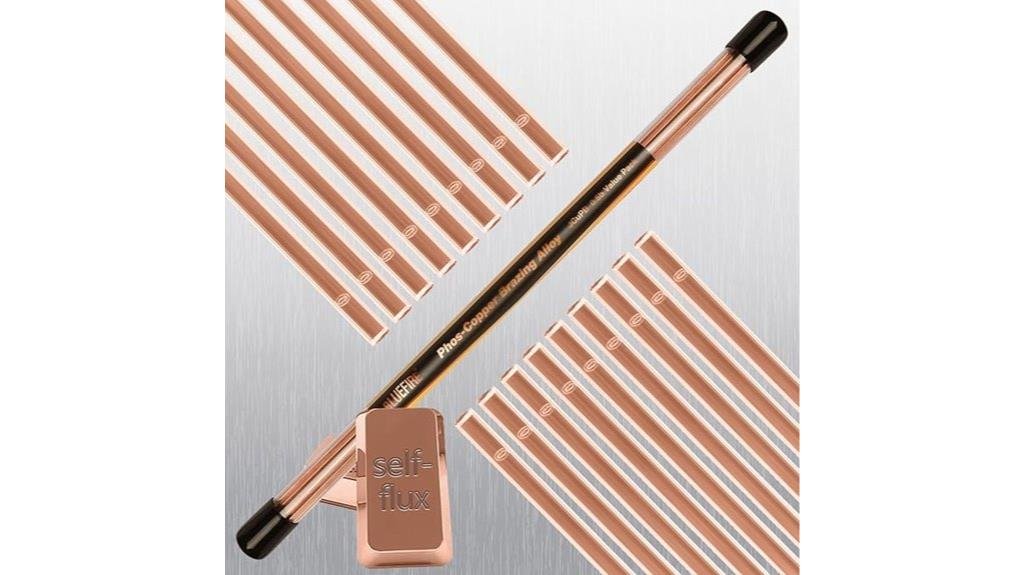
The 21 Sticks BLUEFIRE BCuP-2 review summarizes a professional-grade brazing rod set, composed primarily of copper-phosphorus with a solidus of 1310°F and liquidus of 1508°F, ideal for copper-to-copper, brass, and bronze joints. It offers strong capillary action, self-fluxing convenience, and precise heat control; users should note joint clearance, torch size, and post-braze cleaning. How does it compare on strength, ease of use, and cost-effectiveness?
Key Takeaways
- Bluefire BCuP-2 is a phosphor-copper brazing rod (P 6.6–7.4%, balance Cu) for copper, brass, and bronze joints.
- Melting range is 1310–1508°F (710–820°C), best torch-brazed at about 1508°F (820°C) for consistent flow.
- Optimal joint clearance 0.002–0.007″ for predictable capillary action and leak-free HVAC connections.
- Not suitable for iron/steel or high-phosphorus exposure with dissimilar metals; use flux JFB-102 for brass-to-brass.
- Users rate it highly (average 4.6/5 from 352 reviews); common retail availability and 30-day return guarantee.
Product Specifications and Composition
The 21 Sticks BLUEFIRE BCuP-2 is a half‑pound pack of phosphor copper brazing rods designed for precision brazing tasks.
This section offers composition analysis and clear specification details for the reader.
What are the key specs?
- Dimensions: 0.050″ x 1/8″ x 14″
- Weight: 0.5 lb
- Chemical: P 6.6–7.4%, balance Cu
- Color: gold
How should one consider use?
Recommended joint clearance 0.002–0.007″, self‑fluxing for copper-to-copper, flux advised for brass-to-brass.
Manufacturer: Bluefire, part JCuP B.
Practical, measured, and ready for HVAC and plumbing work.
Performance and Temperature Ratings
Following the specification details and recommended clearances, performance now turns to how the BCuP-2 behaves under heat and in service.
The alloy offers reliable temperature stability and notable heat resistance, with a solidus at 1310°F (710°C) and liquidus at 1508°F (820°C).
Practical considerations include joint clearance 0.002–0.007″, melt range, and phosphor content affecting flow and wetting.
Practical considerations: maintain 0.002–0.007″ joint clearance; melt range and phosphor level govern flow and wetting.
- Operating window: melts between 1310–1508°F, good for HVAC brazing, heat exchangers, controlled melts.
- Thermal behavior: consistent flow, predictable capillary action, stable microstructure after cooling.
- Service: withstands typical HVAC temps; monitor peak exposure and joint design.
Recommended Applications and Limitations
Although intended primarily for copper-based joints, the BCuP-2 alloy also performs well in a range of HVAC and refrigeration tasks, provided users respect its composition and temperature limits.
It suits A/C, evaporators, heat exchangers, water heaters: copper-to-copper, brass, bronze.
Recommended brazing techniques include torch brazing at 1508°F/820°C target, controlled preheat and capillary flow.
Joint preparation matters: clean, flux where needed, maintain 0.002–0.007″ clearance.
Limitations? Not for iron/steel welding, avoid high-phosphorus exposure with dissimilar metals.
Practical tip: use JFB-102 flux for brass-to-brass, monitor solidus 1310°F/710°C during cooling.
Quality, Ratings, and Availability
Because consistent manufacturing practices matter to professionals and DIYers alike, Bluefire’s BCuP-2 brazing rods present a reliable mix of quality control, user feedback, and readily available purchasing options.
The product reliability is supported by manufacturing standards and a 4.6/5 customer feedback average from 352 ratings; dimensions are 0.050″ x 1/8″ x 14″, weight 0.5 lb. Availability: first listed April 28, 2021, with Amazon 30-day return guarantee.
- Quality assurance: tight composition control, phosphor 6.6–7.4%, solidus 710°C.
- Ratings: consistent positive reviews, useful performance notes.
- Purchasing: common e-tail distribution, part JCuP B.
Usage Tips and Best Practices
When preparing to use Bluefire BCuP-2 brazing rods, users should focus on joint fit-up, heat control, and safety to ensure consistent, leak-free joints.
These rods measure 0.050″ × 1/8″ × 14″ and are best used with a joint clearance of 0.002–0.007″ and a working range between the solidus 710°C (1,310°F) and liquidus 820°C (1,508°F).
Tips: clean surfaces, dry joints, position rods for capillary action.
Which brazing techniques work best? Torch heating with even, progressive heat.
What safety precautions matter? Eye protection, ventilation, heat-resistant gloves.
Inspect joints for full fillet, continuity, proper capillary fill.
Frequently Asked Questions
Can These Rods Be Used With Propane Torches Safely?
Yes — he can safely use a propane torch for these rods if proper propane torch safety is observed; the rod melting point (liquidus ~1508°F/820°C) is reachable with sufficient flame and correct technique, avoiding overheating.
Do Sticks Require Pre-Cleaning Before Brazing?
Yes — he insists on pre-cleaning techniques; ironically, despite self-fluxing bragging, brazing preparation demands clean, bright metal surfaces. He removes oxides, oils, and debris with mechanical abrasion and solvent wiping before brazing.
Are Replacement Sticks Sold Individually or Only in Packs?
They are typically sold only in packs; the reviewer notes replacement options focus on purchasing details for multi-stick bundles rather than individual sticks, so buyers should expect to buy half-pound packs rather than single-rod sales.
Is This Alloy Compliant With Potable Water Plumbing Codes?
Investigations reveal limited compliance: the alloy may not meet all potable water plumbing codes. It’s often unsuitable for drinking-water systems without certification; users should verify local potable water plumbing codes and approvals before application.
Can Leftover Rods Be Stored Long-Term Without Deterioration?
Yes. He notes proper storage conditions—cool, dry, low-humidity, sealed container—preserve rod lifespan. When kept free from corrosion and contamination, leftover rods remain usable long-term, with lifespan effectively limited only by physical damage or severe oxidation.
Conclusion
In sum, the 21 Sticks BLUEFIRE BCuP-2 delivers consistent brazing for copper, brass, bronze joints, solidus 1310°F, liquidus 1508°F, strong capillary action. One installer likened a flawless joint to a well-stitched seam after 50 field repairs—small precision, big strength—illustrating reliability. Is it right for heavy HVAC work? Yes, with proper joint prep, heat control, and ventilation. Expect professional-grade results, predictable flow, and widely positive user ratings (4.6/5).