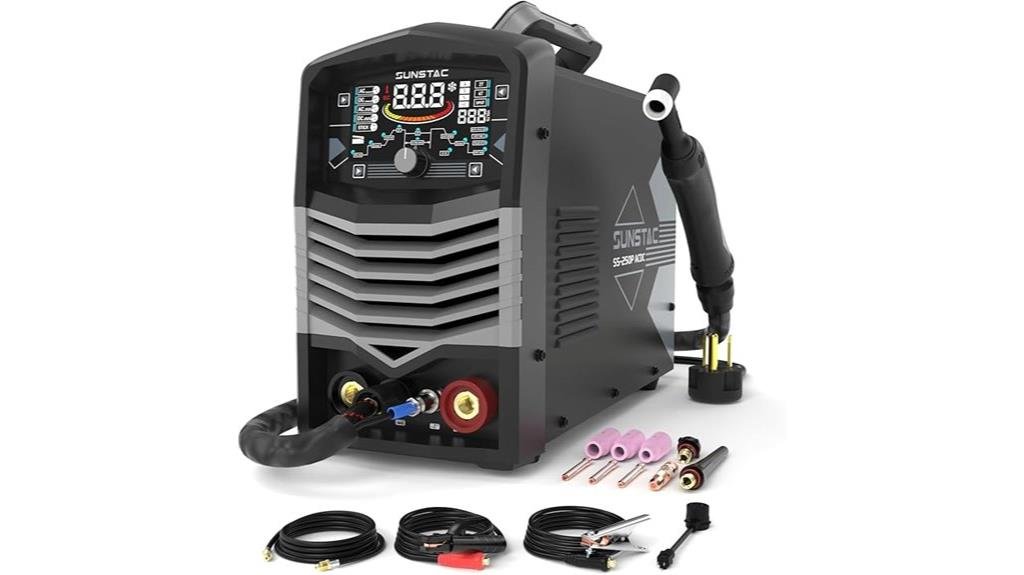
The Sunstac 250A AC/DC TIG Welder, model SS-250P/ACDC, is marketed as a dual-voltage AC/DC TIG machine for hobbyists, garage welders, and small fabrication shops. It supports 110V/220V input, high-frequency TIG starting, pulsed AC and DC TIG, spot modes, stick welding, an LCD control panel, and adjustable settings for aluminum work. The published specifications claim aluminum capacity up to 4 mm on 110V and 6 mm on 220V, but they do not establish a verified 10 mm steel limit or a 0.5 mm minimum aluminum thickness.
The Sunstac SS-250P/ACDC is a feature-rich AC/DC TIG welder with 110V/220V input, pulsed AC/DC TIG, HF start, spot welding, stick mode, parameter memory, and optional foot-pedal control. Its published aluminum limits are 4 mm on 110V and 6 mm on 220V. A specific maximum steel thickness is not published, so claims that it reliably TIG welds 10 mm steel should not be treated as verified.
Quick Verdict
| Category | Verdict |
|---|---|
| Best for | DIY welders and small shops that want AC TIG for aluminum plus DC TIG, pulse, spot, and stick functions in one dual-voltage machine. |
| Main advantage | A broad selection of TIG controls and aluminum capability without requiring separate AC and DC machines. |
| Main limitation | The foot pedal is not included, and some important specifications such as a detailed duty-cycle chart and manufacturer warranty terms are not clearly documented in the sources reviewed. |
| Who should skip it | Buyers who need thoroughly documented industrial specifications, calibrated output records, established service infrastructure, or an included foot pedal. |
This review evaluates the Sunstac 250A from its published specifications and currently available product information. It does not present unverified seller claims as independent hands-on measurements.
Key Takeaways
- The SS-250P/ACDC is listed as a 110V/220V AC/DC TIG welder with output advertised at up to 250A.
- Its modes include high-frequency AC TIG, high-frequency DC TIG, pulsed AC, pulsed DC, AC/DC spot welding, and stick welding.
- The published aluminum limit is up to 4 mm on 110V and 6 mm on 220V; treat these as listing specifications rather than guaranteed results for every alloy, joint, or operator.
- No reliable Sunstac specification was found confirming a 10 mm maximum TIG thickness for steel.
- The LCD, 2T/4T operation, parameter memory, and optional foot-pedal support give users substantial control, although the pedal is sold separately.
- Published weight figures vary slightly by listing, but the machine is roughly 30 lb before adding the gas cylinder, cables, and other TIG equipment.
Key Features and Specifications
The Sunstac 250A AC/DC TIG Welder combines several processes in one inverter-style machine. Its main appeal is flexibility: AC TIG handles aluminum applications, while DC TIG is the normal choice for carbon steel and stainless steel. Pulse and spot controls provide additional ways to manage heat and weld timing.
| Specification | Published information |
|---|---|
| Model | SS-250P/ACDC |
| Input | 110V/220V dual voltage |
| Maximum output | Advertised up to 250A |
| TIG modes | HF AC TIG, HF DC TIG, pulsed AC, pulsed DC, AC spot, and DC spot |
| Additional process | Stick/MMA welding |
| Display | LCD digital control screen |
| Trigger modes | 2T, 4T, and spot functions |
| Parameter memory | Yes, according to published product information |
| Foot pedal | Supported through an optional pedal; pedal not included |
| Listed aluminum capacity | Up to 4 mm on 110V and 6 mm on 220V |
| Approximate weight | About 30 lb based on current published listings |
One useful feature is the parameter-saving function, which can restore previously selected settings. The machine is also described as automatically recognizing a connected compatible foot pedal after restart.
Important specification note: Current sources do not agree perfectly on package dimensions, weight, or the exact accessory inventory. Check the current seller listing and package photos before ordering if a specific torch, regulator, adapter, or accessory is essential to your setup.
Performance on Aluminum and Steel
The most important distinction is between published capability and demonstrated performance. Sunstac’s listing information provides a specific aluminum thickness claim, but a comparable maximum TIG thickness for steel is not clearly published.
Thin Aluminum: About 0.5–3 mm
The machine’s AC TIG and pulsed AC modes give an operator the controls normally desired for thinner aluminum because pulse can help manage average heat input and AC operation provides the cleaning action needed to deal with aluminum oxide. AC balance changes the relationship between oxide cleaning and heat directed into the workpiece.
However, the available Sunstac specifications do not establish 0.5 mm as a guaranteed minimum weldable thickness. Very thin aluminum is sensitive to fit-up, travel speed, amperage control, tungsten preparation, alloy, filler selection, shielding-gas coverage, and operator technique. Practice on matching scrap before working on a finished part.
Aluminum Near the Published Maximum
The listed maximum is 4 mm on 110V and 6 mm on 220V. Treat those numbers as product-listing limits rather than a promise that every 6 mm aluminum joint can be completed in one pass. Joint design, alloy, access, preparation, preheating requirements, torch capacity, and technique can change what is practical.
For additional background on aluminum TIG preparation and technique, see Miller Welds.
Steel and Stainless Steel
DC TIG is the appropriate mode for common carbon-steel and stainless-steel TIG work. Pulsed DC adds another way to manage heat on thin or heat-sensitive joints and can help the operator establish a repeatable rhythm.
The original claim that the Sunstac handles steel up to 10 mm efficiently could not be verified from reliable Sunstac specifications. For steel in the 6–10 mm range, joint preparation, beveling, multiple passes, available amperage, torch capacity, input power, and the machine’s duty cycle can all become important. Do not select the machine for a production 10 mm steel application based only on the advertised 250A figure.
Quick Specs
- Advertised Max Output: Up to 250A
- Input: Dual Voltage 110V/220V
- Processes: AC/DC TIG, pulsed TIG, spot TIG, and stick/MMA
- Published Aluminum Limit: 4 mm on 110V; 6 mm on 220V
- Published Steel Thickness Limit: Not clearly specified
User Experience and Controls
The LCD digital screen is designed to make the selected welding mode and parameters easier to see than a basic dial-only interface. The control system also provides 2T, 4T, spot, pulse, and saved-parameter functions, giving users room to build repeatable setups once they find settings that work for a particular joint.
The machine weighs roughly 30 lb according to available listings, so the power source itself is reasonably portable. Keep in mind that a complete TIG setup also includes a shielding-gas cylinder, regulator or flowmeter, torch, work lead, filler material, consumables, and PPE.
Beginner Setup Tips
- Start with clean material and practice on scrap that matches the alloy, thickness, and joint you plan to weld.
- Use AC TIG for aluminum and DC TIG for carbon steel or stainless steel.
- Use pulse as a heat-control tool rather than assuming it automatically prevents distortion or burn-through.
- Record settings that produce acceptable welds instead of relying on a single generic preset.
- If you want live amperage control while TIG welding, verify the compatible 5-pin pedal before buying an accessory.
Pros, Cons, and Value for Money
Pros
- AC and DC TIG support aluminum as well as common steel and stainless-steel applications.
- 110V/220V input provides more flexibility between home-garage and higher-voltage shop circuits.
- Pulsed AC, pulsed DC, spot, 2T, and 4T modes provide a broad set of controls.
- The LCD and parameter memory can make successful settings easier to repeat.
- Stick mode adds another process for repair and fabrication work.
Cons
- The foot pedal is not included.
- The large number of settings creates a steeper learning curve than a basic DC TIG machine.
- A detailed, clearly published duty-cycle chart was not verified in the sources reviewed.
- Published package dimensions and accessory lists are inconsistent between sources.
- Detailed manufacturer warranty and service terms are not clearly documented in the product information reviewed.
Is it worth considering? Yes, particularly if you actually need AC TIG for aluminum in addition to DC TIG and stick welding. Its value is less compelling if you only weld mild steel and do not need AC, pulse, spot, or the other added controls.
Avoid judging value from a temporary Amazon price or customer star rating. Instead, compare the complete setup cost, included accessories, foot-pedal requirements, warranty terms, input-power requirements, and current seller support.
Alternatives to the Sunstac 250A
If documentation, accessories, or manufacturer support are especially important, compare the Sunstac with other currently sold AC/DC TIG machines before deciding.
| Alternative | Why compare it |
|---|---|
| YESWELDER TIG-200P ACDC PRO | A 110V/220V 200A-class AC/DC TIG machine with pulse, HF start, published duty-cycle information, and foot-pedal compatibility. |
| TOOLIOM TL-200TP ACDC PRO | A dual-voltage AC/DC TIG option with AC/DC pulse, spot welding, a digital display, and optional foot-pedal support. |
| Weldpro TIG200ACDCGD | A 200A AC/DC TIG system with extensive parameter controls and packages that include a foot pedal, making it worth comparing if accessory completeness and published support information matter more than the Sunstac’s advertised 250A figure. |
The better choice depends on the material you weld most often, the circuit available in your shop, required duty cycle, whether you want a pedal included, and how much manufacturer documentation and support you expect.
Warranty, Support, and Buying Considerations
Detailed Sunstac manufacturer warranty terms could not be confirmed from the product-specific documentation reviewed. Do not assume a particular warranty duration, parts-and-labor policy, onsite service program, or mail-in repair arrangement unless the current seller or manufacturer provides those terms in writing.
Amazon return eligibility can also vary with the item, seller, order, and current policy. Review the return information shown for your specific order before purchasing rather than relying on a general 30-day guarantee.
Before You Buy
- Confirm the current package contents and make sure the TIG torch, work clamp, adapter, and other accessories you expect are included.
- Verify the compatible foot-pedal connector if you plan to add remote amperage control.
- Check the input plug, circuit, breaker capacity, grounding, and electrical requirements for the voltage you intend to use.
- Ask for written warranty and service terms if those are important to your purchase decision.
- Do not rely on the advertised 250A figure alone when choosing equipment for sustained high-amperage production work.
Welding presents electrical, arc-radiation, fire, fume, gas-cylinder, and hot-metal hazards. Use suitable PPE, ventilation, fire prevention, proper cylinder restraint, and correctly installed electrical equipment. Follow the machine instructions and applicable OSHA safety guidance.
Frequently Asked Questions
Does the Sunstac 250A include a foot pedal?
No. Published product information says the SS-250P/ACDC supports an optional foot pedal, but the pedal is not included. Documentation describes a 5-pin pedal connection and automatic pedal-mode recognition after restart. Confirm compatibility with the current seller before buying a pedal.
Can the Sunstac 250A weld 0.5 mm aluminum?
The available specifications do not confirm 0.5 mm as an official minimum thickness. Its AC TIG and pulse controls can be useful for thin aluminum, but material that thin requires careful amperage control, fit-up, travel speed, shielding, and practice. Test the exact alloy and joint on scrap first.
Can the Sunstac 250A weld 10 mm steel?
A reliable Sunstac specification confirming 10 mm steel TIG capacity was not found. Thick steel may require beveling, multiple passes, substantial amperage, adequate torch capacity, and sufficient duty cycle. Do not treat 10 mm as a verified machine rating without additional manufacturer documentation.
What gas flow rate should I use for TIG welding?
A common general starting range for TIG welding is about 15–20 CFH of argon, but the correct flow depends on cup size, torch configuration, joint, position, and surrounding air movement. Excessive flow can also create turbulence, so more gas is not always better.
Can the Sunstac 250A run on a generator?
Do not assume that a particular 6–7 kW generator is suitable. The product information reviewed does not provide a verified generator-size requirement. Before generator use, confirm the welder’s input-current requirements and the generator’s continuous output, voltage regulation, grounding requirements, and compatibility with inverter welding electronics.
Are replacement TIG consumables available?
The documentation identifies normal TIG consumables such as collets, collet bodies, ceramic cups, and tungsten electrodes. However, verify the torch model, connector, dimensions, and specific consumable compatibility before ordering third-party replacement parts.
Is an RF or EMI suppressor required for HF TIG?
Not necessarily. High-frequency TIG starting can interfere with nearby radio, computer, or other electronic equipment, but proper equipment grounding, sound cable condition, suitable cable routing, and keeping sensitive electronics away from the welding area are important first steps. Follow the welder manufacturer’s installation instructions and local electrical requirements; additional interference-control equipment may be appropriate if problems remain.
Is the Sunstac 250A good for beginners?
It can be suitable for a motivated beginner because the LCD, 2T/4T functions, pulse modes, and parameter memory provide useful control. However, AC TIG has many adjustable variables, so beginners should expect a learning period and should practice on clean test coupons before working on finished parts.
Bottom Line
The Sunstac SS-250P/ACDC is worth considering if you want one compact machine for AC TIG aluminum work, DC TIG steel and stainless, pulsed TIG, spot welding, and stick welding. Its strongest published aluminum claim is up to 4 mm on 110V and 6 mm on 220V.
The main caution is documentation. Treat the advertised 250A output and aluminum thickness limits as published product claims rather than independent test results, and do not rely on the previous 10 mm steel claim without additional evidence. Check current package contents, pedal compatibility, warranty terms, electrical requirements, and seller support before buying.