Disclosure: As an Amazon Associate, we earn from qualifying purchases. If you click a link on this page and make a purchase, we may receive a small commission at no extra cost to you.
Finding room for a powerful subwoofer amplifier can be difficult when your trunk or under-seat space is limited. The Taramps BASS 1200 offers up to 1,200 watts RMS in a compact Class D monoblock design, with built-in cooling and flexible bass controls. However, choosing the correct impedance version, planning your wiring, and leaving room for ventilation are essential. This review covers its verified specifications, installation needs, tuning options, and limitations to help you decide whether it fits your car audio system.
Quick Verdict
Rating: Recommended with caveats
Best For: Drivers who need a compact, dedicated subwoofer amplifier with 1,200W RMS rated output at 2 ohms.
Bottom Line: The Taramps BASS 1200 combines strong manufacturer-rated bass power, adjustable filters, and active cooling in a relatively small chassis. Its main tradeoffs are the need for correct impedance matching, substantial power wiring, and enough open space for its cooling system.
Taramps BASS 1200 Specifications at a Glance
The following specifications apply primarily to the 2-ohm BASS 1200 version associated with the linked product. Taramps has also offered other impedance versions, so confirm the exact model before ordering.
| Specification | Detail |
|---|---|
| Brand | Taramps |
| Model | BASS 1200 |
| Product Type | Car audio subwoofer amplifier |
| Amplifier Design | Class D monoblock, 1 channel |
| Linked Product Version | 2 ohms minimum output impedance |
| Rated Power at 2 Ohms | 1,200W RMS at 14.4V DC |
| Rated Power at 4 Ohms | 900W RMS at 14.4V DC |
| Frequency Response | 8 Hz to 250 Hz (-3 dB) |
| Low-Pass Filter | Variable, 60 Hz to 250 Hz |
| Subsonic Filter | Variable, 8 Hz to 30 Hz |
| Bass Boost | Parametric, 35 Hz to 60 Hz, 0 to +10 dB |
| Signal Inputs | Low-level RCA and high-level speaker inputs |
| RCA Input Sensitivity | 250 mV to 4V |
| Signal-to-Noise Ratio | Greater than 90 dB, manufacturer specification |
| Operating Supply Range | 9V to 17V DC |
| Recommended Fuse or Breaker | 65A, per manufacturer manual |
| Power and Ground Cable | 16 mm² (5 AWG) |
| Speaker Output Cable | 4 mm² (11 AWG) |
| Remote Turn-On Cable | 0.75 mm² (18 AWG) |
| Chassis Material | Aluminum heatsink housing |
| Cooling | Internal Smart Cooler fan and chassis ventilation |
| Dimensions | 9.41 x 2.87 x 6.18 inches (239 x 73 x 157 mm) |
| Weight | 4.4 lb (2.0 kg) |
| Remote Level Control | Monitor Level Remote supported; confirm package contents with seller |
| Manufacturer Warranty | 12 months under stated manufacturer terms; regional and seller conditions may apply |
| Primary Use | Dedicated car audio subwoofer systems |
What Is the Taramps BASS 1200?
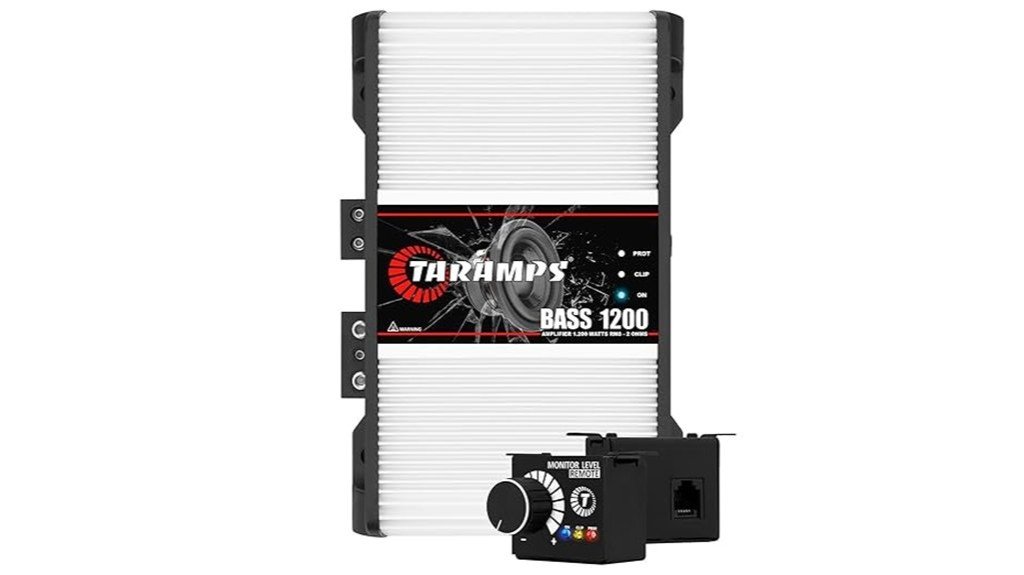
The Taramps BASS 1200 is a single-channel Class D amplifier built for subwoofers and low-frequency audio. It is designed to deliver substantial bass power without the large body found on some traditional car amplifiers. Its aluminum housing measures 9.41 inches across its specified width and weighs about 4.4 pounds.
The linked 2-ohm version is rated for 1,200W RMS at a 2-ohm load and 900W RMS at 4 ohms, both measured at 14.4V. Other BASS 1200 impedance versions exist, but their power ratings and load limits differ. You must match the amplifier version to your final speaker impedance.
It also includes separate low-pass and subsonic filters, adjustable bass boost, RCA inputs, high-level inputs, and active cooling. These features make it useful for both aftermarket stereo installations and compatible factory audio systems.
How This Review Was Evaluated: This assessment uses published Taramps specifications, the manufacturer manual, and installation requirements. It does not claim independent laboratory power measurements or hands-on listening tests. Actual bass output will depend on your subwoofer, enclosure, vehicle electrical system, and tuning.
Who Should Buy It?
Best For
- Drivers building a high-output subwoofer system with limited mounting space.
- Owners of compatible 2-ohm subwoofer configurations who want up to 1,200W RMS of rated power.
- Installers connecting factory stereos through high-level inputs or aftermarket receivers through RCA cables.
Skip If
- You need an amplifier for full-range door speakers or tweeters.
- Your subwoofer setup requires 1-ohm operation and you are considering this specific 2-ohm version.
- Your mounting location is sealed, exposed to moisture, or lacks cooling clearance.
Design and Build Quality
The BASS 1200 uses an aluminum chassis that also serves as a heatsink. Its Class D architecture helps reduce the space needed for amplification, while its internal Smart Cooler fan provides active ventilation.
The housing measures 9.41 x 2.87 x 6.18 inches. That is compact for an amplifier with this output rating, but it still needs mounting clearance, cable access, and room for airflow. You should measure the actual installation area rather than judging fit from the amplifier dimensions alone.
Its connection panel provides dedicated power, ground, remote turn-on, and speaker terminals. The input and tuning panel includes gain, subsonic, low-pass, and bass boost adjustments.
The design prioritizes function over decorative features. You do not get a touchscreen, built-in streaming, or software-based tuning. Instead, you use physical controls, wiring connections, and the compatible remote accessory.
Power Output and Low-End Sound Performance
How Much Power Does the 2-Ohm Version Deliver?
The most important specification is 1,200W RMS at 2 ohms and 14.4V DC. Taramps also rates this version at 900W RMS with a 4-ohm load. These figures are manufacturer test ratings, not guarantees of identical output in every vehicle.
With a lower supply voltage, different speaker impedance, or electrical limitations, available output can change. Your subwoofer’s RMS power handling and enclosure design also affect how much of that power you can use safely.
What Does the 8 Hz to 250 Hz Frequency Range Mean?
The amplifier’s stated frequency response covers 8 Hz to 250 Hz at the -3 dB points. This gives its tuning circuits a wide range of low frequencies to work with.
However, an 8 Hz amplifier specification does not mean your subwoofer can reproduce audible bass that low. The speaker, enclosure, cabin acoustics, and crossover settings determine the useful output you hear.
For everyday music, the key benefit is having enough filtering control to blend the subwoofer with your main speakers while limiting unwanted low-frequency output.
Features and Crossover Controls
Variable Low-Pass Filter: 60 Hz to 250 Hz
The low-pass filter limits the higher frequencies sent to the subwoofer. You can adjust it from 60 Hz to 250 Hz, depending on your main speakers and audio system.
A setting around 80 Hz is a useful starting point for many systems, but it is not a universal requirement. Adjust the crossover based on your speaker response, enclosure, and listening preferences.
Subsonic Filter: 8 Hz to 30 Hz
The adjustable subsonic filter reduces very low frequencies that may place unnecessary strain on a subwoofer, especially in some ported enclosures.
The correct setting depends on the enclosure’s tuning frequency and the subwoofer manufacturer’s guidance. Setting it too low may leave the speaker exposed to excessive cone movement, while setting it too high can remove useful bass.
Parametric Bass Boost: Up to +10 dB
The BASS 1200 offers adjustable bass boost from 0 to +10 dB, with a selectable center frequency between 35 Hz and 60 Hz.
This lets you emphasize a chosen part of the bass range. However, large boosts increase amplifier output demands and may cause clipping or excessive speaker movement.
For a first setup, keep bass boost at 0 dB and establish a clean gain setting before adding any extra emphasis.
RCA and High-Level Inputs
The standard RCA connections work with compatible aftermarket head units. The high-level inputs accept speaker-level signals from factory systems, which may remove the need for a separate line output converter.
The high-level connection also supports an automatic turn-on feature. Taramps notes that automatic activation may not work with every factory radio, in which case a remote turn-on connection may still be needed.
Monitor Level Remote
The BASS 1200 supports Taramps’ Monitor Level Remote for level adjustment and monitoring amplifier status indicators. This can be useful when you want to change bass output from your driving position without reaching the amplifier.
Taramps describes the accessory as included with the amplifier, but some third-party product records list only the amplifier in the box. Confirm the remote and connecting cable are included in the exact seller package before purchasing.
Subwoofer Compatibility and Impedance Matching
Correct impedance matching matters more than choosing a subwoofer based on diameter alone. A 10-inch or 12-inch speaker is not automatically compatible simply because its size seems appropriate for the amplifier.
The linked 2-ohm BASS 1200 version is intended for a minimum 2-ohm final speaker load. A 4-ohm load is also supported, but the manufacturer rates output at 900W RMS rather than 1,200W RMS.
For example, two compatible single-voice-coil 4-ohm subwoofers wired in parallel produce a nominal 2-ohm load. A dual-voice-coil subwoofer may also offer suitable wiring options, depending on its coil impedances.
Do not connect a final 1-ohm load to the 2-ohm amplifier version. If your intended setup requires 1 ohm, choose an amplifier specifically rated for that load.
Before You Buy: Check the impedance printed on the amplifier and calculate the final impedance of your subwoofer wiring. The BASS 1200 has been sold in different impedance versions. A product advertised as 1,200W RMS does not automatically deliver that output at every speaker load. Also confirm which version, remote accessory, and other components are included in your order.
Thermal Management and Protection Systems
High-power amplifiers generate heat even when their circuits operate efficiently. The BASS 1200 combines its aluminum heatsink with an internal fan called Smart Cooler.
The fan helps move heat away from internal components. Its operation changes according to the cooling system’s control, so you should not assume it runs at full speed continuously.
The manufacturer also lists protection against output overload and abnormal supply voltage, with thermal protection identified in its product information. These systems provide safeguards, but they cannot replace proper wiring and ventilation.
Does the Cooling Fan Make Noise?
Because the BASS 1200 uses an active fan, some mechanical sound may be noticeable when it operates. The actual noise level depends on fan speed, mounting location, and the surrounding cabin.
A trunk-mounted amplifier may be less noticeable than one installed directly below a front seat. There is no verified fan-noise measurement available for this review, so silent operation should not be assumed.
Installation Safety and Electrical Requirements
Installing a 1,200W RMS amplifier involves more than connecting audio cables. The power supply, grounding, protective fuse, and cooling arrangement all affect safe operation.
Taramps recommends installation by a qualified professional. Its manual specifies 16 mm² (5 AWG) power and ground cables, 4 mm² (11 AWG) speaker wiring, and a 65A fuse or circuit breaker. These cable recommendations assume a run of no more than 4 meters. Longer runs may require larger conductors.
Power, Ground, and Fuse Placement
The main positive power line needs a properly rated protective fuse or circuit breaker close to the battery. Follow the manufacturer’s specified protection requirements and use wiring that meets the installation’s length and current demands.
The ground connection must be secure and provide a low-resistance return path. Loose terminals, undersized cables, and poor grounding can contribute to voltage drops, heat, and amplifier faults.
Disconnect the vehicle battery’s negative terminal before beginning electrical work. Do not make or remove amplifier connections while the unit is operating.
Battery and Alternator Capacity
The manufacturer’s installation diagram specifies a battery capacity of at least 65 Ah. Its published figures also show significant electrical consumption under demanding test conditions.
Battery capacity alone does not prove that your alternator and vehicle wiring can support continuous high-output audio. A professional installer should assess the complete electrical system, especially if you plan to use the amplifier near its rated output for extended periods.
Mounting Position and Clearance
Install the amplifier on a stable surface protected from moisture, dust, and excessive heat. Keep it away from fuel lines, sharp edges, and areas where cargo can damage cables.
Taramps specifies at least 1 inch of space around the heatsink for cooling. Keep the fan opening and ventilation paths unobstructed.
The aluminum housing can become hot during use. Avoid mounting it where passengers, children, or loose objects may contact the heated surface.
How It Performs in Real Use
1. Compact Trunks and Under-Seat Installations
The 9.41 x 2.87 x 6.18-inch body may help you place the BASS 1200 in a trunk side compartment, behind a panel with adequate airflow, or beneath a seat with enough clearance.
Under-seat installation is not guaranteed to work in every vehicle. Seat rails, carpet, wiring, moving seat components, and cooling clearance can reduce the usable space.
For tight installations, measure the complete area and plan cable routing before buying.
2. Daily Driving with a Dedicated Subwoofer
For an everyday bass system, the amplifier provides variable filtering and input gain adjustment. These controls let you match the bass channel to your head unit and speakers rather than simply running maximum gain.
A properly matched 2-ohm subwoofer setup can take advantage of the rated 1,200W RMS output when suitable electrical conditions are available. The final sound still depends heavily on the subwoofer and enclosure.
3. Factory Stereo Upgrades
If your vehicle retains its original head unit, the high-level inputs provide a direct connection option for compatible speaker-level signals.
This can simplify an upgrade that adds bass without replacing the dashboard receiver. However, some factory audio systems use signal processing or unusual output configurations that may require additional integration equipment.
4. High-Output Bass Sessions
During demanding playback, the Smart Cooler fan and protection circuits help manage the amplifier’s operating conditions. The manual’s rated output figures are based on specified test conditions, so real vehicle output can differ.
If the amplifier shows clipping or protection warnings, reduce the level and investigate the cause. Continuous clipping, voltage problems, or overheating should not be treated as normal operating behavior.
Setup Tips for Better Bass and Reliability
Correct setup can make a larger difference than adding extra bass boost. Use the following checks when planning your installation.
- Confirm your speaker load: Calculate the final impedance of every connected subwoofer and verify that it meets the amplifier’s minimum rating.
- Plan the power cables: Follow the manufacturer’s wiring recommendations and account for the complete cable run.
- Start with bass boost at zero: Establish clean gain and crossover settings before increasing bass emphasis.
- Match the low-pass filter: Use the main speakers and enclosure response to guide adjustments.
- Set the subsonic filter carefully: Follow your subwoofer and enclosure recommendations, especially with ported boxes.
- Check the clip indicator: Use suitable testing equipment or professional help to establish safe operating levels.
- Keep the cooling system clear: Check for blocked vents, loose cables, and items that may shift against the fan opening.
Pro Tip: Treat the gain control as an input-sensitivity adjustment, not a volume knob. Set the gain using an appropriate test procedure and watch for clipping. If you use the Monitor Level Remote, its warning indicators can help you recognize when the system is being pushed too hard.
Maintenance and Long-Term Care
The BASS 1200 does not require routine user access to its internal electronics. The most useful maintenance checks involve its mounting area, cables, and ventilation.
Periodically inspect accessible connections for looseness, damage, or signs of overheating with the system powered off. Keep the fan intake and exhaust area free from dust buildup and stored objects.
Do not spray liquids into the amplifier or open the housing for cleaning. If you notice repeated protection shutdowns, abnormal fan behavior, or damaged terminals, arrange an inspection by a qualified technician.
Because the amplifier is not marketed as a marine-rated unit, avoid installation where rain, condensation, salt spray, or water intrusion may reach it.
Pros and Cons
Pros
- Manufacturer-rated 1,200W RMS output at 2 ohms and 14.4V.
- Compact aluminum chassis measuring 9.41 x 2.87 x 6.18 inches.
- Separate adjustable low-pass, subsonic, and parametric bass boost controls.
- Both RCA and high-level inputs for different stereo configurations.
- Smart Cooler fan, protection features, and Monitor Level Remote compatibility.
Cons
- The linked 2-ohm version cannot safely run a 1-ohm final speaker load.
- Requires substantial electrical wiring, proper fuse protection, and adequate ventilation.
- The internal fan may be audible in quiet mounting locations, and remote accessory inclusion should be confirmed.
Is It Worth the Price?
The Taramps BASS 1200 is worth considering if you need high manufacturer-rated bass output without dedicating a large section of your vehicle to the amplifier. Its main value comes from the combination of compact dimensions, adjustable bass controls, flexible inputs, and active cooling.
However, the amplifier’s purchase price is only part of the total cost. You may need suitable power and speaker wiring, fuse protection, mounting hardware, and professional installation. Some vehicles may also require electrical system improvements for demanding use.
It is a better fit for buyers who already know their subwoofer impedance and have planned a suitable mounting location. If you need an inexpensive, simple amplifier for a modest subwoofer, a lower-power model may be more practical.
How It Compares to Alternatives
The Skar Audio RP-1200.1D is another Class D monoblock rated at 1,200W RMS, but its stated full-power load is 1 ohm. That makes it worth comparing when your subwoofer wiring is designed for a 1-ohm amplifier. The Taramps BASS 1200 linked here instead delivers its rated maximum at 2 ohms, so the two should not be selected based on wattage alone.
The Kicker CXA1200.1 is another alternative with a 1,200W RMS rating at 2 ohms and support for 1-ohm operation. Its larger published length may matter if mounting space is tight. The Taramps makes sense when its 2-ohm rating, compact body, active cooling, and tuning controls suit your build. Compare the exact model revisions, installation requirements, and total costs before deciding.
Frequently Asked Questions
Does the Taramps BASS 1200 really produce 1,200 watts RMS?
Taramps rates the 2-ohm version at 1,200W RMS into a 2-ohm load at 14.4V DC. The same version is rated at 900W RMS into 4 ohms. Actual output depends on electrical conditions and the connected load, and this review does not include independent bench testing.
Can I connect a 1-ohm subwoofer to the linked BASS 1200?
No. The linked model is identified as the 2-ohm version, so its final speaker load must not fall below 2 ohms. Taramps has offered a separate 1-ohm version, but you must confirm the exact amplifier rating before connecting your subwoofer.
Can the amplifier work with a factory stereo?
Yes. Its high-level inputs can accept compatible speaker-level signals from a factory head unit. Automatic turn-on is supported, although some factory systems may need a separate remote connection or additional integration equipment.
What wire gauge and fuse does the Taramps BASS 1200 require?
The manufacturer manual specifies 5 AWG power and ground wire, 11 AWG speaker wire, 18 AWG remote wire, and a 65A protective fuse or breaker. The stated cable recommendations assume a maximum run of 4 meters. Follow the manual and seek professional installation guidance for longer or more complex wiring.
Can I install the BASS 1200 under a vehicle seat?
Possibly, if the available space fits its 9.41 x 2.87 x 6.18-inch housing and allows proper ventilation. The manual specifies at least 1 inch of cooling clearance around the heatsink. Check seat movement, surrounding materials, cable routing, and fan airflow before choosing that position.
Does the Taramps BASS 1200 come with a remote bass control?
Taramps identifies the Monitor Level Remote as an included accessory for the documented model. However, third-party package descriptions are not fully consistent. Check the seller’s included-components list to confirm that the remote and its cable are supplied with your order.
Do I need to upgrade my car battery or alternator?
Not every installation requires an upgrade, but the amplifier can place substantial demands on a vehicle’s electrical system. Taramps shows a minimum 65 Ah battery capacity in its installation diagram. Have your battery, alternator, wiring, and expected audio usage assessed before relying on sustained high-output performance.
Can I use the BASS 1200 in a boat or outdoor audio setup?
The BASS 1200 is intended for protected vehicle installations and is not identified as a waterproof or marine-rated amplifier. Its fan and ventilation openings must remain clear, and the unit should not be exposed to water, salt spray, or excessive moisture. Choose a suitable marine-rated amplifier for exposed boat installations.
The Bottom Line
The Taramps BASS 1200 is a strong option for drivers who need a compact, dedicated subwoofer amplifier with manufacturer-rated 1,200W RMS output at 2 ohms. Its flexible crossover controls, high-level inputs, and active cooling add practical value, but the correct speaker load, electrical wiring, and mounting clearance are essential. If your installation needs 1-ohm operation, full-range amplification, or a sealed mounting location, choose a more suitable model.
Ready to Upgrade Your Bass?
Check the latest Amazon listing for the correct 2-ohm version, included accessories, and current pricing before completing your build.