Disclosure: As an Amazon Associate, we earn from qualifying purchases. If you click a link on this page and make a purchase, we may receive a small commission at no extra cost to you.
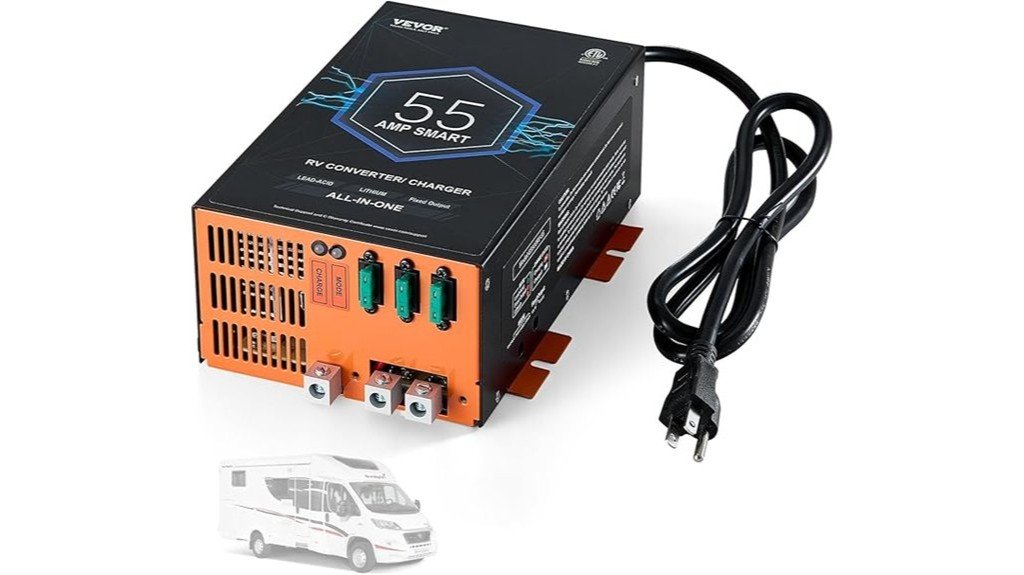
Choosing an RV converter is mostly about three things: matching your battery chemistry, having enough DC output for your 12V loads, and installing the unit safely. The VEVOR 55 Amp RV Converter, model GS800RV-55, converts 120V AC power to 12V DC and supports lead-acid and LiFePO4 charging modes. Its biggest strengths are the 55A maximum output, adjustable 13.0–16.5V fixed-voltage mode, and built-in protection features. Its main limitation is that you still need to confirm your RV wiring, battery setup, ventilation, and mounting space before treating it as a direct replacement.
Quick Verdict
Rating: Recommended with caveats
Best For: RV owners who need a standalone 55A converter for lead-acid or LiFePO4 batteries and want adjustable charging control.
Bottom Line: The VEVOR GS800RV-55 combines a useful 55A output with dedicated battery modes, adjustable fixed voltage, a temperature-controlled fan, and multiple electrical protections. It is a practical value-focused option, but it is not a universal drop-in replacement for every RV power center or wiring setup.
| Specification | Detail |
|---|---|
| Brand | VEVOR |
| Model | GS800RV-55 |
| Product type | Standalone RV power converter and battery charger |
| Input | 120V AC |
| Maximum output current | 55A |
| Maximum output power | 798W |
| Charging modes | Lead-acid, LiFePO4, and fixed-voltage mode |
| Fixed-voltage range | 13.0–16.5V DC adjustable |
| Listed battery range | 55–70Ah medium-capacity RV batteries |
| Dimensions | 9.72 × 6.69 × 3.54 in |
| Weight | 5.8 lb |
| Housing | Metal body with temperature-controlled cooling fan |
| Protection features | Short circuit, over-temperature, overload, low voltage, over voltage, and reverse polarity |
| Safety testing | Tested to ETL Standard |
| In the box | Converter, 3 spare fuses, screwdriver, fuse puller, and user manual |
Key Takeaways
- The GS800RV-55 delivers up to 55A and 798W from a 120V AC source for RV battery charging and 12V loads.
- You can choose dedicated lead-acid or LiFePO4 charging modes, plus a 13.0–16.5V adjustable fixed-voltage mode.
- The listing recommends it for medium-capacity 55–70Ah RV batteries, so larger banks may need a different charging plan.
- A metal housing, temperature-controlled fan, ETL testing, and six listed electrical protection functions support safer operation.
- Installation requires careful wiring, overcurrent protection, ventilation, and compatibility checks. Do not assume 55A converters are interchangeable only because their current rating matches.
What Is the VEVOR GS800RV-55?
The VEVOR GS800RV-55 is a standalone RV converter and battery charger. It takes 120V AC shore or generator power and supplies 12V DC power for charging a compatible battery bank and supporting RV devices such as lighting and other 12V loads.
The product is built around a maximum 55A output and three charging approaches: a lead-acid mode, a LiFePO4 mode, and a fixed-voltage mode you can adjust from 13.0 to 16.5V. VEVOR also lists four-stage smart charging in the product title, while the fixed-voltage setting gives you more manual control when your setup calls for a specific output.
At 9.72 × 6.69 × 3.54 inches and 5.8 pounds, it is compact enough for many RV electrical compartments, but mounting space is only one part of fit. You also need safe cable routing, suitable conductors and protection devices, access to airflow, and a charging profile that matches your battery manufacturer’s requirements.
Who Should Buy It?
Best For
- RV owners replacing or adding a standalone converter around the 55A output class.
- Users with compatible lead-acid or LiFePO4 batteries who want dedicated charging modes.
- Buyers who value an adjustable fixed-voltage option and built-in electrical protection features.
Skip If
- You need a direct replacement converter board made for a specific integrated RV power center.
- Your battery manufacturer requires a charging profile or current limit that this model cannot provide.
- You are not comfortable verifying high-current DC wiring and safe AC installation requirements.
Before You Buy: Match more than the amp rating. Confirm your battery chemistry, required charge voltage, existing converter type, available mounting space, cable capacity, fusing or breaker protection, and ventilation. A 55A label alone does not make two RV converters interchangeable.
Charging Modes and Performance
55A Maximum DC Output
The converter is rated for up to 55A of DC output with a maximum listed output power of 798W. That capacity can support battery charging while also supplying common 12V RV loads, but your real charging current will depend on battery state, battery chemistry, wiring resistance, connected loads, and the charging mode in use.
VEVOR lists the unit for medium-capacity batteries in the 55–70Ah range. Treat that range as the manufacturer’s published recommendation, not as a rule that every battery in that range will accept 55A continuously. Your battery or battery management system may specify a lower maximum charge current.
Lead-Acid, LiFePO4, and Fixed-Voltage Modes
The dedicated lead-acid and LiFePO4 modes are a major reason to choose this model over a basic fixed-output power supply. The verified product description lists a 12–14.6V charging range for both battery categories, while fixed-voltage mode is adjustable from 13.0 to 16.5V.
The adjustable mode adds flexibility, but it also puts more responsibility on you. Set voltage only within the limits specified by your battery maker and RV electrical equipment. An adjustable output is useful when you know the required target voltage, but it should not be treated as permission to raise voltage for faster charging.
Cooling and Heat Management
VEVOR uses a metal housing and a temperature-controlled fan. The fan is designed to run when internal temperature rises past its control threshold and stop when cooling demand falls. That approach can reduce unnecessary fan operation at lighter loads while still providing active cooling when the converter is working harder.
You still need clear airflow around the unit. Do not bury the converter behind loose gear, insulation, or other items that can block the fan or trap heat. Heat management matters more during sustained charging and when the RV compartment itself is already warm.
Installation and Usability
The compact chassis helps with placement, but this is still AC and high-current DC electrical work. Before installation, disconnect applicable AC and battery power sources and follow the VEVOR manual. If you are not confident identifying safe conductor sizing, overcurrent protection, grounding, polarity, and connection points, use a qualified RV technician or electrician.
The verified package includes the converter, three spare fuses, a screwdriver, a fuse puller, and a user manual. Those accessories are useful for setup and basic service, but they do not replace the cables, terminals, strain relief, fuses, breakers, or other installation hardware your RV may require.
Setup Tips Before First Use
- Confirm the battery chemistry and charging limits before selecting a charging mode.
- Measure the available compartment space against the 9.72 × 6.69 × 3.54-inch chassis.
- Plan airflow so the temperature-controlled fan is not blocked.
- Verify polarity before energizing the DC side.
- Use wiring and overcurrent protection sized for the expected current and cable length.
- After startup, check DC voltage at the battery and watch for abnormal heat, odor, noise, or voltage behavior.
Pro Tip: Take a clear photo of your existing converter label, wire locations, and terminal layout before removing anything. Compare the old unit’s output rating, battery support, dimensions, and connection method with the VEVOR GS800RV-55 before you start the swap.
Compatibility and Safety
The GS800RV-55 lists protection against short circuits, over-temperature conditions, overload, low voltage, over voltage, and reverse polarity. VEVOR also states that the converter is tested to ETL Standard. These protections are valuable, but they are backup safeguards rather than substitutes for correct installation.
Battery compatibility also needs a closer look than the words “lead-acid” or “lithium.” For LiFePO4 batteries, confirm the battery management system’s allowed charge current and voltage. For lead-acid batteries, confirm the battery maker’s recommended charging profile and ventilation requirements. If your RV has an integrated distribution center, confirm that a standalone converter is the right form factor before buying.
How It Performs in Real Use
For Routine Shore-Power Camping
When connected to 120V AC power, the converter can handle normal 12V loads while charging a compatible battery bank. The 55A ceiling gives it more headroom than lower-output 35A or 45A models, which can matter when lights, fans, pumps, and other DC loads are active during charging.
For LiFePO4 Battery Upgrades
The dedicated LiFePO4 mode is useful if you are moving away from a lead-acid system and want a converter that supports both chemistries. The important step is confirming that your lithium battery’s approved charge voltage and current match the converter’s behavior. A battery upgrade may also expose limits in older RV cables, disconnects, fuses, or distribution hardware.
For Generator Charging
A converter like this can turn generator-supplied AC into DC charging power, but the generator and AC circuit still need enough capacity for the converter and other RV loads operating at the same time. Avoid assuming the converter will always deliver its maximum output, especially when charging demand falls or other system limits come into play.
For Long-Term Use
The metal case, controlled fan, spare fuses, and listed protection functions are sensible durability features. Long-term reliability will still depend heavily on installation quality, dust and heat exposure, connection tightness, and keeping ventilation clear. Periodic visual checks for loose terminals, discoloration, debris, or unusual fan behavior are more useful than waiting for a charging problem to appear.
Pros and Cons
Pros
- 55A maximum output with a listed 798W maximum output power.
- Dedicated lead-acid and LiFePO4 charging modes.
- Adjustable 13.0–16.5V fixed-voltage mode for compatible applications.
- Temperature-controlled fan and metal housing support heat management.
- Six listed electrical protection functions plus ETL testing.
Cons
- Standalone format may not be a direct fit for integrated converter or power-center replacements.
- Adjustable voltage requires careful setup and should follow the battery maker’s limits.
- Safe installation still requires proper high-current DC wiring, protection, and ventilation.
Is It Worth the Price?
The VEVOR GS800RV-55 sits in the value-oriented part of the 55A converter market. Its appeal comes from combining lithium and lead-acid support, adjustable fixed voltage, a 55A maximum output, a controlled cooling fan, and several protection features in one standalone unit.
You get the most value if those exact features match your existing RV electrical system and battery plan. It is less attractive if you need a converter board designed to slide directly into a specific WFCO, Parallax, or other integrated power center. In that case, paying more for a purpose-built replacement section may save installation work and compatibility uncertainty.
How It Compares to Alternatives
The WFCO WF-9855-AD is another 55A deck-mount converter, but it focuses on automatic battery-chemistry detection rather than VEVOR’s adjustable 13.0–16.5V fixed-voltage control. The Progressive Dynamics PD4655V is a 55A replacement section intended for certain existing RV power centers, making it a better comparison when you need a form-factor-specific upgrade rather than a standalone converter. The VEVOR makes the most sense when you want a standalone 55A unit with dedicated lead-acid and LiFePO4 modes plus adjustable fixed voltage.
Frequently Asked Questions
Is the VEVOR GS800RV-55 compatible with lithium batteries?
Yes. The verified listing includes a dedicated LiFePO4 charging mode as well as a lead-acid mode. You should still confirm your battery manufacturer’s allowed charge voltage and current before installation.
What is the adjustable voltage range?
Fixed-voltage mode is adjustable from 13.0 to 16.5V DC. Use that range only within the safe limits of your battery and connected RV equipment.
Can it replace any existing 55A RV converter?
No universal fit is stated. The VEVOR is a standalone converter, so you need to compare your existing unit’s form factor, wiring method, output rating, battery support, dimensions, and protection requirements before treating it as a replacement.
What battery size does VEVOR recommend for this model?
The product listing describes the 55A model as ideal for medium-capacity RV batteries from 55Ah to 70Ah. Battery capacity alone is not enough to determine compatibility, so also check the battery’s maximum charge current and voltage limits.
Does it have app control or remote monitoring?
The verified listing does not advertise app control or remote monitoring for this model. If remote status or wireless control is a must-have feature, confirm that requirement before purchase.
What comes in the box?
The listed package includes one RV converter, three spare fuses, one screwdriver, one fuse puller, and one user manual. Installation cables and other RV-specific electrical hardware are not listed as included.
What is the biggest installation mistake to avoid?
Do not choose or wire the converter based only on the 55A rating. Confirm polarity, conductor capacity, overcurrent protection, battery charging limits, ventilation, and the correct AC and DC connection points before energizing the system.
Who should skip this converter?
Skip it if you need a plug-in replacement board for a specific power center, require remote monitoring, or cannot confirm that your battery and wiring are suitable for this converter. A model designed for your existing power-center chassis may be the easier choice.
The Bottom Line
The VEVOR GS800RV-55 is a strong value-focused choice when you need a standalone 55A RV converter with lead-acid and LiFePO4 modes, adjustable fixed voltage, active cooling, and multiple protection features. Buy it when those specs match your battery and RV electrical layout; skip it when you need a chassis-specific replacement or cannot verify safe wiring and charging compatibility.