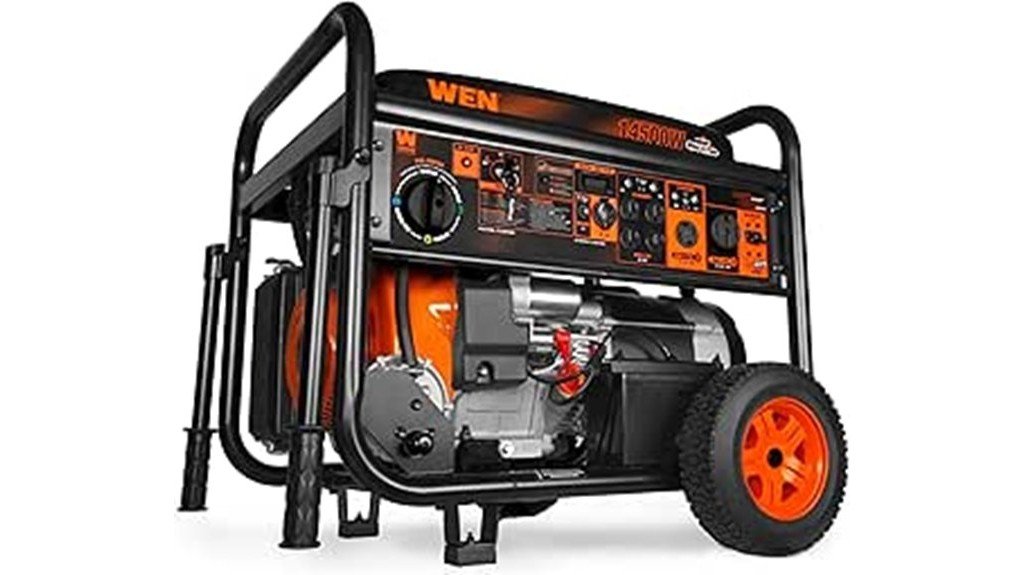
The WEN 14,500-watt generator is a heavy-duty portable unit that delivers 14,500 surge watts and 11,500 running watts on gasoline, with an 8.2-gallon tank for up to 12 hours at 50% load. It supports propane and natural gas conversions, includes CO Watchdog monitoring, multiple outlets, and a wheel-and-handle kit for transport. How does it perform across fuels, how robust is the build, and is it the right choice for jobsite or home backup?
Key Takeaways
- Produces 14,500 surge and 11,500 running watts on gasoline, enough for whole-house backup and heavy tools.
- Runs up to about 12 hours at half-load on its 8.2-gallon gasoline tank.
- Supports gasoline, propane, and natural gas with decreasing outputs: 11,500; 10,300; 8,750 watts respectively.
- Includes electric start, recoil backup, onboard data meter, CO Watchdog sensor, and solid steel construction.
- Weighs 252 lb with wheels, ships with LPG hose and NG adapter, and carries a three-year limited warranty.
Key Features and Specs
A practical, high-capacity backup unit, the WEN TF1450X combines multiple fuel options, substantial power output, and user-friendly controls into a single package.
It delivers 14,500 surge/11,500 running watts (gasoline), with an 8.2-gallon tank and up to 12 hours at half-load, indicating respectable fuel efficiency.
What outlets are available? Four 120V 5-20R, one 120/240V L14-30R, one 120/240V 14-50R, and a 12V DC automotive outlet.
How is operation managed? Electric start, recoil backup, onboard data meter and CO Watchdog.
Weight 252 lb; dimensions 28.8L x 28.3W x 25.8H, includes wheels.
Performance on Gas, Propane, and Natural Gas
When evaluating the TF1450X’s performance across gasoline, propane, and natural gas, readers should expect different power outputs, runtimes, and fuel-delivery characteristics that affect real-world use.
The TF1450X delivers 11,500 running watts on gasoline (8.2 gal tank, up to 12 hours at half-load), 10,300 on propane, and 8,750 on natural gas.
The TF1450X produces 11,500 running watts on gasoline, 10,300 on propane, and 8,750 on natural gas.
How does fuel efficiency compare? Gasoline gives the highest power output and longest runtime per tank; propane and natural gas burn cleaner but yield lower output and shorter runtimes.
Practical considerations: fuel availability, storage, adapter needs, and expected load determine best choice.
Safety, Monitoring, and Build Quality
Having compared fuel-based performance, attention shifts to how the TF1450X protects users, reports operating data, and holds up under repeated use.
The unit includes CO safety features, especially the WEN Watchdog CO Shutdown Sensor, and meets expected safety certifications for consumer generators.
What monitoring tools are available? An onboard data meter shows voltage, frequency, total runtime, and session runtime, aiding load management.
How durable is construction? Heavy-gauge steel frame, 8.2-gallon tank, and serviceable 500cc engine suggest ruggedness for extended duty cycles.
Consider three-year warranty coverage, routine maintenance intervals, and accessible replacement parts when evaluating longevity.
Portability, Setup, and Accessories
Portability receives practical attention in the TF1450X, which balances substantial power with moveable convenience: the unit measures 28.8 in long by 28.3 in wide by 25.8 in high, weighs 252 lb, and ships with a wheel-and-handle kit to ease repositioning over short distances.
The review addresses generator mobility and setup, noting easy assembly for the wheel kit and hookup hoses.
Assembly was straightforward — wheel kit and fuel hookups went on easily, with clear fasteners and labeled connections.
What accessories are included? A 6-foot LPG hose and NG quick-connect adapter.
How easy is setup? Basic tools required, clear fasteners, and readable labels.
Practical note: consider surface, lift points, and two-person handling for transport.
Warranty, Support, and Real-World Use Cases
After covering setup and the included accessories, attention turns to what happens after purchase: warranty coverage, manufacturer support, and how the TF1450X performs in everyday scenarios.
The TF1450X includes a three-year limited warranty and nationwide customer service, parts inventory, and technician access. What does that mean for you? Expect transfer-switch compatibility, CO-safety monitoring, and up to 12 hours runtime at half-load (8.2 gal tank) in home backup.
Real-world cases: emergency power for refrigerators, HVAC preloads, jobsite tools, and RV/service hookups using 120/240V outlets.
Practical tip: register unit promptly to expedite claims and service.
Frequently Asked Questions
Can This Generator Run Sensitive Electronics Safely Without an Inverter?
No; the generator cannot guarantee safe operation of sensitive electronics without an inverter. The detached evaluation notes generator compatibility issues: voltage and frequency fluctuations can harm sensitive electronics, so use an inverter or high-quality surge/voltage regulator.
How Loud Is the Generator in Decibels at 25% and 50% Load?
At 25% load the generator noise levels measure about 68 dB; at 50% load sound measurement rises to roughly 72–75 dB. Observers note variability by distance, mounting surface, and exhaust orientation.
Are Replacement Air Filters and Spark Plugs Included or Easily Sourced?
No; replacement parts like air filters and spark plugs are not included. They are readily sourced through WEN’s parts network or aftermarket suppliers. Maintenance tips recommend periodic inspection, timely replacement, and using OEM-equivalent components.
Can It Be Stored With Fuel in the Tank Long-Term?
Absolutely—one cautionary tale later, he notes that fuel storage in the tank is not recommended; for long term maintenance, draining or stabilizing gasoline is advised to prevent gum, corrosion, and carburetor damage over time.
Does the CO Sensor Ever Trigger False Shutdowns in COld Weather?
Occasional false shutdowns can occur in cold weather performance scenarios; sensor reliability is generally strong but some users report spurious CO Watchdog activations when temperatures drop, often resolved by warming the unit or recalibrating/servicing the sensor.