“`html
Disclosure: As an Amazon Associate, we earn from qualifying purchases. If you click a link on this page and make a purchase, we may receive a small commission at no extra cost to you.
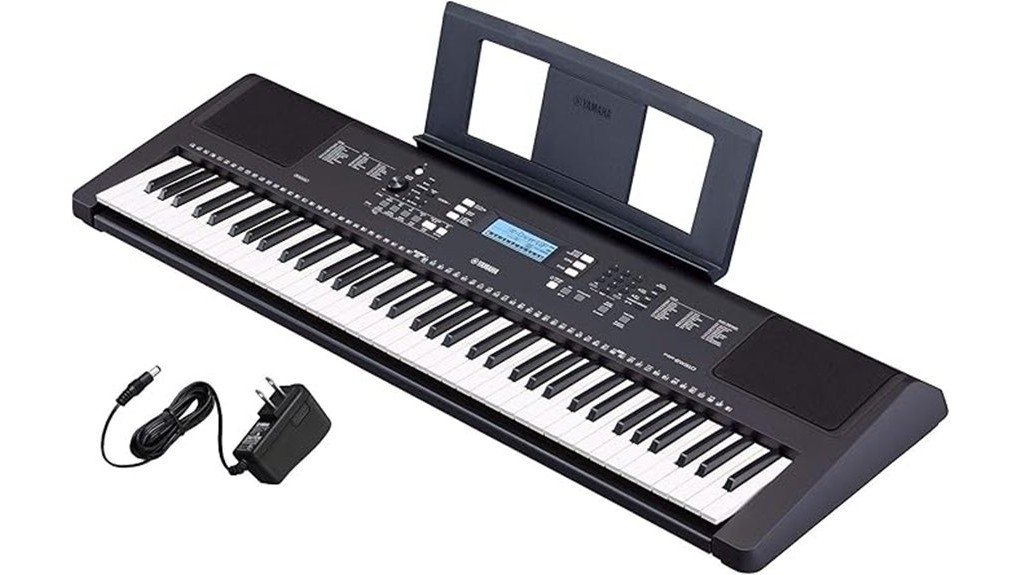
Buying a first keyboard gets tricky when 61 keys feel too small, but full-size digital pianos feel too large or expensive. The Yamaha PSR-EW310 sits in the middle with 76 touch-sensitive keys, hundreds of sounds, built-in lessons, and a portable design.
This review explains who should buy it, where it performs well, and where its beginner-friendly design has limits. You will also see the key specs that matter before you decide whether the Yamaha PSR-EW310 is worth buying.
Our Verdict
Rating: 8/10
Best For: Beginners, returning players, and home musicians who want more range than a 61-key keyboard without moving to a full 88-key digital piano.
Bottom Line: The Yamaha PSR-EW310 gives you 76 touch-sensitive keys, 622 voices, Yamaha lesson tools, USB audio/MIDI, and smart accompaniment in a lightweight keyboard. You give up weighted keys, premium speakers, and the more advanced control found on arranger or stage keyboards.
| Specification | Detail |
|---|---|
| Brand | Yamaha |
| Model | PSR-EW310 |
| Keys | 76 organ-style touch-sensitive keys |
| Touch Response | Soft, Medium, Hard, Fixed |
| Tone Engine | AWM Stereo Sampling |
| Polyphony | 48 notes |
| Voices | 622 total voices, including 11 Super Articulation Lite voices |
| Styles | 205 auto accompaniment styles |
| Preset Songs | 154, including Touch Tutor, Chord Study, and Chord Progression content |
| Connectivity | USB TO HOST, AUX IN, PHONES/OUTPUT, sustain pedal input |
| Speakers | 12 cm x 2 speakers with 2.5 W + 2.5 W amplification |
| Dimensions | 1151 mm x 118 mm x 369 mm, or 45-5/16 in x 4-5/8 in x 14-1/2 in |
| Weight | 5.4 kg, or 11 lb 14 oz, not including batteries |
| Power | PA-130, PA-3C, equivalent Yamaha-recommended adapter, or six AA batteries |
| Included Accessories | Music rest; downloadable song book available from Yamaha |
What Is the Yamaha PSR-EW310?
The Yamaha PSR-EW310 is a 76-key portable keyboard made for beginners, casual players, and home musicians who want more playing range than a compact 61-key model. It is not an 88-key weighted digital piano, and it is not built like a professional stage keyboard. Its strength is giving you a wide feature set in a lighter, more affordable format.
The headline feature is the combination of 76 touch-sensitive keys and Yamaha’s AWM Stereo Sampling sound engine. You get 622 voices, 205 accompaniment styles, 48-note polyphony, and 11 Super Articulation Lite voices that add realistic details to guitar, strings, and other acoustic-style sounds.
At 11 lb 14 oz without batteries, the PSR-EW310 is easy to move between a bedroom, living room, classroom, or small practice space. The tradeoff is that the chassis and keybed feel like a portable keyboard, not a furniture-style piano.
Who Should Buy the Yamaha PSR-EW310?
Who It’s For
- Beginners who want 76 keys so they can practice two-handed parts with more room than a 61-key keyboard allows.
- Home musicians who want many Yamaha sounds, 205 styles, and simple recording without buying a workstation.
- Students who will use built-in lessons such as Keys to Success, Touch Tutor, Chord Study, and Chord Progression.
Who Should Skip It
- Piano-focused players who need fully weighted hammer-action keys for classical technique or graded piano practice.
- Performers who need powerful onboard speakers, metal construction, or deep live-performance controls.
- Buyers who want a simple keyboard with only a few sounds and no menus to learn.
Detailed Features
Keyboard Feel and Playing Range
The 76-key layout is the biggest reason to choose the PSR-EW310 over many beginner keyboards. You get more notes for bass lines, split sounds, and two-handed practice while keeping the instrument smaller than an 88-key model.
The keys are organ-style and touch-sensitive, with Soft, Medium, Hard, and Fixed response settings. That means your playing can get louder or softer based on how hard you strike the keys, but the action will not feel like an acoustic piano.
Sound Engine and Voices
Yamaha uses AWM Stereo Sampling for the PSR-EW310, and the keyboard includes 622 voices. That library covers piano, organ, guitar, bass, strings, brass, woodwinds, drums, percussion, and synth sounds.
The 11 Super Articulation Lite voices are especially useful when you want more expressive guitar or string parts. For example, certain voices can add performance details such as fret noise or string-style articulation, which makes practice and arranging feel less flat.
The 48-note polyphony is enough for most beginner and casual playing. Heavy layering, sustain pedal use, and accompaniment at the same time can still push the limit, so advanced arrangers may want a higher-polyphony model.
Styles, Smart Chord, and Backing Tracks
The PSR-EW310 includes 205 auto accompaniment styles. These styles add rhythm, bass, and chord backing when you play with your left hand, which helps you practice timing and song structure.
Smart Chord is helpful when you are still learning chord shapes. It lets you produce fuller chord harmony with simplified fingering, while Multi Finger mode gives you a more traditional chord-entry option as your skills improve.
Lessons and Learning Tools
Yamaha includes several lesson functions that make the PSR-EW310 stronger as a first serious keyboard. Keys to Success breaks songs into smaller steps, while Touch Tutor helps you see and improve how hard you are playing the keys.
The keyboard also includes Chord Dictionary, Chord Study, Chord Progression, Phrase Repeat, and A-B Repeat. These tools are useful because they focus on real practice problems, not just demo songs.
Connectivity and App Use
USB TO HOST supports two-way MIDI and digital audio transfer, so you can connect the PSR-EW310 to a computer or compatible smart device. That makes it more useful for learning apps, simple recording, and music creation than a keyboard with only a headphone jack.
The AUX IN port lets you connect an external audio source, and the Melody Suppressor feature can reduce lead melody parts from compatible audio. You also get a PHONES/OUTPUT jack for headphones or external speakers and a sustain pedal input for more expressive playing.
Speakers, Portability, and Build
The built-in speaker system uses two 12 cm speakers powered by 2.5 W + 2.5 W amplification. That is enough for home practice, lessons, and small rooms, but external speakers will sound better for group playing or performance.
The keyboard weighs 5.4 kg without batteries, so it is practical to carry around the house or take to lessons. The lighter cabinet is convenient, but it also explains why this model does not feel as rugged as a heavier stage keyboard.
How It Performs in Real Use
For Beginner Practice
The 76 keys give you more room for left-hand bass and right-hand melody than a 61-key beginner keyboard. Touch sensitivity also helps you build dynamic control from the start, which matters when you move from simple songs to more expressive playing.
For Home Songwriting
The 622 voices and 205 styles make the PSR-EW310 useful for sketching ideas. You can layer voices, use arpeggios, record up to 5 songs with 2 tracks, and connect over USB when you want to move ideas into software.
For Lessons and Family Use
Duo mode splits the keyboard into two matching playing ranges, which is useful when a teacher and student share one instrument. The backlit LCD and built-in lesson modes also make it easier to practice without needing a tablet for every exercise.
Pros and Cons
Pros
- 76 touch-sensitive keys give you more playing range than most 61-key beginner keyboards.
- 622 voices and 11 Super Articulation Lite voices provide a large sound library for practice and arranging.
- 205 accompaniment styles and Smart Chord make it easier to play with backing parts.
- USB TO HOST supports MIDI and digital audio transfer for computers and compatible smart devices.
- Built-in lessons include Keys to Success, Touch Tutor, Chord Study, and Chord Progression.
Cons
- The organ-style keys are not weighted, so piano-focused students may outgrow the feel.
- 2.5 W + 2.5 W speakers are fine for practice but limited for performance.
- The large feature set can feel busy when you only want basic piano sounds.
Is It Worth the Price?
The Yamaha PSR-EW310 is strongest as a value pick for learners who want more than a basic starter keyboard. The 76-key range, USB audio/MIDI, 622 voices, and Yamaha learning tools make it a smart buy for home practice and skill building.
You get the most value when you plan to use the extra features, especially styles, Smart Chord, Duo mode, recording, and USB connectivity. Buyers who only want a few piano tones may be happier with a simpler model, while serious piano students should consider an 88-key weighted digital piano.
How It Compares to Alternatives
The Yamaha PSR-EW320 is the newer model to consider when you want a more current 76-key Yamaha portable keyboard. The Yamaha PSR-E373 is also worth considering when you like the PSR feature set but can live with 61 keys instead of 76.
Casio’s CT-X700 is a common alternative for buyers who want a 61-key keyboard with a large sound set and accompaniment features. The PSR-EW310 remains the better fit when your priority is a wider 76-key layout in a portable Yamaha keyboard.
Frequently Asked Questions
Is the Yamaha PSR-EW310 good for beginners?
Yes. The PSR-EW310 is beginner-friendly because it combines touch-sensitive keys, built-in lessons, Smart Chord, Duo mode, and a backlit LCD. The 76-key layout also gives you more room to grow than a smaller 61-key keyboard.
Does the Yamaha PSR-EW310 have weighted keys?
No. It has 76 organ-style touch-sensitive keys, not weighted hammer-action keys. That is fine for portable keyboard playing, but piano-focused students may eventually need an 88-key weighted digital piano.
Can you connect the Yamaha PSR-EW310 to a computer?
Yes. USB TO HOST supports two-way MIDI and digital audio transfer. That makes the keyboard useful for compatible music software, recording, and learning apps.
Can you connect external speakers or headphones?
Yes. The PHONES/OUTPUT jack can be used for headphones or audio output. External speakers are helpful when the built-in 2.5 W + 2.5 W speaker system is not loud enough for your room.
Does the Yamaha PSR-EW310 come with a stand or bench?
Yamaha’s official accessory list confirms a music rest and downloadable song book. Some Amazon bundles may add a power supply or stand, but a bench is not part of the standard Yamaha spec, so check the exact seller box contents before ordering.
How is the Yamaha PSR-EW310 powered?
The keyboard can run from a Yamaha-recommended PA-130 or PA-3C AC adapter, or from six AA batteries. Adapter and bundle contents can vary by listing, so confirm what is included on the product page before checkout.
The Bottom Line
The Yamaha PSR-EW310 earns its 8/10 rating because it gives beginners a wide 76-key layout, touch response, 622 voices, useful lessons, accompaniment styles, and USB connectivity in one portable package. It is best for learning, home practice, and casual music creation.
Skip it when you need weighted piano keys, stronger speakers, or a pro-level performance keyboard. For most beginners who want room to grow without buying a full digital piano, the PSR-EW310 is a strong, practical choice.
Ready to Buy?