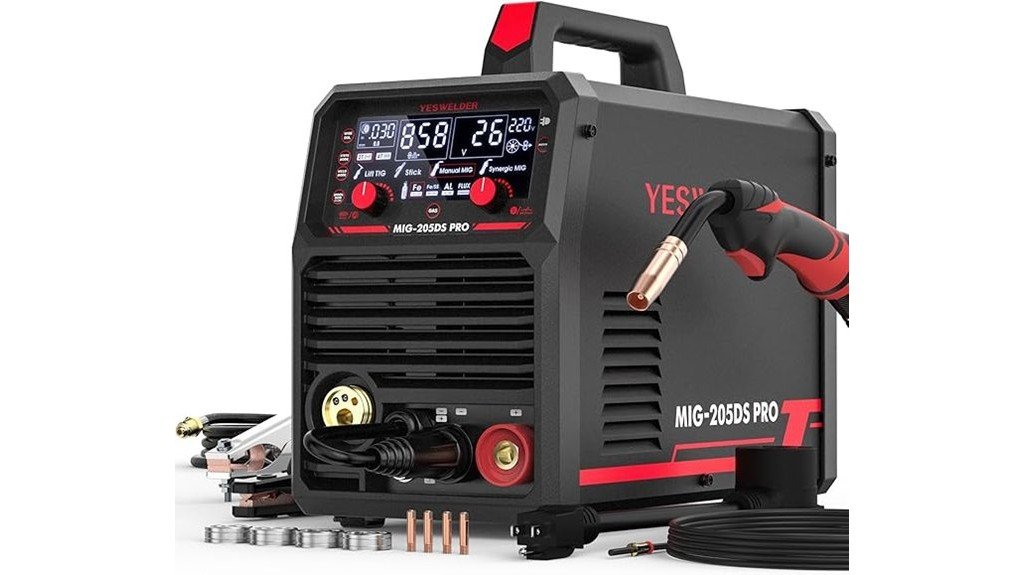
Choosing one welder for MIG, flux-core, stick, aluminum MIG, and occasional TIG work can save space, but only if the machine is flexible without becoming frustrating to set up. The YESWELDER MIG-205DS PRO is a dual-voltage multiprocess welder built around that idea, with synergic and manual MIG controls, up to 205 A output on 220 V, and support for a spool gun and lift TIG. Its biggest strength is the range of work it can cover in a home garage or small fabrication space. Its main limitation is that some of the capability advertised as part of the broader multiprocess package depends on optional accessories.
Last checked: September 13, 2026 (Asia/Dhaka) · Sources checked: YESWELDER product specifications and Amazon product identity
Disclosure: As an Amazon Associate, we earn from qualifying purchases. This does not affect what you pay.
What it is: a 110/220 V multiprocess welder with MIG, flux-cored, lift TIG, and stick processes, plus spool-gun compatibility for aluminum MIG, an LED display, and synergic or manual MIG control.
Quick Verdict
Quick Verdict
Rating: 8.5/10, Recommended with caveats
Best For: DIY welders and small-shop users who want dual-voltage MIG plus flux-core, stick, and occasional lift TIG in one machine.
Bottom Line: You get strong process flexibility, a 205 A maximum output on 220 V, and useful synergic MIG controls in a compact 22.7 lb machine. You should still budget for optional equipment if you want spool-gun aluminum or lift TIG, and lift TIG here is not a substitute for a full AC/DC TIG setup.
Pros
- Runs on 110 V or 220 V, with up to 160 A MIG output on 110 V and 205 A on 220 V.
- Supports gas MIG, flux-cored, stick, lift TIG, and spool-gun aluminum MIG workflows.
- Synergic MIG can match voltage and wire feed settings, while manual MIG keeps more control available.
- Official specifications list a 60% duty cycle at 205 A in MIG mode on 220 V.
- The current machine weight is 22.7 lb, which makes moving it around a garage more realistic than older package-weight figures suggest.
Cons
- A spool gun is supported but is not listed in the standard machine package, so aluminum MIG may require another purchase.
- The WP-17V lift TIG torch is optional, and the machine does not support a TIG foot pedal.
- Lift TIG is DC lift-start only, so it is not the right choice if you need AC TIG for aluminum TIG work.
- You still need to manage polarity, wire type, gas, and consumables correctly when you switch processes.
Before You Buy: The “5-in-1” description counts spool-gun MIG as a separate workflow. The core machine supports MIG, flux-cored, lift TIG, and stick, while spool-gun aluminum MIG and lift TIG require the correct optional accessories.
Key Specs
| Specification | Detail |
|---|---|
| Brand | YESWELDER |
| Model / ASIN | MIG-205DS PRO / B07TVCWDGW |
| Product type | Dual-voltage multiprocess inverter welder |
| Input voltage | 110 V / 220 V ±10%, 50/60 Hz |
| Processes | MIG, flux-cored, lift TIG, stick, plus spool-gun MIG support |
| MIG output | 30-160 A at 110 V; 30-205 A at 220 V |
| Lift TIG output | 15-140 A at 110 V; 15-205 A at 220 V |
| Stick output | 20-140 A at 110 V; 20-205 A at 220 V |
| MIG duty cycle | 60% at 205 A on 220 V; 100% at 158 A on 220 V |
| Dimensions & weight | 16.93 × 8.27 × 14.17 in; 22.7 lb |
| Wire compatibility | ER70S-6, E71T, ER308L, ER4043, ER5356; 0.023, 0.030, 0.035, and 0.045 in diameters |
| Gas options | 100% CO2, mixed gas, or 100% argon depending on process and material |
| Display | LED with wire-feed display during adjustment and current display during welding |
| Included accessories | 10 ft MIG gun, 10 ft electrode holder, 10 ft work clamp, 220-to-110 V adapter, drive rollers, contact tips, graphene liner, gas hose, and user manual |
| Certifications | CE, ETL, UL |
| Warranty | Manufacturer lists 2 years for purchases on or after July 1, 2026 |
Package contents, seller bundles, and availability can change. Check the Amazon page before buying if a specific accessory is essential to your setup.
What Is the YESWELDER MIG-205DS PRO?
The MIG-205DS PRO is a compact inverter welder for users who want several common welding processes without dedicating floor space to several machines. On standard 110 V power, MIG output reaches 160 A. On 220 V, the machine reaches 205 A in MIG, lift TIG, and stick modes.
For MIG work, you can use synergic control to let the machine coordinate key settings or switch to manual MIG when you want direct control over voltage and wire feed. The official specification also supports a spool gun for aluminum MIG, while lift TIG uses an optional WP-17V torch and does not support a foot pedal.
How It Performs in Real Use
Garage MIG Fabrication
For brackets, frames, repairs, and light fabrication, the synergic MIG mode is the feature most likely to save you setup time. You can select the relevant wire and material settings, let the machine establish a starting point, and then fine-tune voltage within the supported ±3 V range. Manual MIG remains useful when your joint fit-up, travel speed, or personal technique calls for a different setting.
Outdoor Flux-Core Repairs
Flux-cored welding gives you a practical gasless option when wind makes shielding gas inconvenient or when you need a faster outdoor repair setup. The machine supports E71T wire and dedicated flux-cored operation. You still need to confirm polarity and choose the correct drive roller and wire size before welding.
Stick Welding for Repair Work
Stick mode extends the machine beyond wire welding when you need a simple electrode setup for repair work. Output reaches 140 A on 110 V and 205 A on 220 V. The current manufacturer specification lists E6013 and E7018 electrode support, so you should match electrode type and diameter to the machine manual and the material you are joining.
Aluminum MIG and Occasional Lift TIG
For aluminum MIG, the machine supports ER4043 and ER5356 wire with 100% argon. You can feed aluminum through the supported setup, including a spool gun workflow, but the spool gun is not part of the standard machine package shown by the manufacturer. Lift TIG is better treated as an extra capability for steel and stainless rather than the main reason to buy the welder, because it is lift-start DC TIG with no foot-pedal support.
Performance & Features
Dual Voltage and 205 A Output
The 110/220 V input is one of the most useful features if your work moves between a home outlet and a properly wired 220 V shop circuit. On 110 V, MIG is rated from 30 to 160 A. On 220 V, the MIG range increases to 30 to 205 A, giving you more output headroom for heavier work.
The official recommended thickness figures reach up to 3/16 in for MIG or flux-core on 110 V and up to 1/2 in on 220 V. Those figures are a machine capability reference, not a guarantee for every joint. Joint design, fit-up, metal condition, wire, gas, travel speed, and multi-pass technique still matter.
Synergic MIG With Manual Fine-Tuning
Synergic MIG is useful when you want a reasonable starting point without building every setting from scratch. The machine can match voltage and wire-feed behavior based on your selected setup, then gives you a ±3 V fine-tuning range. That combination is friendlier for newer users than a fully manual panel while still leaving room to adjust the arc.
Manual MIG is available when you want direct control. The LED display also shows wire-feed speed during setup and actual current while you weld, which makes it easier to repeat settings after you find a combination that works.
Wire, Gas, and Consumable Flexibility
The official wire list covers common mild-steel, stainless, flux-core, and aluminum choices: ER70S-6, E71T, ER308L, ER4043, and ER5356. Supported wire diameters include 0.023, 0.030, 0.035, and 0.045 in. That range lets you set the machine up for several typical garage and light-fabrication jobs without being locked to one wire size.
Gas choice depends on your process and material. The machine supports 100% CO2, mixed shielding gas, and 100% argon in the appropriate workflows. Aluminum MIG calls for 100% argon in the manufacturer guidance.
Duty Cycle and Cooling
At 220 V, MIG is rated at a 60% duty cycle at 205 A and 100% at 158 A. Lift TIG is also listed at 60% at 205 A, while stick is listed at 60% at 205 A and 100% at 139 A. The machine uses continuous fan cooling.
Setup Tips Before First Use
Choose the process first, then match the wire, gas, drive roller, contact tip, and polarity. For aluminum MIG, use the correct aluminum-wire setup and 100% argon.
When 220 V is available from a properly installed circuit, use it for jobs that need the higher output range. The included adapter gives you 110 V flexibility, but the machine cannot deliver the same maximum MIG current on 110 V as it can on 220 V.
Pro Tip: Save a simple note for successful wire, gas, voltage, and wire-feed combinations after test welds. The display and manual control make it easier to return to a known-good starting point on repeat jobs.
Compatibility and Safety
Welding equipment can expose you to electric shock, UV and infrared radiation, hot metal, sparks, fumes, fire risk, and high sound levels. Use appropriate welding PPE, ventilation or fume control, fire-safe work practices, and electrical protection. Follow the YESWELDER manual and the safety instructions for your wire, gas, electrodes, and work environment.
The manufacturer lists overheat, overcurrent, and undervoltage protection, along with CE, ETL, and UL certifications. Those features do not replace safe wiring or a suitable circuit. If you are unsure about receptacle, breaker, extension-cord, grounding, or 220 V circuit requirements, use a qualified electrician rather than guessing.
Who Should Buy It?
Best For
- DIY welders who want MIG, flux-core, stick, and occasional lift TIG in one compact machine.
- Small-shop fabricators who can use 220 V for higher output but still want 110 V flexibility.
- Buyers who want synergic MIG for easier setup while keeping a manual MIG mode available.
Skip If
- You need AC TIG, high-frequency TIG starts, or foot-pedal TIG control.
- You want every process accessory included in the base package with no add-on purchases.
- You need an industrial production machine with a heavier-duty service profile and local dealer support as your top priority.
Is It Worth the Price?
The MIG-205DS PRO fits best as a value-focused multiprocess machine rather than a premium industrial system. You are paying for process range, dual voltage, a 205 A ceiling on 220 V, synergic and manual MIG control, and a relatively portable 22.7 lb chassis.
You get the most value if you will use several modes. If you only need MIG or advanced TIG control, a more specialized machine may be a better fit.
How It Compares to Alternatives
The Hobart Multi-Handler 200 is another 120/240 V multiprocess option with MIG, flux-core, stick, and DC TIG, but it is positioned as a more premium machine with a color LCD and established dealer support. The Lincoln Electric POWER MIG 215 MPi moves further toward a professional shop setup and adds features such as a built-in TIG solenoid and foot-pedal support.
The Forney 190 MP is another dual-voltage multiprocess competitor with spool-gun capability. The YESWELDER makes the most sense when compact size, 205 A output on 220 V, and broad garage-use flexibility matter most.
Frequently Asked Questions
Does the YESWELDER MIG-205DS PRO include a spool gun or TIG torch?
The standard manufacturer package does not list a spool gun or the optional WP-17V lift TIG torch. If either process matters to you, confirm the exact Amazon bundle before ordering because package configurations can vary.
What is the practical advantage of 110/220 V dual voltage?
You can use 110 V when that is the available power source, then move to 220 V when you need more output. MIG output rises from a 160 A maximum on 110 V to 205 A on 220 V.
Can the MIG-205DS PRO weld aluminum?
Yes, the manufacturer supports aluminum MIG with ER4043 or ER5356 wire and 100% argon. A spool gun is supported, but it is not listed as part of the standard welder package.
Does it have synergic and manual MIG?
Yes. Synergic MIG can coordinate the starting settings and allows ±3 V voltage fine-tuning, while manual MIG lets you adjust voltage and wire feed more directly.
What wire sizes and wire types can it use?
The current specification lists 0.023, 0.030, 0.035, and 0.045 in wire diameters. Supported wire types include ER70S-6, E71T, ER308L, ER4043, and ER5356.
Is the lift TIG mode a replacement for a dedicated TIG welder?
Not for buyers who need advanced TIG control. This machine uses DC lift-start TIG, the torch is optional, and foot-pedal control is not supported, so AC aluminum TIG and more precise TIG workflows call for a dedicated machine.
What warranty does the MIG-205DS PRO have?
YESWELDER currently lists a 2-year manufacturer warranty for purchases made on or after July 1, 2026. Check the current seller and manufacturer terms when you buy because warranty conditions can change.
Who should skip this welder?
Skip it if you mainly need AC TIG, high-frequency TIG, foot-pedal control, or an industrial dealer-supported platform. It is better suited to mixed garage, DIY, maintenance, and light-fabrication work where process flexibility matters.
The Bottom Line
The YESWELDER MIG-205DS PRO is a strong fit when you want one 110/220 V machine for MIG, flux-core, stick, aluminum MIG expansion, and occasional lift TIG. Its main strengths are the 205 A maximum output on 220 V, synergic plus manual MIG control, broad wire compatibility, and 22.7 lb chassis, while its main limitation is that the full multiprocess experience can require optional accessories.
Buy it if you expect to use several processes and value a compact garage-friendly setup. Skip it if advanced TIG control, AC TIG, or a premium industrial service platform matters more than versatility.
- Buy if: you want a dual-voltage multiprocess welder and will actually use more than one mode across the year.
- Skip if: you want a dedicated TIG experience or do not want to purchase optional process accessories.
Always confirm current price, warranty terms, and package contents on the live Amazon page before purchase.