Disclosure: As an Amazon Associate, we earn from qualifying purchases. If you click a link on this page and make a purchase, we may receive a small commission at no extra cost to you.
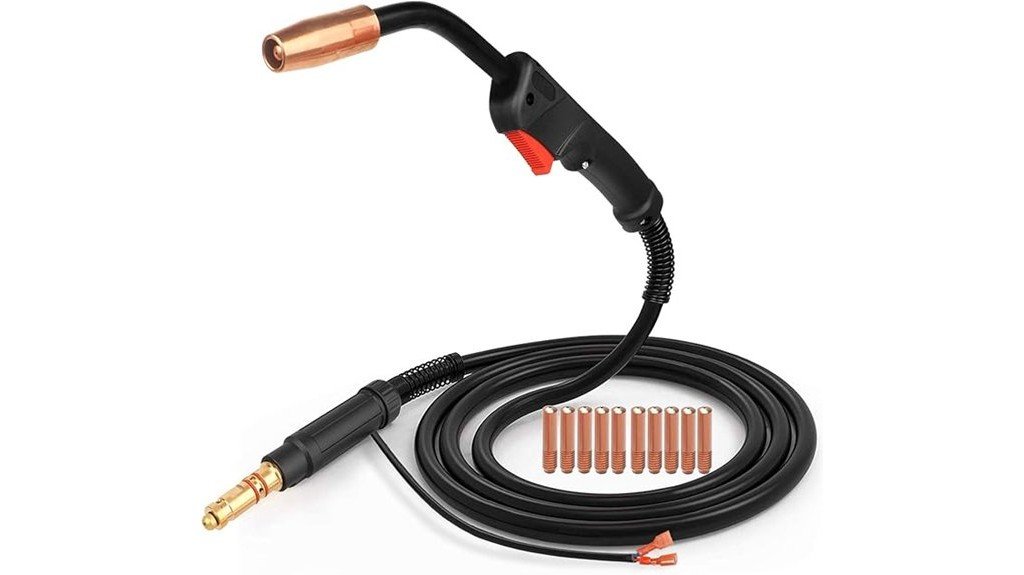
A worn MIG welding gun can cause wire-feed problems, poor arc starts, and delays in your workshop. Replacing the original Lincoln Magnum 100L can be expensive, especially when you own an older compact welder. The Zinger MIG Welding Gun Torch offers a lower-cost replacement with a 10-foot cable, Lincoln K530-5-style connection, and 10 included contact tips. This review explains its compatibility, features, setup requirements, and limitations so you can decide if it is right for your welder.
Quick Verdict
Rating: Recommended with caveats for compatible, light-duty MIG welders.
Best For: Owners of compatible Lincoln SP, Weld-Pak, MIG Pak, and Pro-MIG machines who need an affordable replacement for a K530-5-style gun.
Bottom Line: The Zinger MIG Torch combines a practical 10-foot cable with standard-style consumables and 10 spare contact tips. Its main limitation is compatibility: you must confirm your machine’s gun connection, wire size, and operating requirements before buying. Its exact duty cycle and long-term durability have not been independently verified.
Zinger MIG Welding Gun Torch Specifications
| Specification | Detail |
|---|---|
| Brand | Zinger |
| Product Type | Replacement MIG welding gun and cable assembly |
| Amazon ASIN | B08862JVVJ |
| Replacement Target | Lincoln Magnum 100L K530-5-style welding gun |
| Advertised Amperage | 100 amps |
| Duty Cycle | Not independently confirmed for the Zinger gun |
| Cable Length | 10 feet (approximately 3 meters) |
| Advertised Wire Range | .030 to .035 inch (0.8 to 0.9 mm) |
| Contact Tip Style | 11-series-style MIG contact tips |
| Nozzle Style | 21-series-style gas nozzles |
| Advertised Liner Reference | 35-40-15; confirm liner sizing before replacement |
| Rear Connection | Lincoln-style gun connector with two trigger-control leads |
| Advertised Compatible Families | Selected Lincoln SP, MIG Pak, Pro-MIG, Weld-Pak, and Power MIG models |
| Included Assembly | 1 replacement welding gun with 10-foot cable |
| Extra Contact Tips | 5 x 11-30 (.030 inch) and 5 x 11-35 (.035 inch) |
| Intended Applications | DIY fabrication, sheet metal, automotive repair, and light maintenance |
| Package Note | Verify current package contents and gun configuration before ordering |
What Is the Zinger MIG Welding Gun Torch?
The Zinger MIG Welding Gun Torch is an aftermarket replacement for certain Lincoln welders that use a Magnum 100L K530-5-style gun. Instead of replacing your entire welding machine when its gun becomes damaged, you can install a compatible replacement assembly.
Its advertised features include a 100-amp capacity, a 10-foot cable, and a Lincoln-style rear connection. The package is also listed with 10 additional contact tips in two common wire sizes. These details make it worth considering when your original gun has a damaged cable, faulty trigger, or worn connector.
This is a replacement gun, not a complete welder. It depends on your existing machine for wire feeding, electrical output, gas supply where required, and welding controls. This review assesses published product information and installation requirements; it does not claim independent hands-on or endurance testing.
Who Should Buy It?
Best For
- Owners of compatible Lincoln compact welders replacing an original K530-5-style MIG gun.
- DIY users working on brackets, shop fixtures, automotive sheet metal, and general light repairs.
- Workshop owners who want a spare gun with a 10-foot cable and common replacement contact tips.
Skip If
- Your welder uses a Euro-style, Miller-style, or otherwise incompatible gun connection.
- You need a documented high-duty-cycle gun for frequent heavy fabrication or production welding.
- You require a particular liner, wire size, or trigger connector that the seller has not confirmed.
Feature-by-Feature Breakdown
1. Lincoln K530-5-Style Compatibility
The most important feature is the gun’s advertised compatibility with the Lincoln Magnum 100L K530-5 connection. This setup uses a rear gun connector that seats in the wire-feed housing, along with separate trigger-control connections.
The Zinger listing identifies numerous Lincoln machines in the SP, Weld-Pak, MIG Pak, and Pro-MIG families. Examples include the SP-100, SP-135T, SP-175T, MIG Pak 10, MIG Pak 15, Pro-MIG 135, Pro-MIG 175, and Weld-Pak 100.
However, a matching model name does not always guarantee a matching connection. Some machine families have different versions, code numbers, or gun configurations. Compare your existing rear connector and trigger terminals with the listing before assuming the gun will fit.
2. Ten-Foot Cable and Maneuverability
The 10-foot cable gives you room to work beside a welding cart or around small fabrication projects. This length is useful when repairing vehicle panels, reaching a workbench, or moving around a frame without constantly repositioning the welder.
Cable routing also affects wire feeding. A gentle curve normally creates less resistance than a tight bend or kink. When feeding new wire, keep the cable as straight as practical.
The exact flexibility, jacket thickness, and resistance to long-term abrasion have not been independently established for this Zinger model. Inspect the cable for damage, particularly near the handle and machine connection.
3. Contact Tips, Nozzles, and Liner Compatibility
The advertised use of 11-series-style contact tips and 21-series-style gas nozzles is a useful feature. These are familiar consumable styles found on many Lincoln and Tweco-compatible MIG gun systems.
The package is listed with five .030-inch contact tips and five .035-inch contact tips. Having both sizes can save a separate purchase when you use these wire diameters.
The seller also references a 35-40-15 liner. This part reference should not be treated as proof that every wire diameter will feed correctly. Liner dimensions and compatibility depend on the specific component. Verify the installed liner and replacement liner’s wire-size rating before making a change.
Matching the contact tip to the welding wire matters. An undersized tip can cause feeding problems. An oversized or badly worn tip can affect electrical contact and arc stability.
4. Handle, Trigger, and Heat Considerations
The gun follows the familiar curved-handle layout used on compact MIG torches. Its trigger controls the welder’s wire-feed and welding functions through the machine’s trigger circuit.
For light workshop use, a comfortable grip and a properly routed cable can make it easier to maintain a steady torch angle. However, handle comfort depends on your hand size, gloves, and welding position.
The Zinger gun is advertised at 100 amps, but its exact duty-cycle rating is not confirmed. For comparison, the genuine Lincoln Magnum 100L is specified at 100 amps and 40% duty cycle with CO2 shielding gas. That OEM specification does not establish the Zinger gun’s duty cycle.
Do not assume the replacement can carry 100 amps continuously. Follow the lower applicable operating limit of your gun, welder, and accessories, and stop if you observe abnormal heating or damage.
Before You Buy: Verify that your existing gun uses the K530-5-style connection and matching trigger terminals. The Lincoln K530-3 is a different original gun configuration, so do not assume identical replacement fit or wire capability. Also confirm the wire diameter, liner, and current seller specifications before ordering.
Compatibility and Safety
Check Your Original Gun Before Ordering
Compatibility is more important than appearance. Two welding guns may look similar but use different connections or components.
Before buying, check these details:
- Welder identification: Find the exact model and code number on your machine.
- Original gun reference: Check whether your machine specifies a Magnum 100L K530-5 or equivalent connection.
- Rear connector: Compare the shape, seating arrangement, and locking method.
- Trigger terminals: Confirm the terminal type and connection layout.
- Wire size: Match the drive roll, liner, contact tip, and wire diameter.
- Welding process: Confirm that your welder is configured correctly for solid MIG wire or flux-cored wire.
If the original gun’s identification is missing, use your welder’s operator manual or contact a qualified welding equipment supplier before purchasing.
Shielding Gas and Wire Polarity
The gun alone does not determine whether you can weld with solid wire or self-shielding flux-cored wire. Your machine’s capabilities, shielding gas equipment, wire selection, and polarity must match the process.
Solid MIG wire normally requires an appropriate shielding gas and typically uses DCEP polarity. Many common self-shielded flux-cored wires use DCEN, but polarity requirements depend on the exact wire. Follow the wire manufacturer’s instructions and your welder’s manual.
Do not switch polarity based only on the appearance of the gun. Incorrect polarity can cause poor arc behavior, spatter, and weld defects.
Basic Welding Safety
Disconnect input power before replacing the gun or servicing electrical connections. Follow your welder’s installation instructions, and do not touch exposed conductors.
Always use a suitable welding helmet, dry protective gloves, protective clothing, and adequate ventilation. Remove nearby flammable materials and keep others away from the welding area.
If your project involves critical structural parts, vehicle safety components, or load-bearing repairs, use qualified welding procedures and professional inspection where appropriate.
How It Performs in Real Use
The following scenarios explain where the advertised gun specifications may be useful. They are practical suitability assessments, not results from independent Zinger torch testing.
1. Automotive Sheet Metal Repair
Thin automotive sheet metal often requires careful control of heat input and wire feeding. A compatible 10-foot gun can help you reach door panels, wheel arches, and small repair areas while keeping the welder nearby.
The supplied .030-inch tips are relevant when using matching wire, but you should not assume the installed liner supports thinner .023-inch wire. That size may require a different liner and contact tip.
For thin panels, use your welder’s recommended settings and suitable welding techniques. The gun does not prevent burn-through if the current, travel speed, or joint preparation is incorrect.
2. Farm Equipment and Light Trailer Repairs
Farm gates, small brackets, and noncritical equipment repairs can be suitable jobs for a compact MIG welder. The Zinger’s 10-foot cable may help you reach awkward positions around a workpiece.
If you use .035-inch self-shielded flux-cored wire, confirm that the installed liner and contact tip match that wire. Set polarity according to the wire manufacturer’s directions.
For thick or highly stressed trailer components, do not rely on the gun’s 100-amp advertised capacity as proof that the weld will be strong enough. The welder’s output, material thickness, joint design, and procedure determine what is safe.
3. Workshop Fabrication and DIY Projects
A home workshop may use a MIG gun for steel shelves, equipment stands, small brackets, or simple furniture frames. These jobs often involve short welds with pauses for fitting and checking parts.
The 10-foot cable is practical for moving between a workbench and welding table. Keeping spare .030-inch and .035-inch contact tips nearby also makes it easier to replace a worn or damaged tip.
However, changing the gun will not correct an improperly adjusted wire feeder, poor ground connection, or unsuitable welding settings. Inspect the complete welding system before diagnosing the gun as the problem.
4. Vertical, Overhead, and Tight-Space Welding
The curved gun layout can be useful when you need to approach a joint at an angle. A flexible cable route also helps when working on vertical surfaces or inside a small fabrication assembly.
These positions require suitable welding technique and protection from falling sparks and hot metal. Keep the cable clear of sharp edges and hot surfaces.
Do not assume the gun is lightweight enough for extended overhead work without fatigue. Its exact assembled weight and ergonomic performance have not been independently confirmed.
Pro Tip: Before blaming a new gun for erratic wire feeding, check your wire spool tension, drive roll groove, contact tip size, and cable routing. A tight bend or incorrect drive roll setting can cause feeding problems even when the gun is new.
Installation, Setup, and Maintenance Tips
How to Install the Replacement Gun
Installation is similar to replacing a compatible factory MIG gun, but the exact procedure depends on your welder. Follow its operator manual and have a qualified technician perform the work if you are unfamiliar with electrical connections.
- Disconnect Power: Turn off the welder and unplug it from the electrical supply before working on the gun connection.
- Identify the Connections: Locate the gun connector, locking screw, and trigger-control terminals using your machine’s manual.
- Release Wire Tension: Open the drive roll tension mechanism as instructed by your welder manufacturer.
- Remove the Old Gun: Disconnect the trigger leads and loosen the gun connector’s retaining mechanism. Carefully remove the existing assembly.
- Inspect the Connection: Check the machine-side connection for damage, contamination, and worn gas seals.
- Install the Zinger Gun: Insert the rear connector only if it matches the machine’s fitting. Secure it according to the welder manual without forcing the connection.
- Connect the Trigger Leads: Attach the leads to the correct terminals, following the machine’s wiring instructions.
- Prepare the Wire Feed: Confirm the drive roll, wire, liner, and contact tip are matched. Follow the manufacturer’s wire-loading procedure.
- Check Operation: After reassembling the machine, perform the specified operational checks in a safe area before welding on your project.
Do not operate the welder with required covers or guards removed. When feeding wire under power, keep the gun pointed away from yourself and others because the electrode and feed mechanism may be energized.
Setup Tips Before First Use
Lay the cable out with a gentle curve before loading welding wire. Check that the contact tip is clean, correctly sized, and securely installed.
Inspect the gun connector and trigger leads for damage. If you use shielding gas, verify that your machine has the correct gas equipment and that the connections do not leak.
Start with the settings recommended for your welder, material, and wire. Make a practice weld on suitable scrap material before beginning an important repair.
Cleaning and Routine Maintenance
Regular maintenance can help reduce feed resistance and electrical contact problems.
- Remove spatter from the nozzle using suitable cleaning tools.
- Replace contact tips when they become worn, blocked, or damaged.
- Inspect the cable jacket for cuts, crushing, and heat damage.
- Check the trigger and rear connections for looseness or damage.
- Clean or replace the liner according to the gun and welder manufacturer’s guidance.
- Store the cable in broad loops instead of tight coils.
If your maintenance procedure calls for compressed air, follow the manufacturer’s instructions and use appropriate pressure and eye protection. Never attempt to clean or repair the gun while it is electrically energized.
Common Wire-Feed Problems to Check
When wire feeding becomes uneven, inspect more than the gun itself.
Wire slips at the drive roll: Check drive roll alignment, groove size, and pressure.
Wire jams near the contact tip: Inspect the tip for wear, buildup, or incorrect sizing.
Wire moves poorly through the cable: Straighten tight bends and check the liner for damage or contamination.
The trigger does not start feeding: Check the approved trigger connections and machine controls. Seek qualified service if the issue involves electrical wiring.
Gas flow is weak: Inspect the gas supply and appropriate fittings according to the welder’s manual.
Pros and Cons
Pros
- Advertised as a replacement for compatible Lincoln Magnum 100L K530-5-style guns.
- 10-foot cable provides useful reach for home workshops and light repairs.
- Includes five .030-inch and five .035-inch spare contact tips.
- Uses familiar 11-series-style contact tips and 21-series-style nozzles.
- Offers an aftermarket replacement option without requiring an entirely new welder.
Cons
- Not compatible with every Lincoln welder or other brands’ connector systems.
- Exact duty cycle, long-term durability, and warranty terms remain unverified.
- Wire sizes outside the advertised range may require different components or may not be supported.
Is It Worth the Price?
The Zinger MIG Welding Gun Torch is positioned as a budget-friendly aftermarket replacement for selected Lincoln compact welders. Its value comes from the combination of a 10-foot cable, K530-5-style compatibility, and 10 spare contact tips.
If your existing welder still works well and only the gun needs replacement, buying a compatible aftermarket gun may be more economical than buying a new machine. This is especially relevant for occasional workshop repairs and hobby fabrication.
However, a lower purchase price is not the only factor. You also need correct fit, dependable electrical connections, and suitable operating limits. If you weld frequently at higher output or need documented industrial performance, a genuine or higher-capacity manufacturer-approved gun may be a better investment.
How It Compares to Alternatives
The main alternative is the genuine Lincoln Magnum 100L K530-5. It offers factory-specified components and documented operating ratings. Lincoln specifies the original gun for light-duty work at 100 amps and 40% duty cycle with CO2 shielding gas. The tradeoff is that genuine replacement equipment can cost more than aftermarket options.
You may also find other third-party guns advertised as K530-5 replacements. Compare their connector photographs, wire-size support, consumables, warranty coverage, and seller documentation rather than choosing on price alone.
The Zinger makes the most sense when its listed connections match your existing machine and you want an affordable replacement for occasional use. It is less compelling when you need verified production-duty performance or manufacturer-backed fit assurance.
Frequently Asked Questions
Is the Zinger MIG Torch a direct replacement for the Lincoln Magnum 100L?
It is advertised as a replacement for the Lincoln Magnum 100L K530-5-style welding gun. Compatibility depends on your welder’s connector, trigger terminals, and configuration. Compare these details with your original gun before ordering.
Will the Zinger MIG Gun fit my Lincoln SP or Weld-Pak welder?
The seller lists compatibility with selected Lincoln SP, Weld-Pak, MIG Pak, and Pro-MIG models, including the SP-100, SP-135T, and Weld-Pak 100. However, some machines have different versions or code numbers. Confirm the original gun and connector type rather than relying on the family name alone.
Can I use the Zinger MIG Torch with flux-cored wire?
The advertised configuration supports common .030-inch and .035-inch welding wire sizes. Flux-cored use also depends on your machine, liner, contact tip, and wire requirements. Check the welding wire’s specified polarity and follow your welder’s manual before starting.
Does this MIG gun support .023-inch welding wire?
The seller advertises a .030-inch to .035-inch wire range. Do not assume .023-inch wire will work with the included liner and tips. Smaller wire may require different components, and the replacement gun’s suitability should be confirmed first.
What contact tips and nozzles does the Zinger gun use?
The seller specifies 11-series-style contact tips and 21-series-style gas nozzles. The advertised package contains five 11-30 tips for .030-inch wire and five 11-35 tips for .035-inch wire. Check the current listing before purchasing replacement consumables.
Can I weld continuously at 100 amps with this gun?
No continuous 100-amp operating rating has been verified for the Zinger gun. The 100-amp figure is an advertised capacity, not proof of a 100% duty cycle. Follow the documented operating limits of your gun and welder, and avoid overheating the equipment.
Why is the wire feeding poorly after installing a new gun?
Common causes include incorrect drive roll tension, a mismatched contact tip, a damaged liner, or a tightly bent cable. Check the wire path and your welder’s setup instructions. If the feed motor or electrical controls are not operating correctly, contact a qualified repair technician.
What warranty or return coverage comes with the Zinger MIG Torch?
A specific manufacturer warranty has not been independently confirmed for this listing. Amazon return eligibility can depend on the seller, product condition, and current policy. Review the return details shown on the product page before ordering.
The Bottom Line
The Zinger MIG Welding Gun Torch is worth considering if your compact Lincoln welder needs a K530-5-style replacement gun. Its 10-foot cable, common consumable styles, and included contact tips make it a practical option for occasional DIY repairs.
However, you should skip it if your machine has a different connector or you require independently documented high-duty-cycle performance. Confirm compatibility and the seller’s current specifications before buying.
Ready to Buy?
Check the latest price, included accessories, compatibility details, and seller return terms before ordering.