This review examines the E7018 welding rod’s performance and quality with clear, practical detail. It covers tensile strength (typically 70 ksi), usable current ranges (AC/DC, 90–150 A for 1/8″ rods), slag characteristics, and low-hydrogen handling—plus storage and baking guidelines. What are the trade-offs, best practices, and measurable outcomes for structural and thin-plate work? The assessment that follows answers those questions and highlights key metrics.
Key Takeaways
- E7018 rods (1/8″ recommended at 100–125 A) deliver easy arc starts, very stable arc, and low spatter for consistent welds.
- They produce smooth, predictable beads (optimal width 5–8 mm) with readily removable slag for neat finishes.
- Best for low-carbon steel and thin plates, ideal for small parts and cover welding requiring smooth surfaces.
- Proper performance requires baking 350–380°C for 1 hour, sealed storage, and re-bake at 200°C if exposed.
- Use short-arc/minimal weaving, clean base metal, and run-on tab/strike-and-return to avoid porosity and ensure quality.
Product Specifications and Key Features
Product specifications clarify what the E7018 welding rod offers and how it performs in practical settings.
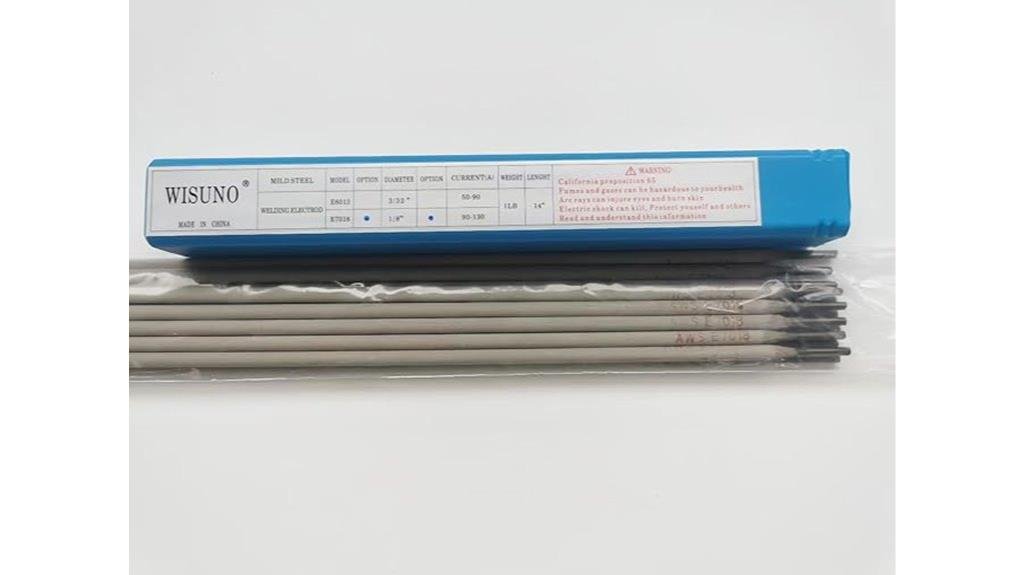
The reader learns electrode specifications: 1/8″ diameter, 1 lb package, compatible with AC and DC, all-position use.
Electrode specs: 1/8″ diameter, 1 lb pack, AC/DC compatible, and usable in all welding positions
What material is welded? Carbon steel, especially low-carbon structures and thin plates.
Practical features: easy arc start, stable arc, clean slag.
Measurements: bake 350–380°C for 1 hour before use; recommended current for 1/8″ is 100–125 A.
Questions answered: packaging size? 1 lb. Polarity? AC or DC.
Considerations: storage, surface prep, and job suitability for smooth cover welds.
Welding Performance and Best Practices
When evaluating welding performance and best practices for the E7018 1/8″ (3.2 mm) carbon steel stick electrode, users should expect an easy arc initiation, a super-stable arc, and consistently smooth weld beads with minimal spatter and readily removable slag.
The rod offers excellent arc stability and predictable deposition.
Recommended welding techniques: short arc, minimal weaving, run-on tab or strike-and-return to avoid porosity.
Question: What current?
Answer: 1/8″ typically 100–125 A.
Practical tips: bake electrodes 350–380°C for 1 hour, clean base metal, control travel speed, monitor bead width (5–8 mm) for optimal fusion.
Applications, Quality Control, and Handling Guidelines
Building on the welding performance and best practices above, this section outlines where the E7018 1/8″ (3.2 mm) carbon steel electrode is most useful, how its quality is controlled, and how it must be handled on the job.
Applications include low carbon steel structures, thin plates, small parts, and cover welding needing smooth surfaces.
Quality control relies on strict chemical composition checks, tensile and elongation tests, and visual seam inspection.
Handling guidelines: bake 350–380°C for 1 hour, remove rust/oil, use short arc, strike-and-return.
How to store electrodes? Follow electrode storage, sealed containers, 200°C re-bake if exposed.
- Safety first.
- Consistency matters.
- Inspect always.
Frequently Asked Questions
Can E7018 Rods Be Used for Welding Stainless Steel?
No, E7018 rods are not suitable for stainless steel welding. E7018 limitations include carbon steel filler chemistry and risk of contamination; stainless steel compatibility is poor, requiring stainless-specific electrodes or filler to preserve corrosion resistance.
What Is the Shelf Life After Baking the Electrodes?
Shelf life after electrode baking is typically limited to about 8–12 hours at ambient conditions; electrode baking restores dryness, but the electrode’s shelf life depends on storage humidity and should be used promptly or rebaked if exposed to moisture.
Are These Rods Suitable for Underwater or Marine Repairs?
No; these rods are not recommended for underwater welding or marine applications. They suit standard AC/DC, atmospheric repairs on low‑carbon steel; specialized waterproof electrodes and procedures are required for submerged or corrosive marine work.
Do These Electrodes Require a Special Welding Power Source?
No, the electrode specifications allow standard AC or DC welding machines; power source compatibility includes both AC and DC. The user should ensure proper current range and stable output to achieve recommended arc characteristics and weld quality.
Is There a Recommended Storage Container or Packaging Method?
Right off the bat, keep it under lock and key: recommended storage options include sealed vacuum packs, airtight desiccant-lined containers, or heated electrode ovens; moisture control is critical to prevent hydrogen pickup and preserve welding integrity.
Conclusion
In conclusion, the E7018 welding rod delivers reliable, low-spatter performance for low-carbon steel, with easy arc starts, stable deposition, and compatibility with AC or DC power. Recommended settings: 3/32″ (2.4 mm) at 70–90 A, 1/8″ (3.2 mm) at 90–130 A. How should it be handled? Bake at 250–300 °F (120–150 °C) if damp, store in sealed containers. Like a steady compass, it guides consistent, high-quality welds for structural and thin-plate work.