
Disclosure: As an Amazon Associate, we earn from qualifying purchases. If you click a link on this page and make a purchase, we may receive a small commission at no extra cost to you.
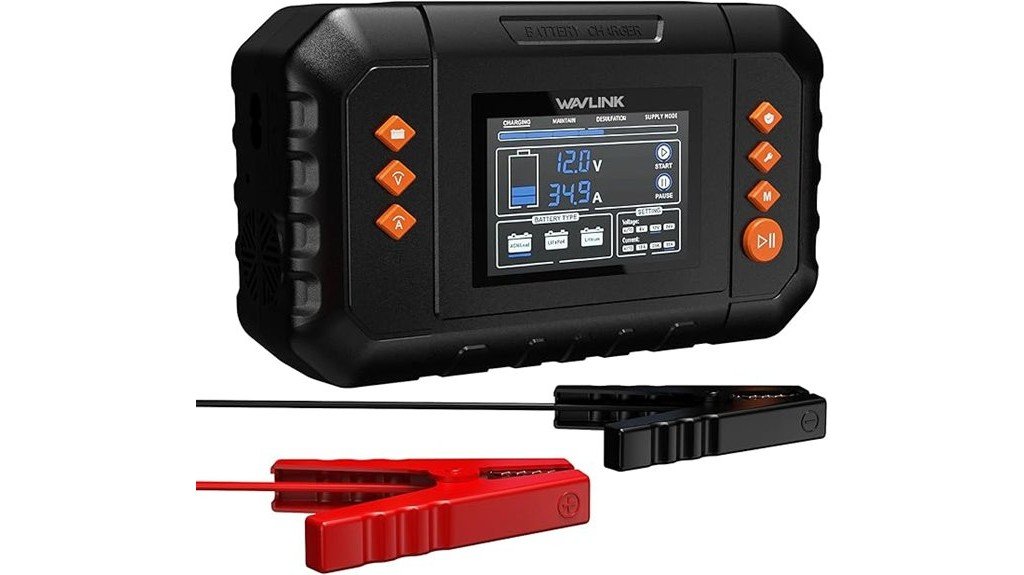
Charging a car, RV, or boat battery can get complicated when you own batteries with different voltages and chemistries. The WAVLINK 450W Smart Battery Charger (WL-GS450C) offers 6V, 12V, and 24V support, with charging current reaching 35A at 12V. Its LCD, maintenance functions, and built-in protections make it a useful option for owners of several vehicles. However, the maximum current varies by voltage, and not every battery type supports every setting. This review explains its specifications, practical benefits, and limitations so you can decide whether it fits your setup.
Quick Verdict
Verdict: Recommended with caveats
Best For: Vehicle owners, RV users, boat owners, and DIY mechanics who maintain different 6V, 12V, and 24V batteries.
Bottom Line: The WAVLINK GS450C offers flexible charging currents, multiple battery settings, and useful maintenance features. Its main limitations are the need to select the correct battery mode and the fact that 35A charging is available only at 12V.
Key Takeaways
- Multiple voltages: Supports 6V, 12V, and 24V lead-acid batteries, plus compatible 12V and 24V lithium and LiFePO4 batteries.
- Adjustable current: Offers up to 35A at 12V and up to 20A at 6V or 24V.
- Smart charging: Multi-stage operation includes charging, battery analysis, and maintenance functions.
- Battery care: Float maintenance and lead-acid desulfation functions may help maintain suitable batteries.
- Safety: Manufacturer-listed protections include reverse polarity, over-current, over-voltage, short-circuit protection, and fan cooling.
- Important limitation: It is not a dedicated multi-bank charger and should not be treated as a repair solution for a failed battery.
Key Features and Specifications
The WAVLINK GS450C is a mains-powered smart charger designed for several common battery types. Its main advantage is the ability to handle different voltage systems without requiring a separate charger for each one.
The following specifications come from WAVLINK’s published product information. Some dimensions and other details differ across retail listings, so check the current product information before ordering.
| Specification | Detail |
|---|---|
| Brand | WAVLINK |
| Model | WL-GS450C / GS450C |
| Product Type | Smart battery charger and maintainer |
| Maximum Output Power | 450W |
| AC Input | 100–240V AC, 50/60Hz |
| 6V Charging Current | 10A or 20A |
| 12V Charging Current | 10A, 20A, or 35A |
| 24V Charging Current | 10A or 20A |
| Automatic Current Setting | Auto mode listed for 6V, 12V, and 24V |
| Lead-Acid Compatibility | 6V, 12V, and 24V; includes listed wet, MF, CA, EFB, AGM, and calcium types |
| Lithium Compatibility | Compatible 12V and 24V lithium and LiFePO4 batteries |
| Battery Capacity | Manufacturer lists charging capacity up to 600Ah |
| Display | LCD with charging status, voltage, and current information |
| Cooling | Fan convection |
| Operating Temperature | -20°C to +40°C (-4°F to 104°F) |
| Dimensions | Manufacturer: 7.87 × 4.53 × 2.17 inches; retailer dimensions may differ |
| Weight | Manufacturer: approximately 3.04 lb (1.38 kg) |
| Power Cable | Approximately 6.6 feet (2 m) |
| Battery Clamp Cable | Approximately 3.6 feet (1.1 m) |
| Included Accessories | Battery clamp set and user manual listed with the charger |
Specification source: Official WAVLINK WL-GS450C product information.
What Is the WAVLINK GS450C Battery Charger?
The WAVLINK GS450C is a smart charger that takes AC power and supplies controlled DC charging current to compatible batteries. It is designed for use with common vehicle and equipment batteries, including those found in cars, motorcycles, tractors, boats, and RVs.
Its main selling point is flexibility. You can charge a compatible 12V vehicle battery, then use a different supported setting for a 24V system. This can be useful if you maintain several vehicles or equipment types.
Unlike a basic charger with one fixed output, the GS450C uses automatic charging stages and adjustable settings. However, you still need to confirm the battery voltage, chemistry, and allowed charging current before connecting it.
Performance and Charging Modes
How Fast Can It Charge?
The headline 35A figure is the charger’s maximum listed charging current, not the current it delivers during every session. WAVLINK specifies 35A at 12V, while 6V and 24V settings top out at 20A.
Actual charging speed depends on battery capacity, remaining charge, temperature, and the selected mode. Smart chargers also reduce current during later stages to avoid overcharging.
For a large 12V battery that allows high-current charging, the GS450C can be more suitable than a small 5A or 10A maintainer. However, a small motorcycle battery may need a much lower current than the charger’s maximum setting.
Multi-Stage Charging
WAVLINK describes a charging process that includes battery analysis, soft start, bulk charging, absorption, and float maintenance. These stages change how the charger delivers power as battery conditions change.
The bulk stage supplies more current when the battery can accept it. Later stages lower the charging rate and help maintain the battery within its supported charging limits.
Maintenance and Desulfation
The maintenance function is useful when a suitable battery sits unused for long periods. For example, an RV or seasonal vehicle may need battery care between trips.
The charger also includes a pulse desulfation feature intended for appropriate lead-acid batteries. This may help with certain performance losses caused by sulfation, but it cannot reliably restore a battery with failed cells or severe physical damage.
Important: Do not use lead-acid repair or desulfation settings on lithium batteries unless the battery manufacturer and charger instructions explicitly permit the selected function.
Advanced Modes and Controls
The Amazon product description lists charging, maintenance, desulfation, standby, supply, and professional functions. Published guidance may describe mode names differently. Check the manual supplied with your unit for the exact controls.
Supply or forced-operation functions require extra care because they may operate differently from normal automatic charging. Do not use them to bypass a battery protection system unless the battery manufacturer specifically approves the procedure.
Pro Tip: Check the battery’s recommended charging current before selecting 10A, 20A, or 35A. The highest available setting is not automatically the safest or fastest choice for every battery.
Battery Compatibility: 6V, 12V, and 24V
Compatibility is one of the most useful features of the GS450C, but voltage and battery chemistry must be considered together.
- 6V lead-acid: Supported for compatible batteries.
- 12V lead-acid: Includes several common flooded, maintenance-free, AGM, and related battery types.
- 24V lead-acid: Supported, with listed charging current up to 20A.
- 12V lithium and LiFePO4: Supported when the battery’s charging requirements match the charger.
- 24V lithium and LiFePO4: Also listed as compatible, subject to battery specifications.
- 6V lithium: Not included in WAVLINK’s published lithium compatibility information.
A battery management system, or BMS, may also affect lithium charging. Check whether your battery permits charging from this type of charger, especially if the battery has entered a low-voltage protection state.
Before You Buy: Check both battery chemistry and nominal voltage. The charger’s 6V support does not mean it supports 6V lithium batteries, and the 35A setting is specified for 12V charging only. Confirm the battery manufacturer’s maximum recommended charging current.
Safety Systems and Build Quality
Built-In Safety Protections
WAVLINK lists several protections for the GS450C:
- Reverse-polarity protection
- Over-current protection
- Over-voltage and overcharge protection
- Short-circuit protection
- Backflow prevention
- Intelligent fan cooling
- Advertised sparkproof and fire-resistant design
These systems provide useful safeguards, but they do not remove the need for correct battery handling. Always make secure connections and follow the battery manufacturer’s instructions.
WAVLINK also describes temperature-aware charging functions. The published operating range is -20°C to +40°C, but that does not mean the charger or every compatible battery can safely charge at every temperature in that range.
Housing, Size, and Cooling
The charger’s enclosure, control panel, and fan-assisted cooling make it a practical bench or garage charger. The fan needs clear airflow during charging.
One specification deserves attention: WAVLINK’s own dimensions differ from those shown by some retail listings. If you plan to store the charger in a fitted compartment, verify the size of the exact unit before purchasing.
Keep the charger in a dry, stable location where cables will not be pulled, crushed, or exposed to moving vehicle parts.
Outdoor and Marine Safety
The GS450C may charge batteries used in boats and outdoor equipment, but that does not make the charger itself waterproof. No confirmed water-resistance rating is established in the reviewed manufacturer specifications.
Use it in a protected, dry, ventilated location. Keep the charger away from rain, standing water, and battery gas accumulation. Do not leave it unattended in wet outdoor conditions.
User Experience and Interface
The LCD is a useful feature when you want to monitor charging without connecting a phone. It displays information such as battery voltage, charging current, and charging progress.
You can use the charger’s controls to select suitable charging settings. This gives you more flexibility than a simple fixed-output maintainer, but it also adds decisions that beginners must understand.
The available information does not establish smartphone-app control or wireless monitoring. Treat the GS450C as a charger with local screen-based controls rather than a connected smart-home device.
The main learning curve is choosing the correct voltage, chemistry, and charging current. Once you understand those settings, the display can help you monitor the process.
How It Performs in Real Use
The following are practical use-case assessments based on the published specifications, not results from independent hands-on charging tests.
Car and SUV Battery Charging
For a compatible 12V car battery, the charger provides a choice of current settings. Its 35A maximum is useful when the battery permits higher charging current and you want more output than a small maintainer can provide.
However, the charger cannot fix a battery with damaged internal cells. If a battery repeatedly loses charge, check its condition and the vehicle’s electrical system.
RV and Camper Battery Maintenance
RVs and campers may sit unused between trips. The maintenance function makes the GS450C worth considering for supported batteries that need periodic charging or storage maintenance.
It can also fit into an overland vehicle setup where dependable battery maintenance matters.
Check the battery bank’s voltage, chemistry, and capacity before use. This charger is not a substitute for a complete solar charge controller or an installed RV charging system.
Boat Battery Charging
The GS450C can be used with compatible marine batteries. Its multiple voltage settings may help if you own different equipment, while maintenance charging can be useful during storage.
It is not a dedicated waterproof onboard marine charger. Keep it away from water, use a safe AC supply, and follow marine electrical safety practices.
Workshop and Seasonal Equipment
If you maintain tractors, lawn equipment, or seasonal vehicles, the adjustable voltage and current settings can reduce the need for several basic chargers.
The main limitation is that small batteries may not accept the available higher current settings. Always confirm their charging limits rather than assuming that automatic operation makes every setting suitable.
Setup Tips Before First Use
Correct setup helps you avoid charging errors and unnecessary battery stress.
- Identify the battery: Check its nominal voltage, chemistry, capacity, and charging requirements.
- Inspect the equipment: Look for damaged cables, cracked battery cases, leaks, or signs of overheating. Do not charge a visibly damaged battery.
- Choose a safe location: Place the charger on a dry, stable surface with ventilation around its cooling openings.
- Connect the clamps: With AC power disconnected, follow the charger and vehicle manuals for the correct positive and negative connection points.
- Connect AC power: Use a suitable grounded power source according to the supplied instructions.
- Select the correct settings: Confirm voltage, battery chemistry, and permitted charging current before starting.
- Monitor the initial charging period: Check for unusual heat, warning messages, damaged cables, or other signs of trouble.
- Disconnect safely: Follow the manual’s shutdown and clamp-removal sequence before storing the charger.
Do not charge frozen batteries or use incompatible repair modes. If you are unsure about charging a battery while installed in a vehicle, consult the vehicle manual or a qualified technician.
Who Should Buy This Charger?
Best For
- Owners of different vehicles who need compatible 6V, 12V, and 24V charging options.
- RV and boat owners who want charging and maintenance functions in one device.
- DIY mechanics who value adjustable charging current and an LCD status display.
Skip If
- You need a dedicated multi-bank charger for independently charging several batteries.
- You require a waterproof charger for permanent outdoor or onboard installation.
- You only maintain a small battery that requires a lower current than the available settings allow.
Pros and Cons
Pros
- Supports three common lead-acid battery voltages.
- Provides up to 35A charging current at 12V.
- Works with listed 12V and 24V lithium and LiFePO4 batteries.
- Includes an LCD and multi-stage charging functions.
- Offers maintenance features and several advertised safety protections.
Cons
- The 35A setting is not available at 6V or 24V.
- Advanced settings require care and may confuse first-time users.
- It lacks verified waterproof construction and independent multi-bank charging.
Is It Worth the Price?
The WAVLINK GS450C is worth considering if you need a higher-output charger that handles different battery voltages and chemistries. Its value comes from combining charging current options, maintenance functions, and real-time monitoring.
For someone who regularly maintains larger compatible batteries, these features may justify choosing it over a basic low-current charger. You may also save space by using one supported charger across several types of equipment.
However, you may not need this level of output if you only maintain one small 12V battery. In that case, a simpler 5A or 10A maintainer could be a more suitable purchase. Compare current prices and warranty terms before deciding.
How It Compares to Alternatives
The NOCO GENIUS10 is a 10A charger designed for compatible 6V and 12V batteries. It offers lower charging current than the WAVLINK’s 12V maximum and does not provide a 24V charging setting. It is worth comparing if you prefer a lower-output charger for regular vehicle maintenance.
The CTEK MXS 5.0 is a 5A charger aimed at compatible 12V lead-acid batteries. Its focus is smaller-scale charging and maintenance rather than high-current or multi-voltage use.
The WAVLINK GS450C makes more sense if 24V support or higher charging current is a real requirement. If those features are unnecessary, the alternatives may be easier to match to your needs.
Frequently Asked Questions
Can the WAVLINK GS450C charge 6V lithium batteries?
WAVLINK lists 6V charging for compatible lead-acid batteries, while its published lithium compatibility covers 12V and 24V batteries. Do not assume that 6V lithium batteries are supported. Check the battery and charger instructions before use.
Does it deliver 35A when charging a 24V battery?
No. The manufacturer’s specifications list 35A as an available 12V setting. At 24V, the listed current choices are 10A and 20A, plus automatic selection.
Does it include interchangeable clips and ring terminals in the box?
The checked Amazon listing describes a battery clamp set and user manual. Interchangeable ring terminals were not confirmed as included accessories. Check the package contents on the current listing if you need permanent ring-terminal connections.
Can it charge two batteries simultaneously?
The reviewed product is not advertised as a charger with two independent charging banks. Its listed package includes one battery clamp set. If you need to charge separate batteries at the same time, choose a dedicated multi-bank charger.
Can it repair a completely dead battery?
Not necessarily. WAVLINK describes pulse repair for certain lead-acid battery conditions, but states that a completely failed battery cannot be restored by the charger. Battery testing or replacement may be needed if charging repeatedly fails.
Can it be used unattended outdoors in wet conditions?
No. The reviewed specifications do not establish a waterproof enclosure rating. Keep the charger in a dry, ventilated location and do not leave it exposed to rain or standing water.
How long does it take to charge a 100Ah battery?
There is no single reliable charging time. It depends on the starting charge level, battery chemistry, selected current, temperature, and how the charger reduces output during later stages. The 35A maximum should not be used as a constant-current guarantee.
Is there a warranty, and how long does it last?
The checked Amazon product description advertises a 12-month manufacturer warranty. Confirm the current warranty terms, exclusions, and seller information before ordering. Keep your purchase receipt in case you need support.
The Bottom Line
The WAVLINK 450W Smart Battery Charger is a practical choice if you maintain compatible batteries across several vehicles and need flexible 6V, 12V, and 24V charging options. Its strongest feature is the 35A maximum charging setting at 12V, combined with multi-stage charging and maintenance functions. Skip it if you need waterproof installation, independent multi-bank charging, or a simpler low-current maintainer.
Editorial review note: This assessment uses published manufacturer specifications and product listing information. Charging performance was not independently bench-tested. Actual results depend on battery condition, chemistry, capacity, and operating conditions.
Related automotive reading: For another vehicle electronics topic, see our Kenwood DMX500S review.



[…] in 5 lb boxes, ideal for small jobs and field repairs requiring quick, reliable […]
[…] straightforward. You still need to verify the 5-hole mounting, hub spacing, magnet alignment, and proper wiring and […]
[…] Pick: Ring Chime (Newest Model) — It delivers clear, customizable alerts with Wi-Fi 6 support and a plug-in setup that takes under two minutes. Check Price on […]
[…] FAQ → Original questions were generic. Replaced with 5 purchase-specific questions: parking mode power, SD card size, front-only vs dual, GPS accuracy, and Kia-specific […]
[…] is not a wired 12-volt accessory, and you do not connect it to a battery or charger. It works as a mechanical add-on over […]
[…] 100809 offers strong value for the price when you need portable power for camping, tailgating, or RV trips. Its combination of 3000 running watts, a 48.1-pound body, clean inverter output, and CO Shield […]