

The 2026 Ford F-650 is built for jobs that demand more carrying capacity and flexibility than a conventional pickup can provide. With its 7.3-liter gasoline V8, commercial-grade chassis, and wide range of body configurations, it is designed for heavy daily work rather than weekend comfort. This review covers its engine specifications, payload, driving experience, operating costs, and the details you should examine before buying.
Quick Answer
The 2026 Ford F-650 gas model has a 7.3L V8 producing 335 horsepower and 468 lb-ft of torque, paired with a 6-speed automatic transmission. A 26,000-pound GVWR configuration offers substantial carrying capacity, although actual payload depends on the installed body. Expect rugged construction, flexible upfitting, and a firm unloaded ride.
Last checked: October 25, 2026. Key specifications, pricing references, and licensing rules were checked against manufacturer and government sources.
🔧 Why the 2026 Ford F-650 matters for commercial work
The Ford F-650 is a medium-duty commercial truck designed to carry equipment, materials, and specialized bodies that may exceed the capabilities of lighter pickups. Unlike a conventional pickup, it typically leaves the factory as an incomplete chassis that can be fitted with equipment for a specific job.
Not everyone needs a pickup that feels like a small apartment. But if your job requires carrying heavy, bulky loads without fuss, a medium-duty chassis is where things start to make sense.
The F-650 sits squarely in that world. Its heavy frame, commercial suspension, and available wheelbase configurations allow it to support flatbeds, utility bodies, cargo boxes, and other specialized equipment.
This is not about weekend heroics. It is about workday reliability, serviceability, and controls that drivers can operate without unnecessary complexity.
🛠️ 2026 Ford F-650 engine, transmission, and specifications
The gasoline-powered Ford F-650 uses a 7.3-liter V8 with a Ford TorqShift 6-speed automatic transmission. This engine provides the torque needed for moving heavy loads, while the transmission includes Tow/Haul and manual gear-selection functions.
At the heart of this example is the 7.3-liter gasoline V8, producing 335 horsepower and 468 lb-ft of torque at 3,750 rpm.
Ford’s F-650 gas model specifications also confirm a heavy-duty 6-speed automatic with double overdrive, SelectShift manual control, and Tow/Haul operation.
Key Ford F-650 specifications at a glance
| Specification | 2026 Ford F-650 Gas |
|---|---|
| Engine | 7.3L gasoline V8 |
| Horsepower | 335 hp at 3,750 rpm |
| Torque | 468 lb-ft at 3,750 rpm |
| Transmission | TorqShift 6-speed automatic |
| GVWR range | 22,000–29,000 lb, depending on configuration |
| Maximum GCWR | Up to 37,000 lb when properly equipped |
| Standard fuel capacity | 50 gallons for Regular Cab/SuperCab; 60 gallons for Crew Cab |
| Drive configuration | 4×2, rear-wheel drive |
These ratings come from Ford’s 2025–2026 Fleet Solutions Guide. The exact limits depend on the model, axle ratings, wheelbase, tires, and installed equipment.
How much payload can the Ford F-650 carry?
A 26,000-pound GVWR F-650 with an estimated bare-chassis weight of 9,500 pounds would have approximately 16,500 pounds of theoretical remaining weight capacity. However, that figure is not the cargo capacity of a completed truck.
Understanding the difference between payload and the truck’s gross vehicle weight rating is essential.
GVWR is the maximum permitted weight of the loaded vehicle, including its chassis, body, equipment, occupants, fuel, and cargo.
For the example:
- Gross vehicle weight rating: 26,000 pounds
- Estimated bare-chassis weight: 9,500 pounds
- Remaining weight before upfitting: approximately 16,500 pounds
Suppose a cargo body, permanently mounted equipment, passengers, and additional supplies add 4,000 pounds. The remaining carrying allowance in that illustration would fall to about 12,500 pounds, assuming the starting weight estimate is accurate.
The completed truck must also remain within its individual front and rear axle ratings. A load positioned too far behind the rear axle can exceed an axle limit even when total vehicle weight remains below GVWR.
Warning: Never treat the difference between GVWR and estimated bare-chassis weight as guaranteed cargo capacity. Weigh the completed vehicle, account for occupants and equipment, and verify individual axle and tire limits before loading it.
How large is the fuel tank?
The example truck is described with a 50-gallon fuel tank. Ford lists 50 gallons as the standard gasoline capacity for Regular Cab and SuperCab configurations, with 60 gallons for Crew Cab models.
The original dealer inventory example describes a diesel configuration, so it should not be used by itself to establish the exact gasoline model’s equipment.
Real-world driving range depends on fuel consumption, terrain, idle time, vehicle weight, and body aerodynamics. A fully loaded box truck working in stop-and-go traffic will behave differently from a lightly equipped flatbed traveling on a highway.
🚪 Ford F-650 exterior and build quality
The Ford F-650’s exterior favors practical service access and durable commercial hardware over styling. Its tall cab, substantial chassis, heavy-duty wheels, and exposed frame make its intended purpose immediately clear.
The entire front hood and fender assembly tilts forward, giving technicians access to important engine components. For anyone who has worked in a crowded shop, this tilt-forward design can make inspections and repairs more convenient.
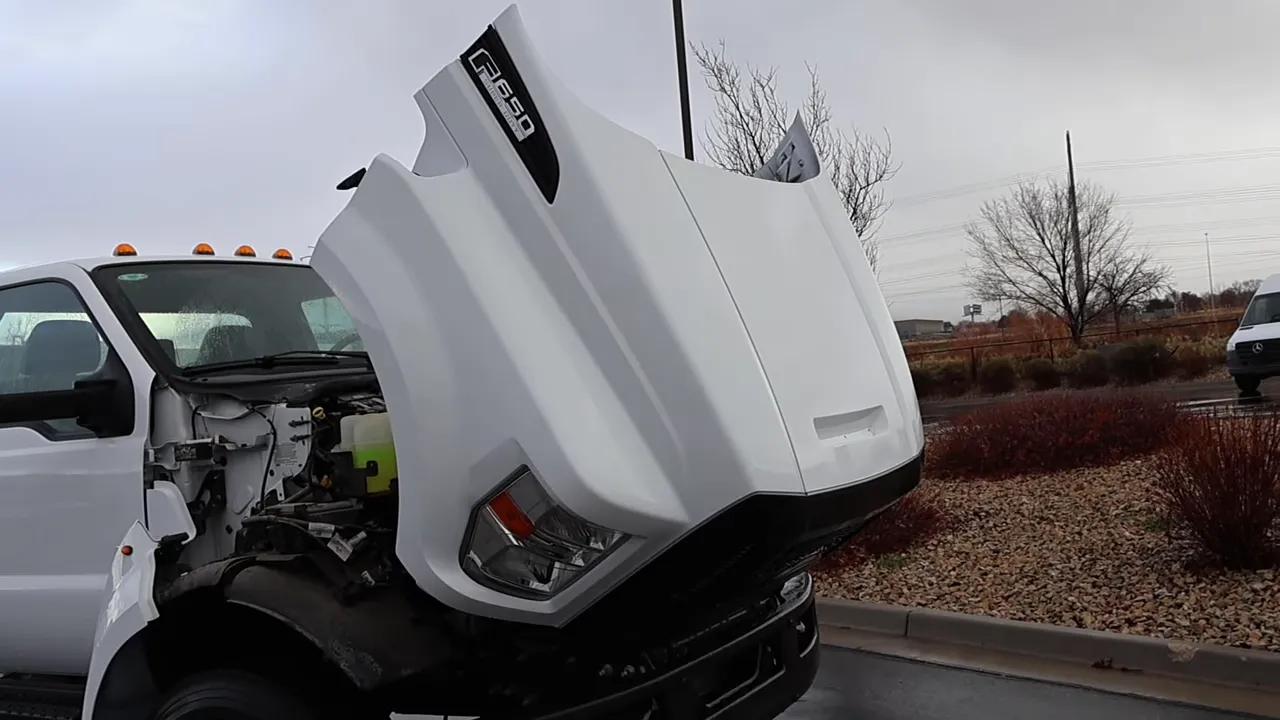
The large grille and front lighting are suited to commercial use. Roof-mounted marker lights improve the truck’s visibility, while heavy-duty mirrors help drivers monitor the sides of the vehicle and its installed body.
These details matter on delivery routes, construction sites, and busy work yards where the driver must frequently maneuver around equipment.
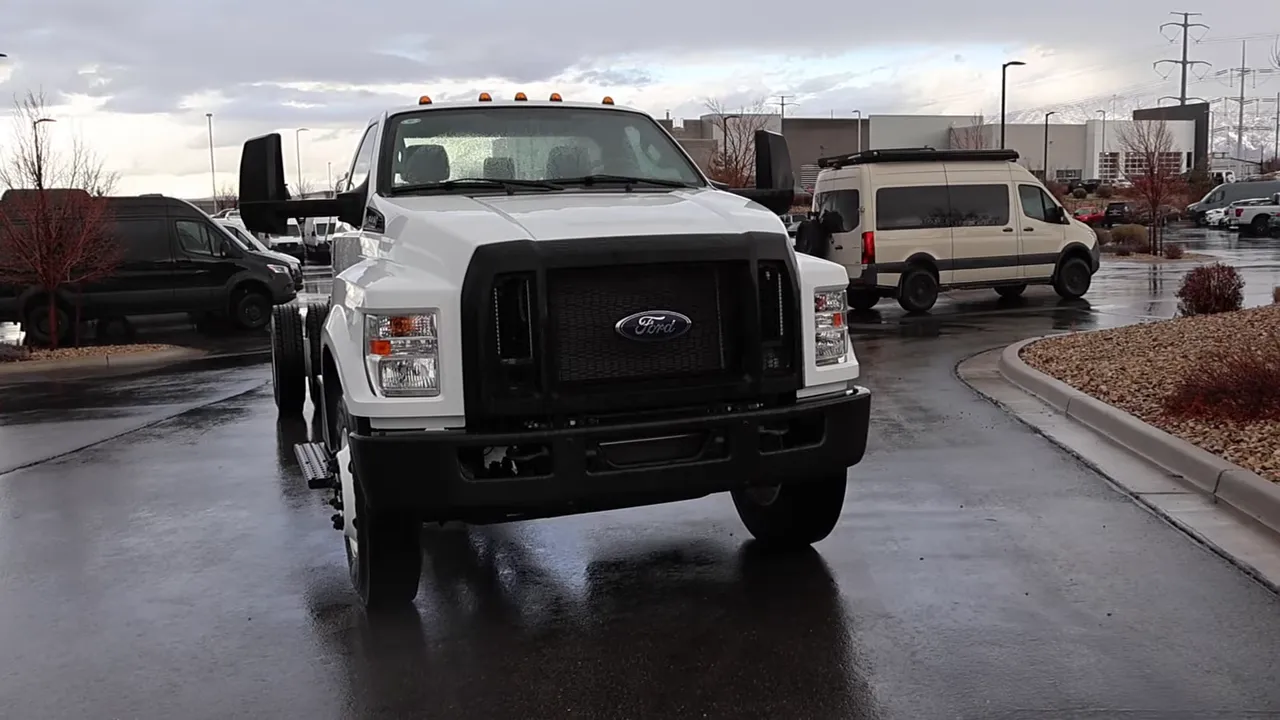
Commercial tires and dual rear wheels
The truck shown is described as using 295/75R22.5 tires, approximately 40 inches in overall diameter, with a Load Range G rating. The rear axle uses dual wheels.
Commercial tires are selected for specific weight, pressure, speed, and operating requirements. Dual rear wheels help distribute axle loads across additional tires, but they do not increase the vehicle’s certified axle or gross weight ratings.
Tire sizes and load ranges can vary between F-650 configurations. Check the actual tire sidewalls and vehicle certification labels rather than assuming every F-650 has the same fitment.
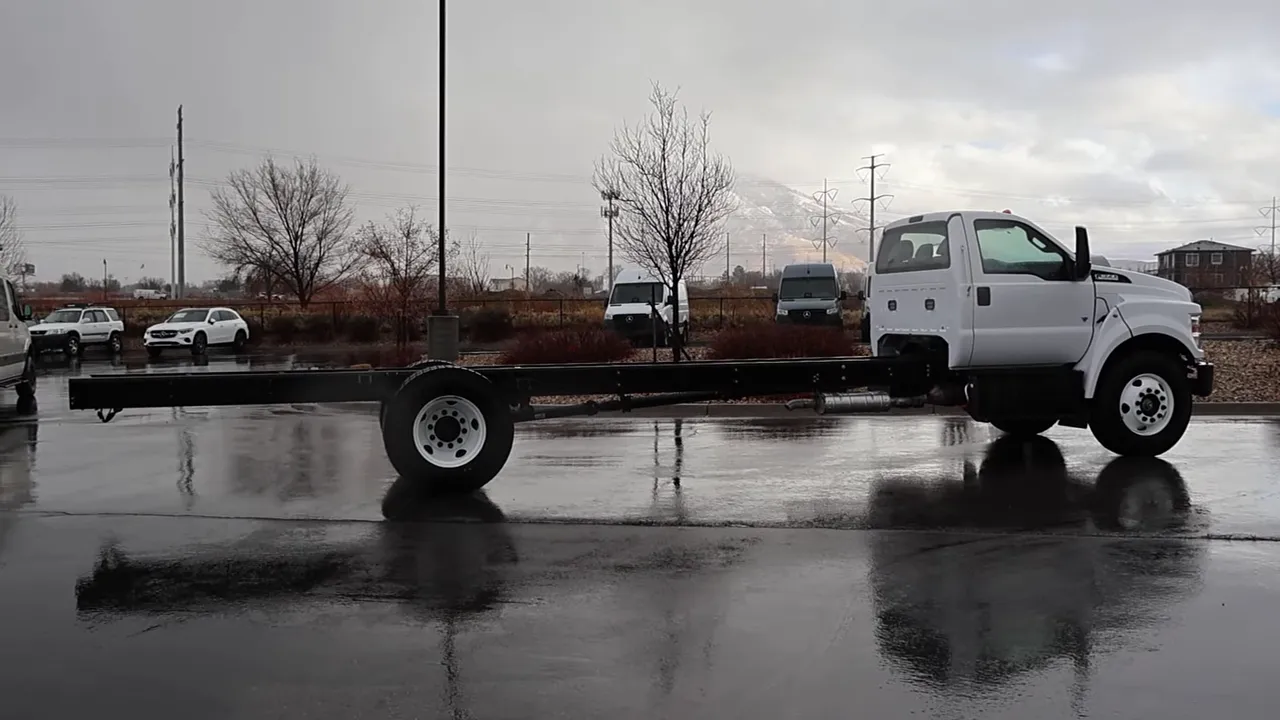
Why does the F-650 have such a long exposed frame?
The exposed frame allows commercial body builders to install equipment that matches the truck’s intended work. Instead of buying a finished cargo vehicle and modifying it extensively, businesses can specify an appropriate chassis and complete it for their needs.
Possible upfits include flatbeds, enclosed cargo bodies, cranes, service equipment, auxiliary tanks, and specialized municipal bodies.
However, an upfit must match the chosen frame length, axle capacities, weight distribution, electrical provisions, and vehicle certification requirements. A long frame provides flexibility, but it does not make every installation automatically safe or compatible.
🪑 Ford F-650 interior, seating, and controls
Inside, the F-650 prioritizes clear controls, durable surfaces, and easy operation during long commercial workdays. The basic cabin is functional rather than luxurious, although available options can improve comfort and convenience.
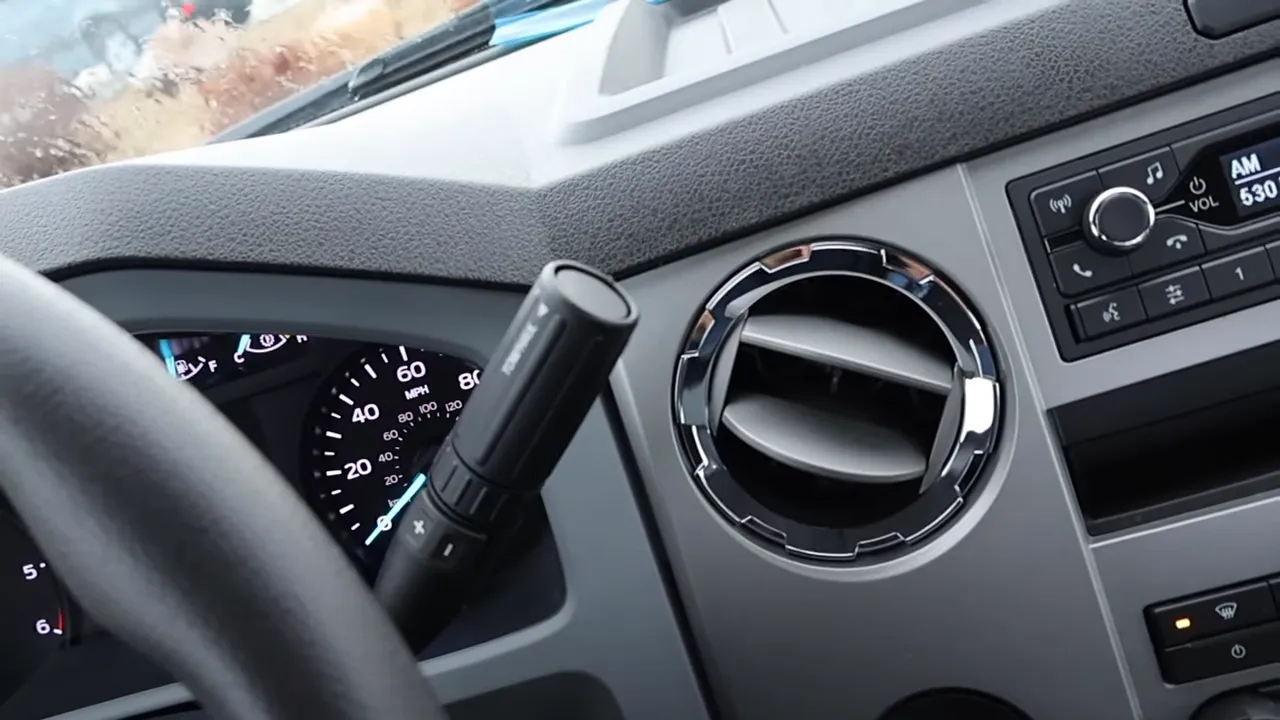
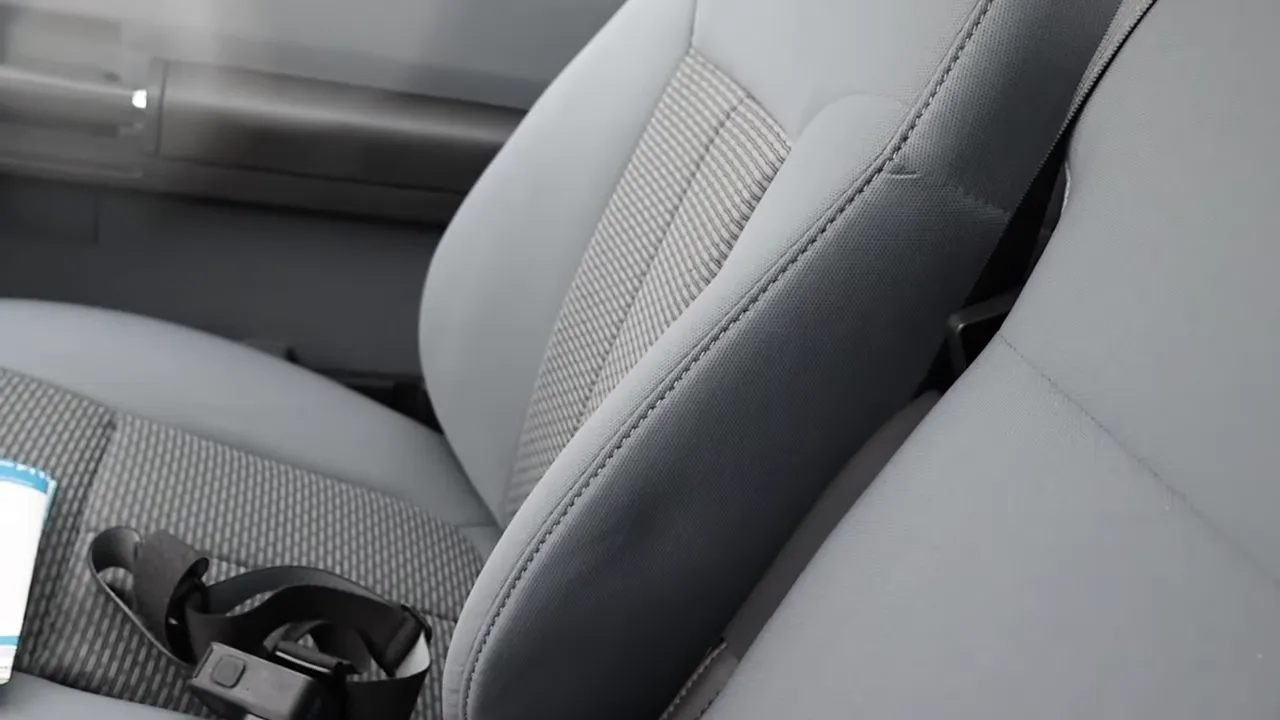
The example features cloth seating, straightforward dashboard controls, and an instrument cluster that combines traditional gauges with a small information display.
Transmission and work-related controls
The column-mounted gear selector operates the 6-speed automatic transmission. Tow/Haul mode adjusts transmission behavior for demanding conditions, while manual selection lets the driver hold or restrict gears when appropriate.
Useful work-oriented equipment includes:
- Tow/Haul mode: Helps manage shifting when carrying loads or towing.
- Manual gear selection: Allows greater control over the available gear range.
- Four upfitter switches: Available for operating properly connected auxiliary equipment.
- 110V household-style outlet: An available option for compatible electrical devices.
- Large exterior mirrors: Help the driver monitor the truck’s length and surrounding traffic.
The four upfitter switches and 110V outlet are optional equipment, not features guaranteed on every base F-650.
Is the cabin comfortable enough for daily driving?
The cabin is practical for regular commercial driving, but it does not deliver the same luxury or refinement as a well-equipped consumer pickup. The seating and controls are designed around repeated use, visibility, and straightforward operation.
The analog-focused instrument layout keeps essential information easy to read. The truck also offers an AM/FM radio, USB input, and Bluetooth connectivity, with additional equipment depending on configuration.
The simple layout is appealing for fleet drivers who prioritize familiarity and durability. Still, fewer visible screens should not be mistaken for proof that the vehicle has fewer possible electronic problems.
⚙️ Ford F-650 serviceability and long-term durability
Serviceability is one of the F-650’s strongest practical advantages. The forward-tilting hood, commercial-grade components, and accessible chassis layout help technicians inspect and maintain a truck intended for demanding use.
The 7.3L gasoline engine uses an overhead-valve design. Ford also specifies a forged-steel crankshaft, piston cooling jets, and a variable-displacement oil pump for this engine.
These features support its commercial design, but they do not eliminate the need for regular maintenance or guarantee a particular service life.
Maintenance points worth checking
- Follow the correct engine oil and filter schedule for the vehicle’s operating conditions.
- Inspect the cooling system, hoses, belts, and fluid levels.
- Monitor tire pressure, tread wear, and dual-wheel condition.
- Check brakes, suspension components, steering joints, and frame-mounted equipment.
- Inspect electrical connections and accessories installed by the upfitter.
- Keep detailed service records, especially when several drivers share the vehicle.
Ford service program 25B65
Ford issued Customer Satisfaction Program 25B65 for certain 2024–2026 F-650 and F-750 trucks equipped with the 7.3L engine and 6R140 transmission. The program addresses powertrain control module software that may allow engine overspeed under certain conditions.
According to the Ford 25B65 service communication, affected vehicles are eligible for powertrain control module reprogramming at no charge. The stated program expiration date is December 31, 2026.
Not every 2026 F-650 is affected. Before purchasing or placing a truck into service, have a Ford commercial dealer check its VIN for applicable open service actions and completion records.
🚚 2026 Ford F-650 driving impressions
The F-650 drives like a commercial truck built to carry substantial weight. Its high seating position, light steering effort, and strong powertrain are useful in work environments, but the stiff suspension can make an empty chassis uncomfortable on rough roads.
Ride quality: loaded versus unloaded
Driving the F-650 requires a different mindset from driving a half-ton pickup. It is larger, heavier, and tuned for demanding commercial loads.
With little or no cargo, the rear suspension can feel harsh. Leaf springs selected to support heavy loads may transmit bumps and vibration into the cabin when there is insufficient weight to compress them.

Steering and maneuverability
Steering feels surprisingly light for a vehicle of this size. That makes low-speed maneuvering more manageable around delivery yards, construction areas, and parking lots.
However, the F-650’s overall size and turning requirements still demand planning. The installed body, wheelbase, mirror position, and rear overhang can all affect how much room the driver needs.
A longer chassis may be useful for cargo capacity but less convenient on narrow streets or at small loading docks.

Braking and control
Braking performance is designed around the truck’s commercial weight ratings, but the driver must allow for its considerable mass. The gas F-650 uses a hydraulic brake system with traction control, and Ford also lists hill-start assistance and electronic stability control.
On rough pavement, an unloaded chassis may bounce enough to make braking feel unsettled. This does not necessarily indicate weak brakes; suspension movement, tire contact, and road conditions can change how braking feels.
Drivers should adjust following distance and braking technique for road conditions and actual vehicle weight. Never assume the truck will stop or handle the same way with every load.
How does the 7.3L V8 perform?
The 7.3L gasoline V8 emphasizes useful working power rather than sporty acceleration. Its 468 lb-ft of rated torque helps get a heavy vehicle moving and supports acceleration under load.
The engine works with the 6-speed automatic to manage gear changes during climbing, hauling, and everyday commercial driving.
Tow/Haul mode can help reduce unnecessary shifting on grades. Drivers can also select an appropriate gear range when extra control is useful.
“This thing’s an absolute tank.”
That original driving impression captures the truck’s personality. It feels substantial, purposeful, and built for jobs that would overwhelm a lighter-duty vehicle.
But there is a trade-off. This is not the ideal truck for someone whose main priority is quiet, plush, unloaded highway cruising.
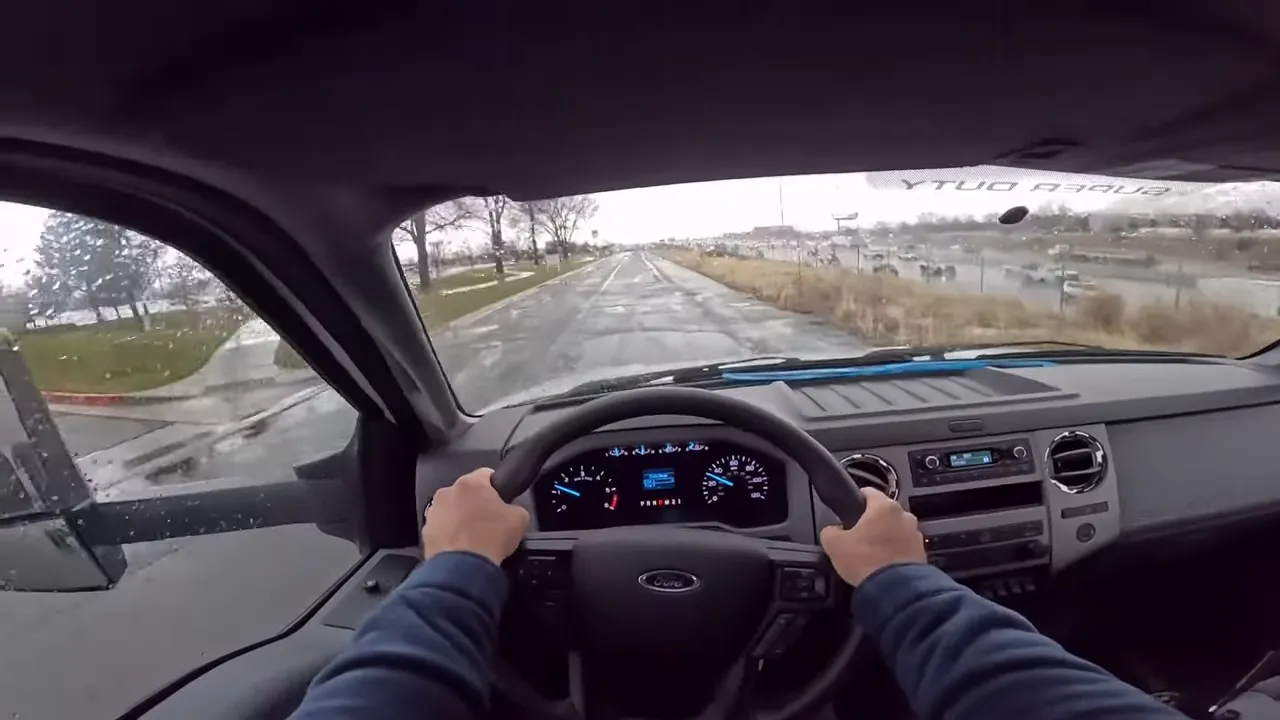
Unloaded dynamics deserve special attention if you plan to use the F-650 mostly without cargo. Expect a firm ride and noticeable suspension movement over uneven surfaces.
With an appropriate working load, the suspension may feel more settled. That does not mean maximum loading is desirable; both underloading for comfort and overloading for capacity are poor substitutes for specifying the correct suspension.
📋 Ford F-650 price, licensing, and buying considerations
Buying an F-650 involves more than choosing an engine and cab. The final price, licensing requirements, useful payload, and long-term operating costs depend heavily on how the truck will be completed and used.
How much does a 2026 Ford F-650 cost?
Ford listed the 2026 F-650 Gas Straight Frame starting at $69,995 in the US market. The final transaction price depends on the cab, equipment, destination charges, dealer pricing, and installed commercial body.
Ford’s 2026 F-650 commercial vehicle listing provides the manufacturer starting-price reference.
The original estimate of roughly $70,000–$80,000 for basic examples is consistent with a starting chassis price around that level. Once you add utility bodies, cargo boxes, crane equipment, tool storage, or other specialized gear, a completed truck can exceed $100,000.
That higher figure is not a standard price for every completed F-650. A simple flatbed and a fully equipped service crane truck may have very different costs.
Does a Ford F-650 require a CDL?
A 26,000-pound GVWR F-650 does not automatically require a CDL under the federal weight threshold. However, a straight truck with a GVWR of 26,001 pounds or more generally falls into the Class B CDL category when used in covered commercial operation.
The Federal Motor Carrier Safety Administration administers national commercial driver licensing standards, while individual states issue CDLs and enforce applicable requirements.
The federal CDL vehicle classifications distinguish these common cases:
- 26,000-pound GVWR straight truck: Generally below the federal Class B weight threshold, unless another CDL-triggering condition applies.
- 26,001-pound or higher GVWR straight truck: Generally requires a Class B CDL for covered operation.
- Qualifying truck-and-trailer combination: A Class A CDL may be needed when the combination reaches the applicable 26,001-pound threshold and the towed vehicle exceeds 10,000 pounds GVWR.
- Special operations: Passenger transport or placarded hazardous materials can create CDL requirements even at lower vehicle weights.
Licensing is only one part of commercial compliance. Registration, medical certification, hours-of-service rules, weight restrictions, and insurance obligations may apply separately.
Note: Before buying or operating an F-650, confirm the exact GVWR, GCWR, trailer ratings, licensing classification, and registration requirements with your state licensing authority and commercial insurance provider.
Gasoline versus diesel: which F-650 makes more sense?
The 7.3L gasoline V8 suits buyers who want a straightforward gas-powered work truck. Ford also offers an F-650 with a 6.7L Power Stroke turbo-diesel V8 for applications that benefit from substantially greater rated torque and a diesel-oriented powertrain.
The standard diesel rating is 270 horsepower and 800 lb-ft of torque, with higher-output versions available. The diesel model also uses a different transmission configuration.
Gasoline can be attractive for fleets with familiar service procedures and less demanding duty cycles. Diesel may be more suitable where heavy-load operation, sustained work, and specific powertrain equipment justify its additional complexity.
Choose based on expected mileage, idle time, loads, maintenance access, fuel costs, and actual job requirements rather than engine torque alone.
How flexible is the F-650 for upfitting?
The F-650’s long frame and commercial electrical provisions make it a flexible starting point for specialized vehicles. Available body-builder wiring, upfitter switches, and power-takeoff provisions can support equipment installations when properly specified.
One detail matters more than it first appears: equipment placement changes axle loading and the completed truck’s center of gravity.
NTEA’s vehicle axle-weight and center-of-gravity guidance explains why body weight, cargo position, occupants, and mounted equipment must be considered together.
Before ordering, ask the body builder for a completed-vehicle weight estimate, front and rear axle load calculations, and confirmation that the proposed installation meets applicable certification requirements.
✅ Ford F-650 pros and ❌ cons
The F-650 offers impressive commercial capability and body flexibility, but those strengths come with compromises. It makes the most sense when its size and weight capacity are necessary for earning a living.
Pros
- Strong gas V8: 335 horsepower and 468 lb-ft of torque for demanding work.
- Substantial carrying capability: Multiple GVWR configurations support different commercial applications.
- Flexible chassis: Suitable for flatbeds, cargo bodies, cranes, and utility equipment.
- Service access: Forward-tilting hood makes many engine inspections easier.
- Work-focused interior: Straightforward controls and durable materials.
- Commercial equipment options: Available switches, PTO provisions, and driver-assistance features.
Cons
- Harsh unloaded ride: Heavy-duty suspension can be uncomfortable without cargo.
- High completed-vehicle cost: Specialized bodies and equipment significantly increase the purchase price.
- Basic cabin: Less refined than a premium consumer pickup.
- Large dimensions: Requires care on narrow roads, at loading docks, and during parking.
- Optional safety conveniences: The base configuration described does not include a standard rear-view camera.
- Operating expenses: Commercial tires, maintenance, fuel, and insurance require careful budgeting.
🔍 Best commercial uses for the Ford F-650
The F-650 is most valuable where a business needs one purpose-built truck for substantial equipment or cargo. Its ability to accept different body types allows operators to match the vehicle to a specific industry.
- Flatbed delivery: Transporting heavy construction materials and bulky supplies.
- Service trucks: Carrying organized tools, replacement parts, compressors, and repair equipment.
- Municipal cargo bodies: Moving equipment and materials for public works operations.
- Utility and construction trucks: Supporting properly engineered crane or platform installations.
- Tanker and bulk transport: Carrying compatible specialized tanks and equipment within all applicable weight and operating restrictions.
A Crew Cab can also be useful when the business must transport additional workers alongside its equipment.
Not every application needs the highest available GVWR. Selecting the smallest configuration that safely meets the workload can help control purchase costs and reduce unnecessary vehicle size.
💡 Ford F-650 ownership and maintenance tips
Successful F-650 ownership begins with choosing the correct chassis for the job and planning its maintenance before it enters service. Small specification mistakes can create larger problems after a commercial body has been installed.
- Specify the suspension for the actual working load. Consider how much weight the truck carries on an average day, not only its maximum occasional load. The wrong suspension choice can affect ride quality and long-term component wear.
- Plan the upfit before purchasing. Confirm the wheelbase, cab-to-axle measurement, equipment mounting locations, fuel tank placement, electrical provisions, and power requirements.
- Follow the appropriate service schedule. Use the vehicle’s maintenance information and account for demanding conditions such as repeated idling, stop-and-go driving, and heavy loads.
- Train drivers for loaded and unloaded handling. Explain how payload changes steering response, braking feel, suspension movement, and vehicle stability.
- Keep accurate weight records. Weigh the completed vehicle and update your loading calculations when heavy equipment is added or relocated.
- Review service actions before delivery. Use the VIN to identify outstanding Ford programs, recalls, or required updates.
It also helps to track fuel use, tire replacement, downtime, and routine service expenses. Those records show whether the chosen configuration remains economical for your business.
Key Takeaways
- The gas F-650 is available with different GVWR ratings, so the 26,000-pound example does not represent every configuration.
- Body weight, equipment placement, and individual axle limits determine how much useful cargo you can safely carry.
- The 26,001-pound federal CDL threshold can make vehicle specification especially important for fleet operators.
- Rear-view cameras, four upfitter switches, and the 110V outlet are available equipment rather than guaranteed base features.
- A completed-vehicle weight estimate and an upfitter-approved equipment plan should be part of the buying process.
🧾 Frequently Asked Questions
How much payload can the Ford F-650 carry?
A 26,000-pound GVWR F-650 with an estimated 9,500-pound bare-chassis weight would have about 16,500 pounds remaining before upfitting. Actual cargo payload is lower after accounting for the commercial body, equipment, passengers, and other vehicle weight. Axle ratings may impose additional limits.
Does the Ford F-650 require a commercial driver’s license?
A 26,000-pound GVWR F-650 generally falls below the federal Class B CDL weight threshold. A straight truck rated at 26,001 pounds or more generally requires a Class B CDL for covered commercial use. Towing, hazardous materials, passenger operations, and state requirements can change the answer.
What engine and transmission are in the 2026 Ford F-650?
The gasoline F-650 uses a 7.3-liter V8 producing 335 horsepower and 468 lb-ft of torque, paired with a 6-speed TorqShift automatic transmission. Ford also offers a 6.7-liter Power Stroke turbo-diesel V8, paired with a 10-speed automatic, for buyers needing a different commercial powertrain.
How big is the Ford F-650 fuel tank, and what is its range?
The standard gasoline fuel capacity is 50 gallons for Regular Cab and SuperCab models and 60 gallons for Crew Cab models. Real-world range varies with cargo weight, road conditions, idling, speed, and body type. Without measured fuel consumption for a specific configuration, a reliable range figure cannot be calculated.
Are Ford F-650 tires and wheels commercial grade?
Yes. The F-650 uses commercial-duty wheels and tires selected for its axle and operating requirements. The example is described with 295/75R22.5 Load Range G tires and dual rear wheels. Actual sizes and load ratings vary, so confirm the specific truck’s tire markings and certification labels.
Is the Ford F-650 comfortable when unloaded?
The Ford F-650 generally has a firm unloaded ride because its suspension is designed to support heavy commercial loads. Rough roads can produce noticeable bouncing and vibration. An appropriate working load may make the suspension feel more settled, although comfort still depends on the chassis and suspension configuration.
How much does a 2026 Ford F-650 cost?
{"@context":"https://schema.org","@type":"FAQPage","mainEntity":[{"@type":"Question","name":"How much payload can the Ford F-650 carry?","acceptedAnswer":{"@type":"Answer","text":"A 26,000-pound GVWR F-650 with an estimated 9,500-pound bare-chassis weight would have about 16,500 pounds remaining before upfitting. Actual cargo payload is lower after accounting for the commercial body, equipment, passengers, and other vehicle weight. Axle ratings may impose additional limits."}},{"@type":"Question","name":"Does the Ford F-650 require a commercial driver's license?","acceptedAnswer":{"@type":"Answer","text":"A 26,000-pound GVWR F-650 generally falls below the federal Class B CDL weight threshold. A straight truck rated at 26,001 pounds or more generally requires a Class B CDL for covered commercial use. Towing, hazardous materials, passenger operations, and state requirements can change the answer."}},{"@type":"Question","name":"What engine and transmission are in the 2026 Ford F-650?","acceptedAnswer":{"@type":"Answer","text":"The gasoline F-650 uses a 7.3-liter V8 producing 335 horsepower and 468 lb-ft of torque, paired with a 6-speed TorqShift automatic transmission. Ford also offers a 6.7-liter Power Stroke turbo-diesel V8, paired with a 10-speed automatic, for buyers needing a different commercial powertrain."}},{"@type":"Question","name":"How big is the Ford F-650 fuel tank, and what is its range?","acceptedAnswer":{"@type":"Answer","text":"The standard gasoline fuel capacity is 50 gallons for Regular Cab and SuperCab models and 60 gallons for Crew Cab models. Real-world range varies with cargo weight, road conditions, idling, speed, and body type. Without measured fuel consumption for a specific configuration, a reliable range figure cannot be calculated."}},{"@type":"Question","name":"Are Ford F-650 tires and wheels commercial grade?","acceptedAnswer":{"@type":"Answer","text":"Yes. The F-650 uses commercial-duty wheels and tires selected for its axle and operating requirements. The example is described with 295/75R22.5 Load Range G tires and dual rear wheels. Actual sizes and load ratings vary, so confirm the specific truck's tire markings and certification labels."}},{"@type":"Question","name":"Is the Ford F-650 comfortable when unloaded?","acceptedAnswer":{"@type":"Answer","text":"The Ford F-650 generally has a firm unloaded ride because its suspension is designed to support heavy commercial loads. Rough roads can produce noticeable bouncing and vibration. An appropriate working load may make the suspension feel more settled, although comfort still depends on the chassis and suspension configuration."}},{"@type":"Question","name":"How much does a 2026 Ford F-650 cost?","acceptedAnswer":{"@type":"Answer","text":"The 2026 Ford F-650 Gas Straight Frame had a US manufacturer starting price of $69,995. Actual pricing depends on cab configuration, factory options, commercial equipment, dealer charges, and installation labor. A heavily customized completed truck can cost substantially more than the original chassis."}}]}
📌 Final thoughts: Is the Ford F-650 worth buying?
The 2026 Ford F-650 is a work tool more than a lifestyle vehicle. Its strongest qualities are substantial carrying capability, durable construction, accessible service points, and a chassis designed for many commercial applications.
The compromises are clear: a harsh empty ride, basic cabin comfort, a large footprint, and potentially high costs once specialized equipment is added.
If you need a reliable platform for moving heavy loads or supporting a custom commercial body, the F-650 deserves consideration. Start with the intended payload, select the appropriate GVWR and wheelbase, and confirm the completed vehicle’s specifications before purchasing.

Sources
- Ford Motor Company — F-650 Gas Straight Frame: Engine specifications, transmission, equipment availability, and weight ratings.
- Ford Pro — 2025–2026 Fleet Solutions Guide: Fuel capacities, engine outputs, and GVWR/GCWR information.
- Ford Pro — 2026 F-650 and F-750: Manufacturer starting-price information.
- Federal Motor Carrier Safety Administration — CDL Program: Commercial licensing responsibilities and guidance.
- FMCSA — Commercial Vehicle Groups: Class A, B, and C licensing thresholds.
- Ford Motor Company — Customer Satisfaction Program 25B65: Powertrain control module service action for certain affected vehicles.
- NTEA — Multistage Vehicle Certification: Requirements for completed commercial vehicles.
- NTEA — Vehicle Axle Weight and Center-of-Gravity Guidance: Weight calculations for commercial vehicle upfits.
- Federal Highway Administration — Weight Terminology: Definitions of GVWR, GCWR, and axle weight.
- Cornell Legal Information Institute — 40 CFR 1037.801: Regulatory vehicle terminology.
- Modern WorkTruck Solutions — Ford F-650 and F-750: Original article reference for the commercial gasoline powertrain.
- Weber Ford — F-650 Diesel Inventory Listing: Original dealership reference; configuration differs from the gas review.
- Verizon Connect — GVWR Explanation: Background on vehicle weight terminology.
- Commercial Carrier Journal — Commercial Truck Reference: Original tilt-forward design reference.
- Goodyear — Commercial Truck Tires: Original commercial tire reference.
- Work Truck — Tire Load Ratings and Sizes: Explanation of commercial tire sizing and load classifications.