Disclosure: As an Amazon Associate, we earn from qualifying purchases. If you click a link on this page and make a purchase, we may receive a small commission at no extra cost to you.
AWithZ P20B Spot Welder Review
You want clean, strong battery tab welds, not burned cells, weak nickel strips, or settings that shift from one weld to the next. The AWithZ P20B answers that problem with 14.6 kW maximum pulse welding power, two built-in supercapacitors, 999 gear settings, and both automatic and foot-pedal modes. This review checks the verified specs, material limits, included accessories, controls, safety notes, and real tradeoffs, so you can decide if this capacitor spot welder is worth buying for your battery-building work.
Our Verdict
Rating: 8/10
Best For: DIY battery builders, repair techs, and small-shop users who need controlled welds on 18650, 14500, 21700, 26650, 326650, LiFePO4, and similar battery packs.
Bottom Line: The AWithZ P20B gives you strong capacitor-based pulse welding, fine 999-step control, a 2.4-inch LCD screen, and a useful starter accessory kit. It is not the right pick for heavy industrial production, and you need test welds before trusting a new material stack.
| Specification | Detail |
|---|---|
| Brand | AWithZ |
| Model | P20B |
| ASIN | B0DNLXHC23 |
| Product Type | Capacitor battery spot welder |
| Peak Pulse Power | 14.6 kW maximum pulse welding power |
| Energy Storage | Two built-in supercapacitors |
| Settings | 999 adjustable gear settings |
| Timing Controls | Preheating 1-10 ms, intermittent time 1-20 ms, trigger time 0.5-5.0 seconds, and 1-3 continuous weld pulses |
| Display | 2.4-inch LCD display with mode, gear, and operating information |
| Modes | Automatic mode and foot-pedal mode |
| Power Source | AC power |
| Input | AC 100-240V with 15A charger |
| Lead Length | 60 cm flexible welding leads |
| Body Size | About 7 x 5.15 x 3.14 in |
| Machine Weight | About 3.6 lb |
| Listed Item Weight | 5.48 lb |
| Package Dimensions | 9.25 x 8.54 x 5.79 in |
| Battery Compatibility | 18650, 14500, 21700, 26650, 326650, LiFePO4, cylindrical lithium battery packs, and industrial battery repair work |
| Material Compatibility | 0.6 mm nickel-plated sheet, 0.6 mm stainless steel sheet, 0.6 mm iron sheet, 0.3 mm pure nickel sheet with flux, and 0.2 mm copper sheet with flux |
| Safety Features | Overcharge, over-discharge, over-temperature protection, and automatic shutdown after 8 minutes with no operation |
| Warranty | 18-month warranty listed in the product manual |
| Included Accessories | 15A charger, 2 m foot pedal, 18650 battery holder, file, manual, 5 m roll of 0.15 mm nickel-plated sheet, and 3 pairs of replacement welding pins |
What Is the AWithZ P20B Spot Welder?
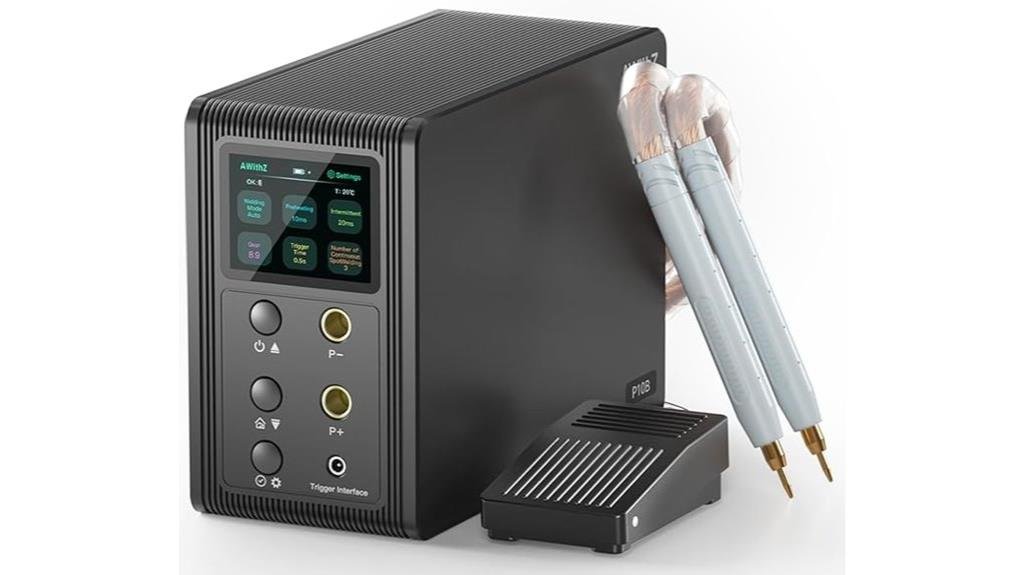
The AWithZ P20B is a capacitor battery spot welder made for battery pack building, battery repair work, and thin metal tab welding. It sits above many basic handheld welders because it uses two built-in supercapacitors and lists 14.6 kW maximum pulse welding power. That setup gives you short, strong pulses without relying on the same circuit behavior as a traditional AC spot welder.
The main reason to consider the P20B is control. You get 999 adjustable gear settings, a 2.4-inch LCD display, automatic mode, foot-pedal mode, and timing controls for preheating, pulse delay, trigger time, and continuous weld pulses. Those controls matter when you move from 0.15 mm nickel-plated strip to thicker nickel-plated sheet, pure nickel, stainless steel, iron, or thin copper.
The package focuses on battery work right away. It includes the P20B machine, a 15A charger, a 2 m foot pedal, an 18650 battery holder, a file, a manual, a 5 m roll of 0.15 mm nickel-plated sheet, and 3 pairs of replacement welding pins. The 60 cm flexible leads help you position the welding pen without dragging the machine around your bench.
Key Takeaways
- Delivers 14.6 kW maximum pulse welding power with two built-in supercapacitors for short, strong welds.
- Uses 999 adjustable gear settings, so you can tune weld strength for different material thicknesses.
- Includes a 2.4-inch LCD display that shows mode, gear, and operating information during setup and welding.
- Supports automatic and foot-pedal modes, giving you speed for simple work and control for careful alignment.
- Works with common battery pack cells, including 18650, 14500, 21700, 26650, 326650, and LiFePO4 cells.
- Handles listed materials up to 0.6 mm nickel-plated sheet, 0.3 mm pure nickel sheet with flux, and 0.2 mm copper sheet with flux.
- Best for DIY and light-to-medium shop use, not continuous heavy industrial production.
How this review was checked
We checked the live Amazon product listing and supporting product manual data for the AWithZ P20B before editing this review. We used verified product details for power, modes, compatibility, included accessories, material limits, display, weight, package size, safety notes, warranty, and setup details.
Performance and Welding Capability
Pulse Power and Weld Strength
The AWithZ P20B lists 14.6 kW maximum pulse welding power, which gives it more headroom than many low-cost handheld welders. The two built-in supercapacitors store energy for quick discharge, so the weld happens in a short pulse instead of a long heat cycle. That helps when you need strong battery tab welds without putting too much heat into nearby cell areas.
The P20B can handle common battery materials when you match the gear setting to the job. The listed range includes 0.6 mm nickel-plated sheet, 0.6 mm stainless steel sheet, 0.6 mm iron sheet, 0.3 mm pure nickel sheet with flux, and 0.2 mm copper sheet with flux. You should still run pull tests on scrap pieces because material stack, surface condition, probe pressure, and pulse timing all affect joint strength.
Repeatability for Battery Pack Work
The 999 gear settings give you very fine control, but they also create a learning curve. Once you find a working setting for 0.15 mm nickel-plated strip or 0.3 mm pure nickel, write that setting down for future builds. This saves time when you return to the same cell type, strip thickness, or pack layout.
The P20B suits common 18650, 14500, 21700, 26650, 326650, and LiFePO4 battery pack projects. It works best when you build a repeatable process: clean the contact area, hold the probes firmly, keep the probe tips sharp, and allow short cooling pauses during repeated cycles. Those habits matter more than chasing the highest gear number.
Modes, Controls, and Ease of Use
Automatic Mode
Automatic mode helps when you need a faster rhythm for simple welds. You set the proper gear, position the welding pen, and let the machine fire when the probes make contact. This mode works well for repeated nickel strip welds on a clean battery pack layout.
The 2.4-inch LCD display and OK indicator make setup easier because you can see when the unit is ready. The listing says the machine can reach the spot welding mark in about five minutes after connecting the 100-240V input and 15A charger. That short start time helps when you handle small repair jobs or quick test welds during a pack build.
Foot-Pedal Mode
Foot-pedal mode gives you better control when probe placement matters. The included 2 m pedal lets you hold both probe tips exactly where you want them before firing the pulse. This is useful near cell edges, busbar sections, or tight pack layouts where a small movement can ruin the weld.
The 60 cm flexible leads also help with bench work. They bend freely enough for normal positioning, and the replacement pins let you keep the welding tips in good shape over time. Probe wear changes weld quality, so fresh pins can matter as much as the gear setting.
Display, Timing Controls, and Setup Notes
The P20B uses a 2.4-inch LCD display to show mode, gear, and operating information. The interface matters because 999 gear settings can feel too broad without a clear screen. A visible display makes it easier to return to a working setup after you test a certain strip thickness.
The control system also gives you more than a simple power setting. You can adjust preheating from 1-10 ms, intermittent time from 1-20 ms, trigger time from 0.5-5.0 seconds, and continuous spot welding from 1-3 pulses per trigger. These options help when you need a different approach for nickel-plated strip, pure nickel, stainless steel, iron, or copper.
The welder lists protection features for overcharge, over-discharge, and over-temperature conditions. That does not remove the need for safe battery handling, but it does add useful protection for normal bench use. The listing also notes automatic shutdown after 8 minutes with no operation, which helps reduce accidental idle time.
- Quick Start: OK display after charging and setup
- Modes: automatic and foot-pedal operation
- Gears: 999 adjustable settings
- Timing: preheating, intermittent time, trigger time, and continuous pulse settings
- Display: 2.4-inch LCD screen
- Leads: 60 cm flexible leads with replaceable pins
- Controls: digital display and tactile buttons
Battery and Material Compatibility
Supported Battery Types
The AWithZ P20B targets battery pack building for common cylindrical cells and LiFePO4 packs. The listed battery types include 18650, 14500, 21700, 26650, 326650, LiFePO4, and similar battery pack work. That covers many DIY e-bike packs, tool battery repairs, small energy storage projects, and general battery rebuild work.
You still need to match the welding setup to the exact cell and tab design. A flat, clean contact surface helps the probes press evenly, while a poor pack layout can cause weak joints or uneven heat. For any new cell type, start with scrap strips and confirm your weld strength before working on the final pack.
Supported Metal Thicknesses
The P20B lists support for 0.6 mm nickel-plated sheet, 0.6 mm stainless steel sheet, 0.6 mm iron sheet, 0.3 mm pure nickel sheet, and 0.2 mm copper sheet. The listing notes that pure nickel and copper require flux, so you should not treat those materials like basic nickel-plated strip. Copper needs more care because it conducts heat and electricity differently than nickel.
The included 5 m roll of 0.15 mm nickel-plated sheet gives you a practical starter material. It is thin enough for common battery pack practice, so you can learn the controls before moving to thicker or more demanding materials. Keep notes for each material because a strong setting on nickel-plated strip may not work the same way on pure nickel or copper.
How It Performs in Real Use
For 18650 and 21700 Battery Packs
For 18650 and 21700 battery packs, the P20B gives you enough control to build a repeatable routine. The 999 gear settings let you tune weld strength for your strip thickness, and foot-pedal mode helps you line up the probes before firing. You get the best results when you use consistent pressure and repeat the same weld pattern across the pack.
For 26650, 326650, and LiFePO4 Packs
Large cylindrical cells and LiFePO4 pack work often need careful alignment because cell formats and tab positions can vary. The 60 cm flexible leads and 2 m foot pedal make the P20B easier to position around a larger pack layout. You should avoid rushing repeated welds because short cooling pauses help keep the leads and probe tips consistent.
For Copper and Thicker Metal Sheets
The listing includes thin copper support up to 0.2 mm with flux, but copper demands more testing than nickel. It can need higher settings, better probe pressure, cleaner surfaces, and careful surface preparation depending on your material stack. The P20B can handle this use case, but you should treat copper as an advanced material rather than your first practice strip.
Pros, Cons, and Who It’s Best For
Who It’s For
- DIY battery builders who work with 18650, 21700, 26650, 326650, or LiFePO4 cells and need more control than a basic handheld welder.
- Small repair shops that need automatic and foot-pedal modes for repeatable tab welding on thin sheet materials.
- Makers who want a compact capacitor spot welder with 14.6 kW peak pulse power and a starter accessory kit.
Who Should Skip It
- You should skip it if you need an industrial machine for long, continuous production runs.
- You should skip it if you want a one-button tool with no test welding or material setup.
- You should skip it if your work requires welding materials beyond the listed thin sheet range.
Pros and Cons
Pros
- 14.6 kW maximum pulse welding power gives you strong output for common battery tab welding.
- Two built-in supercapacitors provide short, controlled pulse energy for repeatable welds.
- 999 gear settings let you tune the machine for nickel-plated sheet, pure nickel, stainless steel, iron, and thin copper.
- Automatic and foot-pedal modes give you speed for simple welds and control for careful probe placement.
- The kit includes a 15A charger, 2 m foot pedal, 18650 holder, file, manual, 0.15 mm nickel-plated sheet, and replacement pins.
Cons
- The 999 settings give you fine control, but they also require testing before you find the right setup.
- It suits light-to-medium duty work better than heavy industrial production.
- Copper welding up to 0.2 mm requires flux, careful prep, firm probe pressure, and patient testing.
Is It Worth the Price?
The AWithZ P20B makes the most sense when you need more than a basic portable spot welder. Its 14.6 kW maximum pulse welding power, two supercapacitors, 999 gear settings, foot-pedal mode, 2.4-inch LCD display, and 60 cm leads put it in a stronger value position for serious DIY battery work. You get a complete starter kit, so you do not need to buy every small accessory separately before your first practice weld.
It offers strong value for the price if you build or repair battery packs often. The biggest value comes from repeatable control, not from raw power alone. If you only need a welder for one small project, a simpler unit may cost less and feel easier to learn.
For regular pack building, the P20B is a smart buy because it gives you room to grow. You can start with 0.15 mm nickel-plated sheet, then move into thicker nickel-plated sheet, pure nickel with flux, stainless steel, iron, or thin copper with flux as your skills improve. That range makes it a worthwhile investment for a focused battery workbench.
How It Compares to Alternatives
If you want a lower-power AWithZ option, the AWithZ UF20B 10.5 kW model may suit lighter battery repair work with less output headroom. If you want more power in the same brand family, the AWithZ P30C and AWithZ P60F variants give you higher-tier options for tougher jobs. The P20B remains the balanced choice if you want 14.6 kW output, foot-pedal control, and enough flexibility for common DIY and small-shop battery work.
Compared with simple handheld battery spot welders, the P20B gives you more precise control and a stronger accessory setup. Compared with heavier professional machines, it stays compact enough for a small bench. That middle position makes it best for users who need repeatable welds but do not need full production-line capacity.
Frequently Asked Questions
Can the AWithZ P20B weld 0.3 mm pure nickel sheet?
Yes. The listed material range includes pure nickel sheet up to 0.3 mm, and the listing notes that it requires flux. You should still run test welds because probe pressure, surface prep, and gear settings affect joint strength.
Does the AWithZ P20B work for 18650 and 21700 battery packs?
Yes. The P20B is listed for common battery pack work, including 18650, 14500, 21700, 26650, 326650, and LiFePO4 cells. It works best when you document your settings for each cell and strip thickness.
What comes in the box with the AWithZ P20B?
The package includes the P20B spot welding machine, a 15A charger, 2 m foot pedal, 18650 battery holder, file, manual, 5 m roll of 0.15 mm nickel-plated sheet, and 3 pairs of replacement welding pins. That gives you enough basic parts to start practice welds after setup.
Should you use automatic mode or foot-pedal mode?
Use automatic mode when you repeat simple welds and already trust your settings. Use foot-pedal mode when you need better control over probe placement, especially near tight tabs or larger pack layouts.
Can the AWithZ P20B weld copper battery tabs?
The listed material range includes copper sheet up to 0.2 mm with flux. Copper needs careful testing because it behaves differently from nickel, so start with scrap material before welding a real pack.
Does the AWithZ P20B require safety gear?
Yes. You should wear safety glasses or a face shield, heat-resistant gloves, and long sleeves when spot welding. Sparks, hot metal, and battery materials can create real risk during tab welding.
The Bottom Line
The AWithZ P20B earns an 8/10 because it combines 14.6 kW maximum pulse welding power, two built-in supercapacitors, 999 gear settings, a 2.4-inch LCD display, and useful automatic and foot-pedal modes in one compact battery spot welder. You should buy it if you build or repair battery packs often and want fine control over nickel, stainless steel, iron, and thin copper tab work. You should look elsewhere if you need heavy industrial output or a simple tool that requires almost no testing.
Ready to Buy?