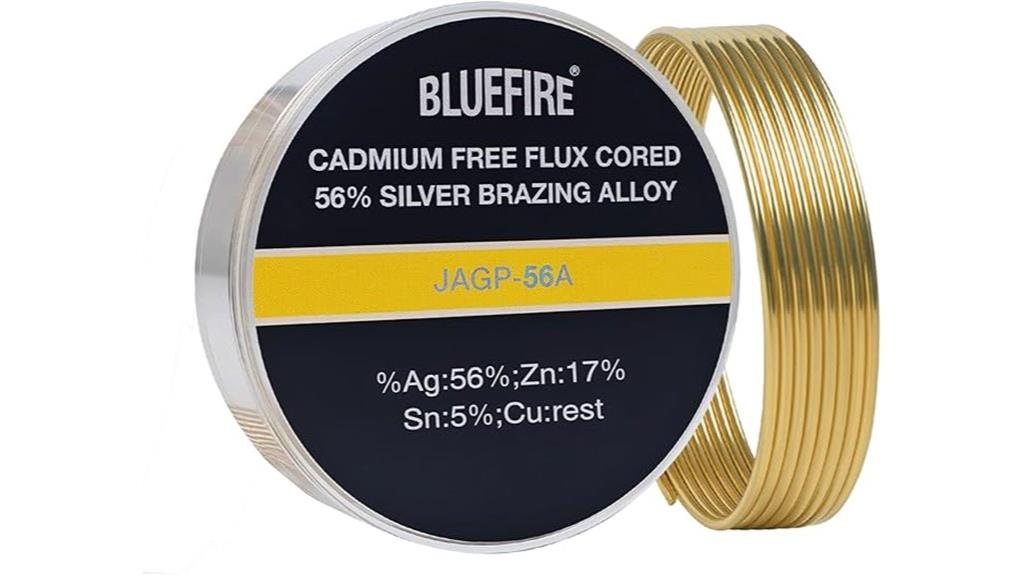
The BLUEFIRE JAGP-56A is presented as a 56% silver brazing alloy with a 1145°F solidus, notable fluidity, and deep penetration for tight joints. It suits plumbing, HVAC, electronics; requires minimal flux, offers strong tensile strength, and works with thin-walled tubing and delicate parts. What are the exact flux choices, flame settings, and joint clearances to optimize results—those practical details follow next.
Key Takeaways
- BLUEFIRE JAGP-56A is a cadmium-free brazing alloy (56% Ag, 17% Zn, 5% Sn, balance Cu) for reliable joints.
- Low solidus (1145°F/618°C) and high fluidity deliver strong capillary action and deep penetration.
- Flux-cored 1/16″ coil often eliminates external flux, simplifying application for tight assemblies.
- Works with common heat sources (propane torch); recommended brazing clearance is 0.002–0.005″.
- Meets major standards (ANSI/AWS, ASME, QQ-B-654A, AMS 4763, NSF 51, ISO 17672) with typical safety precautions.
Product Specifications and Composition
Specifications and composition are presented to give a clear, practical picture of what the BLUEFIRE JAGP-56A offers and how it should be used.
The product undergoes a composition analysis showing 56% Ag, 17% Zn, 5% Sn, balance Cu; cadmium-free.
Composition analysis: 56% Ag, 17% Zn, 5% Sn, balance Cu — cadmium-free for safer brazing.
What are the alloy benefits? Low-temperature brazing, good fluidity, and capillary action without extra flux.
Practical specs: 1/16″ flux-cored coil, solidus 1145°F (618°C), liquidus 1208°F (652°C), brazing clearance 0.002–0.005″.
Considerations: torch type (propane OK), applications (brass, copper, steel), portability, and compliance standards listed.
Performance and Brazing Characteristics
Evaluate the BLUEFIRE JAGP-56A for its practical brazing performance: the flux-cored 1/16″ coil delivers a low solidus of 1145°F (618°C) and reaches liquidus at 1208°F (652°C), producing a narrow melting range that promotes controlled flow and reliable joint formation.
The reviewer notes melting efficiency, fluidity, capillary action, and deep penetration; flux application is simplified by the core, eliminating external flux in many cases.
Q: What clearances work best? A: 0.002–0.005″ preferred.
Q: Heat source? A: Propane torch is adequate.
Expect high ductility, consistent joint wetting, and predictable heating windows.
Recommended Applications and Use Cases
For technicians, hobbyists, and small-scale fabricators seeking a versatile, low-temperature brazing alloy, the BLUEFIRE JAGP-56A coil offers a practical balance of performance and convenience: its 1/16″ flux-cored wire with 56% silver brazes reliably at a solidus of 1145°F (618°C) and reaches liquidus at 1208°F (652°C), making it well-suited for brass, copper, and steel joints that require tight clearances (preferred 0.002–0.005″ gap).
It flows with high fluidity and capillary action, penetrates deeply for strong, ductile joints, and usually needs no external flux when used with a propane torch.
Common applications include plumbing and heating fittings, refrigeration and HVAC components, electrical connectors and contacts, food-processing containers and piping (meets NSF 51), precision instruments such as surgical tools and watches, and decorative metalwork—what heat source should be used?
Recommended application scenarios:
- Plumbing, heating: 0.002–0.005″ gaps, copper/brass fittings.
- HVAC, refrigeration: valves, heat exchangers.
- Electronics: connectors, waveguides (small joints).
- Precision instruments: delicate assemblies.
Brazing techniques: torch brazing with propane or MAPP, controlled preheat for larger assemblies, jigging for alignment.
Practical considerations: regulator, tip size, joint clearance, and post-braze inspection.
Handling, Safety, and Compliance
Handle BLUEFIRE JAGP-56A with standard brazing precautions and attention to temperature, ventilation, and joint preparation: the alloy reaches a solidus at 1145°F (618°C) and liquidus at 1208°F (652°C).
Operators should expect localized workpiece temperatures up to 1400°F (760°C) during brazing.
The reader should ask: What safety precautions are required? Use heat-resistant gloves, eye protection, respirators if ventilation is poor, and maintain clear work zones.
Is compliance standards met? Yes: ANSI/AWS A5.8, ASME SFA 5.8, QQ-B-654A, AMS 4763, NSF 51, ISO 17672.
Store dry, label coils, follow waste disposal rules.
Tips for Best Results and Troubleshooting
When preparing to use BLUEFIRE JAGP-56A for reliable brazes, operators should prioritize joint fit, heat control, and cleanliness to achieve consistent capillary flow and penetration.
Operators seeking liberation from failures will value clear guidance. Which brazing techniques work best? Use 0.002–0.005 in. clearance, preheat slowly, apply 1205°F–1400°F within the brazing range, and feed the 1/16 coil steadily.
Is flux required? Minimal flux usage is needed, but clean surfaces and controlled flame eliminate residues.
Troubleshooting: poor flow = increase temperature 10–30°F, gaps too large = re-machine, oxidized parts = clean with solvent, repeat.
Frequently Asked Questions
Can BLUEFIRE JAGP-56A Be Reflowed in a Furnace for Mass Production?
Yes, it can be furnace-compatible for mass production; the alloy’s narrow melting range and predictable fluidity suit controlled reflow cycles, empowering manufacturers seeking liberation from manual torch brazing toward scalable, consistent, efficient processes.
What Is the Shelf Life and Ideal Storage Conditions for the Coil?
Shelf life is typically indefinite if kept sealed; storage conditions demand cool, dry, oxygen-limited confinement. The reader senses liberation: sealed coils, protected from humidity and contamination, preserve performance and free craftsmen to work without worry.
Are Replacement Coils or Different Diameters Available for This Product?
Yes. It offers replacement options and varied coil sizes; users seeking liberation can select alternative diameters and spare coils to match tasks, enabling independent repairs, portability, and freedom from constraints across applications and workplaces.
Does the Alloy Affect Electrical Conductivity in Fine Electronics?
Yes. It subtly influences electrical performance: the alloy composition (56% Ag with Zn, Sn, Cu) preserves good conductivity yet slightly alters resistance and contact behavior, so designers seeking freedom should verify joint dimensions and clearances.
Can the Brazed Joints Be Post-Machined or Polished Without Special Care?
Yes. It can be machined and polished using standard brazing techniques without special care, provided joint integrity is preserved; liberated makers should verify clearance and cool slowly to avoid stress, ensuring smooth finishes and reliable performance.
Conclusion
The BLUEFIRE JAGP-56A proves a reliable choice for precision brazing, offering 56% silver content, a 1,145°F solidus, and superior fluidity for deep penetration and minimal flux. It performs well on copper, brass, and thin-sheet assemblies, and suits plumbing, HVAC, and electronics when controlled heat and proper flux are used. Users should note joint fit, torch control, and ventilation. For delicate work, its predictable flow is almost magically consistent, delivering durable, reproducible joints.