When you’re towing, semi-metallic brake pads generally stop your truck better than ceramics because they handle high heat, heavy loads, and fade far more effectively. Ceramic pads run quieter and cleaner but can overheat and lose friction on long grades or near GCWR, reducing safety margins. Semi-metallics increase rotor wear and noise yet provide stronger, more consistent braking under 5,000–8,000 lb trailer loads, which is critical for emergency stops and mountain descents, as you’ll soon see in more detail.
Why Brake Pad Material Matters When You’re Towing
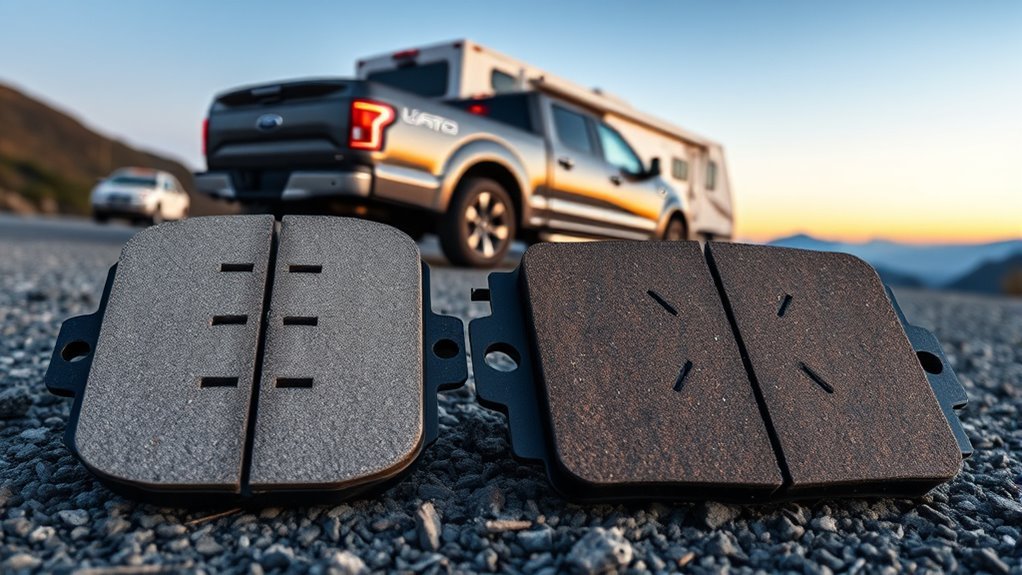
When you’re towing, brake pad material isn’t a minor detail—it directly affects heat management, stopping distance, and overall safety. Under heavy loads, brake temperatures spike, so you need a compound that maintains coefficient of friction instead of fading. Here, material choice becomes central to towing safety and pad compatibility with your truck’s duty cycle.
Ceramic pads can overheat and lose bite when you’re descending grades or making repeated hard stops with a trailer. Semi‑metallic pads, by contrast, tolerate higher temperatures, sustain grip, and deliver more consistent deceleration in extreme towing conditions. They’re noisier and harsher on rotors, but users repeatedly report longer service life in towing, making them a more reliable and cost‑effective option when maximum braking performance matters. Additionally, ceramic formulations are engineered for low dust output, which can be beneficial for maintaining cleaner wheels during towing activities.
How Ceramic and Semi-Metallic Pads Are Built
Material choice only tells half the story; how each pad is built explains why it behaves the way it does under a trailer load.
With ceramic pads, pad composition centers on dense ceramic fibers blended with fine copper fibers. Manufacturing processes compress and cure this mix into a rigid, uniform friction block. The result is a stable structure that sheds minimal, light-colored dust, runs smoothly, and is relatively gentle on rotors, which helps preserve braking hardware over long towing seasons.
Semi-metallic pads use a high percentage of steel, iron, and copper particles bound with resin. Their manufacturing processes create a tougher, more abrasive matrix that bites harder into the rotor and generates darker, grittier dust, trading component wear and cleanliness for maximum robustness.
Heat, Fade, and Stopping Power Under Heavy Loads
Although both pad types can stop a trailer, they diverge sharply once you’re dealing with sustained heat and real towing weights. Under repeated downhill stops with 5,000–8,000 lbs behind you, semi‑metallic pads manage heat and fade far better. They reach operating temperature quickly, then hold friction as rotor temps climb, preserving towing safety when you need maximum decel on long grades.
Ceramic pads, by contrast, run the risk of overheating; once past their thermal window, pedal effort rises while actual stopping power drops. When you evaluate brake pad compatibility for towing, you’re really comparing how each material behaves at elevated temperatures.
| Load (lbs) | Pad Type | Relative Braking Performance |
|---|---|---|
| 3,000 | Ceramic | Good |
| 3,000 | Semi‑metallic | Good |
| 5,000 | Ceramic | Fair |
| 5,000 | Semi‑metallic | Very Good |
| 8,000 | Semi‑metallic | Excellent |
Rotor Wear, Pad Life, and Long-Term Maintenance
When you choose pads for towing, you’re really choosing how much rotor wear you’ll accept, how long the pads will last under load, and what you’ll spend over the life of the system.
Semi‑metallic pads typically increase rotor wear but offer superior pad life and thermal stability, while ceramics are easier on rotors yet can lose effectiveness under sustained high temperatures.
To manage long‑term maintenance costs and safety margins, you’ll need to balance these trade‑offs with disciplined inspection intervals and high‑quality components.
Rotor Wear Differences
Even with the same calipers and rotors, your choice between semi‑metallic and ceramic pads changes how quickly the rotors wear, how long the pads last, and what you’ll spend on long‑term brake maintenance. Semi‑metallic pads bite harder, boosting brake efficiency under towing, but their abrasive fibers shave material from the disc faster, reducing rotor lifespan. Ceramic pads generate a more stable, less aggressive friction layer, so they’re generally gentler on rotors and extend service intervals.
| Pad Type | Rotor Wear Rate | Typical Use Case |
|---|---|---|
| Semi‑metallic | Higher, faster wear | Heavy towing, steep grades |
| Ceramic | Lower, slower wear | Mixed use, light–moderate tow |
| Either (neglect) | Unpredictable, unsafe | Skipped inspections, overload |
You’ll want frequent rotor inspections with semi‑metallics to catch thickness loss and heat checking before they become a safety risk.
Pad Lifespan in Towing
Under sustained towing loads, pad lifespan depends less on brand and more on friction material, heat management, and inspection discipline.
In real towing scenarios, semi‑metallic pads typically deliver better pad longevity than ceramics because they tolerate sustained high rotor temperatures without glazing or fade, especially with 5,000–8,000 lb trailers.
Ceramic pads run cleaner and are easier on rotors, but they’re more prone to overheating under heavy loads, which can shorten pad life when you’re descending long grades or stopping repeatedly with a loaded trailer.
Key lifespan factors you control:
- Match pad type to trailer weight and route profile
- Monitor pad thickness before and after long trips
- Watch for heat-related glazing or cracking
- Use engine braking to reduce thermal load
- Replace pads at conservative wear limits for towing safety
Long-Term Maintenance Costs
Although pad choice often starts with pedal feel and towing confidence, it ultimately shows up in your long‑term maintenance costs through pad replacement intervals, rotor wear, and inspection frequency.
In a strict cost analysis, semi‑metallic pads can be cheaper per mile under heavy towing because their higher heat tolerance often delivers longer pad life. However, they’re harder on rotors, so you’ll likely replace rotors sooner, increasing total brake maintenance cost.
Ceramic pads usually treat rotors more gently and, in normal driving, often last longer than semi‑metallics, extending rotor service intervals. They also shed less dust, cutting wheel-cleaning time and corrosion risk.
Regardless of material, you should schedule frequent inspections when towing to detect cracking, taper wear, and heat‑related rotor damage early.
Noise, Vibration, and Brake Feel in Real-World Towing
When you’re towing, the way your brakes sound and feel becomes a real safety signal, not just a comfort issue.
Semi-metallic pads typically generate more squeal and growl under hard stops, while ceramics emphasize noise reduction and smoother engagement.
You’ll also feel more vibration with semi-metallics, because their metallic content transmits energy through the pedal, demanding better vibration control from the rest of the system.
- Semi-metallic pads: higher noise and vibration, but sharper initial bite.
- Ceramic pads: quieter, smoother pedal, ideal for lighter trailers.
- Under max-load towing, semi-metallics’ firmer feedback can improve confidence.
- For long highway hauls, ceramics reduce fatigue from constant noise and harshness.
- Your choice should match load weight, terrain, and your tolerance for NVH.
Brake Dust, Wheel Cleanliness, and Corrosion Concerns
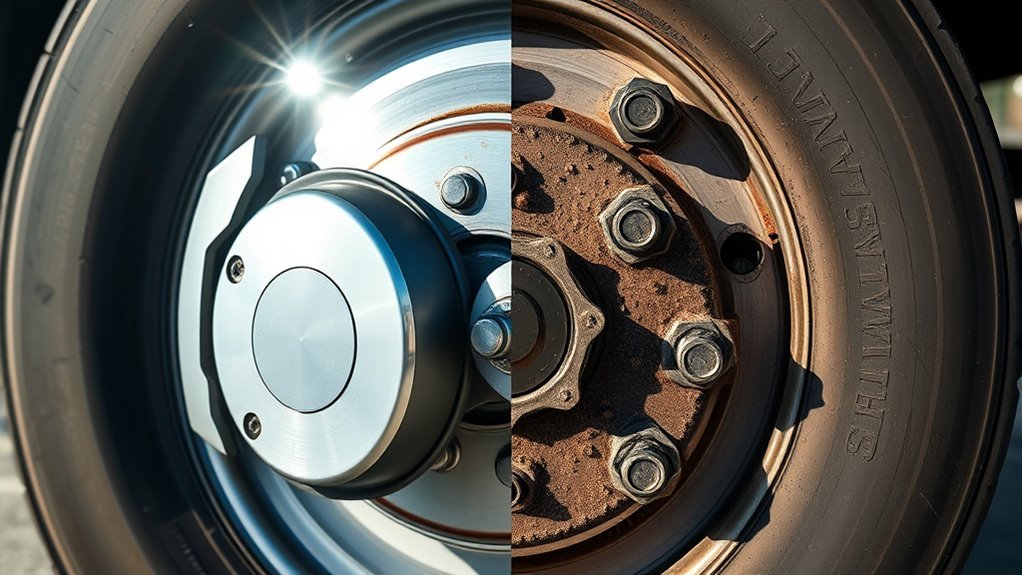
Even if you focus mainly on stopping power and fade resistance for towing, you can’t ignore how different pad compounds affect brake dust, wheel cleanliness, and long‑term corrosion.
With ceramic pads, you typically see far less visible residue, so brake dust management becomes easier and your wheels stay cleaner between washes.
Semi-metallic pads tell a different story. Their dust is darker, coarser, and rich in ferrous particles. Those particles can embed in clearcoat, hold moisture, and create localized rust staining, undermining corrosion prevention over time—especially if you tow in wet or salted environments.
Ceramic dust is lighter-colored and largely non‑corrosive, so it’s less likely to accelerate wheel or hardware degradation, a meaningful factor when you’re protecting an expensive tow vehicle.
Performance in Mountains, Stop-and-Go Traffic, and Emergencies
Once you leave flat highways and start dealing with grades, congestion, and panic stops, the way a brake pad manages heat under load matters more than its dust output or rotor friendliness.
For mountain performance with a trailer, semi‑metallic pads typically outperform ceramics because they tolerate higher rotor temperatures and maintain friction on long descents. That translates into shorter, more repeatable stops and less fade when you’re holding back 5,000–8,000 lbs.
- Semi‑metallics deliver stable coefficients of friction on steep grades.
- Ceramics can soften as temperatures climb in extended downhill braking.
- In stop‑and‑go traffic, ceramics run quieter but may need more pedal force.
- Semi‑metallics respond faster under heavy loads and repeated stops.
- During emergency braking, semi‑metallics retain grip and driver confidence.
Best Brake Pad Choices for Half-Ton and Heavy-Duty Trucks
For half-ton and heavy-duty trucks that regularly tow, semi-metallic brake pads are the primary choice because they handle the elevated rotor temperatures and repeated high-energy stops that towing creates. When you make your brake pad selection, you should prioritize friction stability, fade resistance, and wear life over noise and dust. Field reports consistently show semi-metallic pads outlasting ceramics in towing use, especially on long grades and repeated stops.
| Truck Class | Recommended Pad Type | Key Reason for Towing Safety |
|---|---|---|
| ½-ton light duty | Semi-metallic | Better heat management |
| ¾-ton | Semi-metallic | Higher friction under heavy load |
| 1-ton+ HD | Semi-metallic | Maximum fade resistance |
Ceramics can run quieter, but they’re more prone to overheating and accelerated wear under trailer loads, reducing towing safety.
Brand Examples and Popular Pad Options for Towing
When you’re selecting towing pads, you’ll want to compare top semi‑metallic options like RAYBESTOS HD and Hawk LTS against leading ceramic choices such as ACDelco 14D785CH and Bosch BC905 QuietCast.
Semi‑metallic pads typically offer higher friction and better fade resistance under heavy loads, while ceramic pads often run quieter and produce less dust at slightly lower operating temperatures.
Top Semi-Metallic Options
Several semi-metallic pad lines stand out as proven choices for towing, combining higher temperature tolerance, consistent friction, and durability under heavy loads.
When you’re prioritizing semi metallic advantages and towing performance, focus on proven HD formulas and complete systems validated under high-heat, high-mass braking cycles.
- Raybestos HD Semi-Metallic: Engineered for extreme heat loads; ideal for frequent mountain descents and max-GVWR towing.
- Power Stop K6268-36 Z36 Kit: Matched rotors and semi-metallic pads; low dust and reduced noise without sacrificing μ (friction coefficient).
- ACDelco 14D785CH: OE-style safety focus; stable friction curve across temperature ranges.
- Hawk LTS: Optimized for trucks/SUVs; strong initial bite and fade resistance under heavy trailers.
- Durability Edge: Field reports show semi-metallic pads typically outlast ceramic in towing, reducing service intervals and risk of fade-related incidents.
Leading Ceramic Pad Choices
Semi‑metallic pads set the benchmark for heat capacity and fade resistance under maximum tow loads, but many tow rigs still run ceramics for their quieter operation, low dust, and rotor-friendly behavior.
In brake pad comparisons, two leading ceramic choices are Bosch BC905 QuietCast (about $36.18) and ACDelco 14D785CH (about $43.02). Both target daily-driving trucks that occasionally tow.
Bosch QuietCast ceramics emphasize noise control and stable friction at elevated temperatures, while ACDelco’s ceramic compound focuses on consistent pedal feel, low dust, and extended rotor life.
However, when you push towing performance—long downhill grades, repeated hard stops, GCWR near max—ceramics can lose effectiveness as rotor and pad temperatures spike.
For trucks that tow frequently or at maximum weight, semi‑metallics remain the safer choice.
How to Choose the Right Pads for Your Truck and Trailer Weight
Choosing the right brake pads for towing starts with one critical variable: combined truck and trailer weight.
> Selecting tow-ready brake pads begins with one factor: the total combined weight of your truck and trailer.
You need pad compatibility with your axle ratings, rotor material, and the manufacturer’s towing guidelines. For loads in the 5,000–8,000 lb range, semi-metallic pads usually deliver safer, more consistent stopping thanks to higher heat resistance and stable friction coefficients.
Use this checklist when matching pad type to weight:
- Verify gross combined weight rating (GCWR) and typical loaded trailer weight.
- Choose semi-metallic pads for frequent towing near GCWR or in mountainous terrain.
- Avoid ceramic pads when sustained braking generates extreme rotor temperatures.
- Confirm pad friction rating and temperature range in the product specs.
- Reassess pad choice if you change trailer size, load, or driving conditions frequently.
Frequently Asked Questions
Do Ceramic or Semi-Metallic Pads Affect My Truck’s Factory Warranty When Towing?
They usually don’t void your factory warranty, but warranty implications arise if pads don’t meet OEM specs. Use pads matching OEM friction ratings; document installation to prove safe towing performance and compliance if a brake-related warranty claim occurs.
How Do Brake Pad Choices Interact With Electronic Trailer Brake Controllers?
Brake pad material doesn’t change electronic brake controller compatibility directly, but it alters front-axle friction and heat, affecting towing efficiency, bias, and ABS behavior. You should re-test controller gain, boost, and manual override after any pad change.
Are Ceramic Pads Safe for Use With Oversized Aftermarket Brake Rotors and Calipers?
Yes, you can safely run ceramic pads with oversized components if you verify brake compatibility: match pad compound to rotor metallurgy, confirm caliper temperature limits, maintain proper bedding procedures, and regularly monitor rotor temperatures and pad wear patterns.
Do Different Pad Materials Change Recommended Brake Fluid Type or Service Intervals?
Pad material doesn’t usually change brake fluid type, but higher-heat pads demand fluids with better boiling points. You should follow OEM brake fluid compatibility and shorten service interval recommendations under heavy towing, track use, or repeated high‑load descents.
How Does Cold-Weather Performance Differ Between Ceramic and Semi-Metallic Pads When Towing?
You’ll see semi-metallic pads deliver better cold weather performance and initial bite when towing, while ceramics need slight warmup, reducing early stopping torque and towing efficiency; however, ceramics maintain quieter operation and lower rotor wear once temperatures stabilize.
Conclusion
When you’re towing, you can’t treat brake pads as an afterthought. Semi‑metallic pads typically deliver higher thermal capacity, more consistent friction, and better fade resistance under heavy loads, making them safer for frequent mountain descents and emergency stops. Ceramics run cleaner, quieter, and gentler on rotors, but can lose bite when pushed hard. Match pad type to your truck’s GVWR, trailer weight, and duty cycle—and always verify ratings, installation quality, and bed-in procedure.