Long-term stroller storage takes more than folding the frame and placing it in a corner. You need to remove food, dirt, and moisture, protect the moving parts, choose a stable indoor location, and inspect the stroller before your child rides in it again. The exact cleaning and disassembly steps should always follow your model’s manual.
Quick Answer
To store a stroller long-term, clean it according to the manufacturer’s instructions, let every part dry completely, remove only user-detachable accessories, and place it under a breathable cover in a cool, dry, pest-free indoor area. Before reuse, check recalls, frame locks, brakes, wheels, harnesses, and fabric condition.
Key Takeaways
- Use the cleaning, washing, lubrication, and disassembly directions for your exact stroller model.
- Never cover or fold away damp fabric. Moisture can support mold, odors, staining, and corrosion.
- Choose a clean indoor location with stable temperature and humidity, not simply any basement, attic, or garage.
- Do not vacuum-seal the complete stroller or wrap it tightly in non-breathable plastic.
- Before reuse, check the model and serial number for recalls and test every safety-critical part without a child seated.
At a Glance
| Time Required | About 45–90 minutes of active work, plus complete air-drying time |
| Difficulty | Easy, with model-specific instructions |
| Tools Needed | User manual, soft brush or vacuum attachment, cloths, mild cleaner approved by the manufacturer, labels, small bags, and a breathable cover |
| Cost | Low; most supplies are common household items, with a cover or humidity meter optional |
Importance of Long-Term Stroller Storage
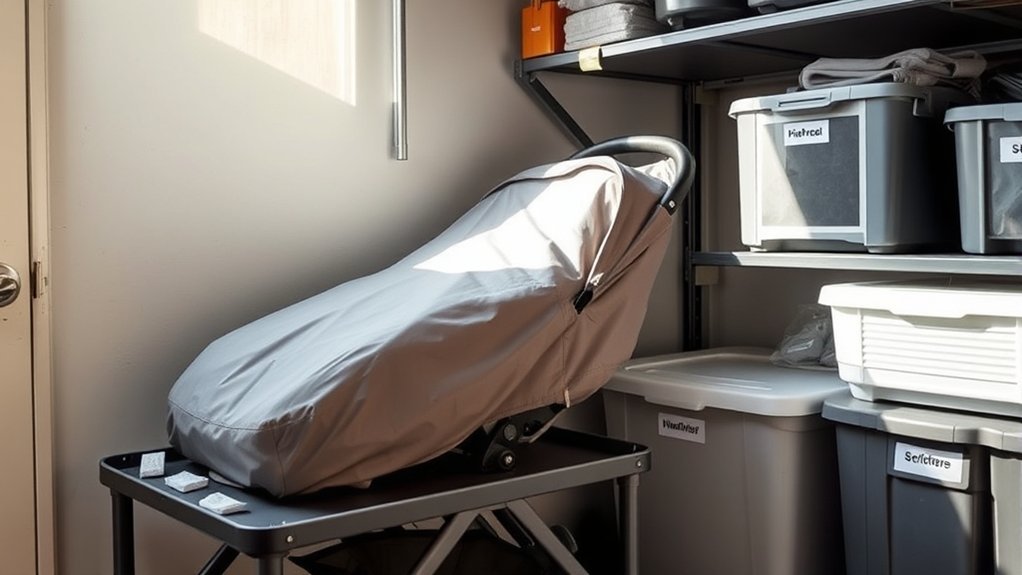
Correct long-term storage helps preserve the stroller’s fabric, frame, wheels, brakes, folding joints, and harness system. It also makes future inspection easier because dirt and dried spills are not hiding cracks, corrosion, pests, or worn webbing.
Cleaning and complete drying are especially important. The U.S. Environmental Protection Agency explains that moisture control is the key to preventing mold and recommends drying damp items promptly. A stroller should be fully dry before you fold it, cover it, or place it in storage.
Storage does not guarantee that an older stroller will remain safe forever. Recalls, missing parts, crash damage, corrosion, and material deterioration can make a stored stroller unsuitable for reuse. Keep the model name, model number, serial number, manual, and proof of purchase together whenever possible.
Warning: Do not use a stroller that is recalled, has a cracked or bent frame, will not lock open, has unreliable brakes, or has a damaged harness. Stop and contact the manufacturer for an approved repair or replacement.
Before You Start: Find the Manual and Record the Model
Find the instructions for your exact model before removing fabric, wheels, canopies, baskets, or hardware. Cleaning methods vary. A seat pad that is machine washable on one stroller may require hand cleaning on another, and some lubricants or household cleaners can damage coatings, plastics, foam, or flame-resistant materials.
If the paper manual is missing, search the manufacturer’s official support site. For example, Graco provides a product-instructions portal, while other brands offer model-specific manuals through their support pages.
- Photograph the stroller fully assembled from the front, back, sides, and folding joints.
- Record the brand, model, manufacture date, model number, and serial number.
- Save the manual with the stroller or in a clearly labeled digital folder.
- Check the CPSC recall database before storage and again before reuse.
Preparing Your Stroller for Storage

Preparation should remove crumbs, spills, mud, moisture, and anything that could attract insects or rodents. Work in a well-ventilated area and keep small parts away from children.
Empty the basket, cup holders, parent console, seat pockets, rain cover pouch, and accessory compartments. Remove batteries from any detachable light, fan, sound unit, or electronic accessory so leaking batteries cannot damage the stroller during storage.
Clean Thoroughly Before Storing
Start with dry debris. Use a soft brush or low-suction vacuum attachment around seams, the basket, hinges, wheel housings, and under the seat. Avoid pulling hard on loose threads or placing a powerful vacuum nozzle directly against delicate fabric.
Remove only fabrics and accessories that the manual identifies as user-removable. Wash or spot-clean them exactly as directed. Do not assume every fabric part can go in a washing machine or dryer.
Wipe the frame, plastic parts, basket supports, and wheels with the cleaner approved in the manual. A mild soap-and-water solution is common, but the manufacturer’s instructions take priority. Keep water away from sealed bearings, electronic parts, and areas the manual says not to soak.
Inspect the brakes, folding mechanism, wheel attachments, handle, seat supports, harness webbing, buckles, stitching, and fasteners while the stroller is clean. Dirt can conceal damage that should be addressed before storage.
Dry Every Part Completely
Air-dry the stroller and removable fabric in a shaded, ventilated place. Open folds, pockets, padding, and seams so trapped moisture can escape. Do not store fabric that feels cool or damp, and do not refit a seat pad until both the pad and the frame beneath it are dry.
The EPA advises keeping indoor humidity below 60 percent when possible, ideally between 30 and 50 percent, to help control moisture and mold. A small humidity meter can help you judge a basement, closet, or storage room instead of guessing.
Use Protective Covers
A clean, breathable fabric cover can reduce dust, scratches, and pest exposure while allowing some airflow. Choose a cover large enough that it does not compress the canopy, seat padding, harness, or handle.
Avoid sealing the whole stroller in a plastic bag or wrapping it tightly with an impermeable tarp. Trapped moisture and condensation can create odors, staining, mold, or corrosion. If you use a water-resistant outer cover in a potentially dusty room, make sure the stroller is completely dry and the cover is not airtight.
Check the cover during storage. Replace or clean it if it becomes damp, torn, dirty, or infested.
Choosing the Right Storage Location
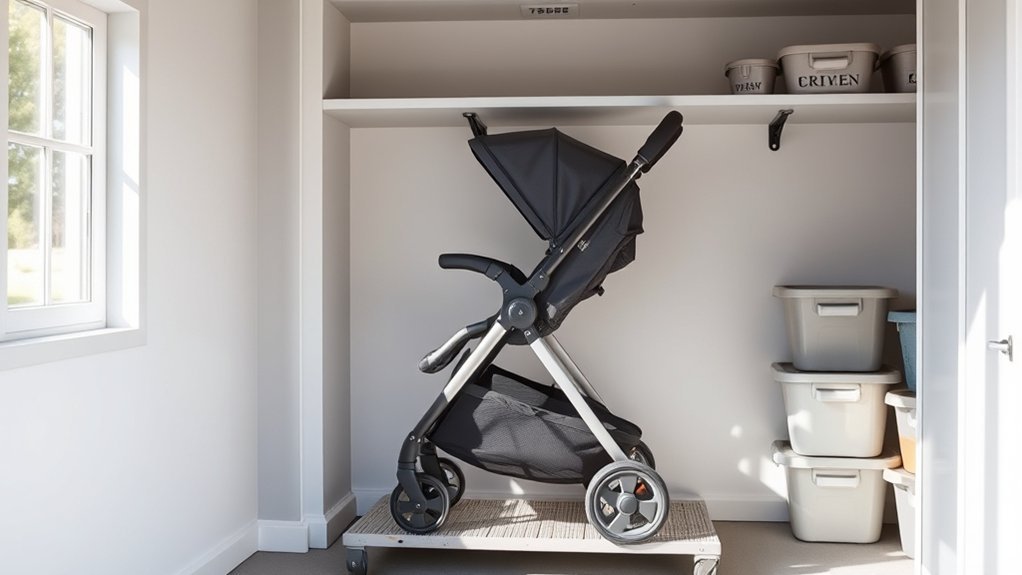
The best location is a clean, dry, pest-free indoor space with stable temperature and humidity. A closet, interior storage room, or conditioned utility area is usually safer than a place exposed to roof heat, freezing temperatures, leaks, or outdoor air.
Do not rely on the name of the room. Some basements are dry and controlled, while others are damp. Some garages stay stable, while others become extremely hot, cold, dusty, or humid.
Assess Available Space
Choose a spot where the stroller fits without heavy objects resting against it. Leave enough room to remove it without dragging the frame or snagging the fabric.
- Protect the frame: Store the stroller on a level surface in its normal folded or standing position, as allowed by the manual.
- Avoid pressure points: Do not stack boxes on the seat, canopy, handle, basket, or wheel assemblies.
- Keep it accessible: Place the manual and labeled parts beside the stroller so nothing gets separated.
- Prevent falls: Do not balance a heavy stroller on a narrow shelf or hang it by the handle unless the manufacturer specifically approves that method.
Consider Environmental Factors
Check for water leaks, condensation, musty odors, pests, direct sunlight, and large temperature swings. The EPA notes that mold can grow when spores land on wet surfaces and that moisture control is central to prevention.
Keep the stroller off a damp concrete floor with a stable shelf or platform that safely supports its weight. Elevation can reduce contact with minor moisture, but it does not make a wet room suitable.
Avoid direct sunlight, which can fade fabric and age some plastics over time. Keep the stroller away from heaters, furnaces, hot pipes, chemicals, paint, fuel, pesticides, and areas where sharp tools or heavy equipment may strike it.
Note: A basement, attic, or garage is acceptable only when it stays dry, reasonably clean, pest-free, and within a stable temperature and humidity range. Outdoor storage is not recommended for long-term stroller care.
Evaluate Future Needs
Think about how soon you may need the stroller and whether its configuration will still suit your child or family. Keep adapters, bassinets, second seats, rain covers, snack trays, and other compatible parts labeled by model.
- Future use: Note which child, age range, and configuration the stroller was last set up for.
- Compatibility: Keep only manufacturer-approved adapters and accessories with the stroller.
- Service needs: Replace missing or worn parts with approved parts before storage when possible.
- Resale or donation: Preserve the manual, labels, serial number, and recall information for the next caregiver.
Best Practices for Storing Strollers
Once the stroller is clean and dry, fold it according to the manual. Engage any storage latch, but do not force the frame if the fold feels stiff or misaligned. A jammed hinge may contain debris or need service.
Store accessories in labeled containers. Keep small hardware, clips, and approved adapters together, but do not put loose metal parts directly against fabric where they could stain or tear it.
A stroller is ready for storage only when it is clean, completely dry, documented, protected from pressure, and placed in a stable environment.
Do not store the stroller outdoors, under an open porch, or in a shed that admits rain, insects, rodents, or large temperature swings. Elevating an outdoor stroller does not protect its fabric, bearings, brakes, harness, or folding joints from the environment.
Keep the stroller where an adult can inspect it every few months without moving heavy objects. Easy access makes it more likely that you will notice leaks, pests, mold, rust, or a damaged cover early.
Protecting Your Stroller From Damage
Damage prevention depends on controlling moisture, pressure, dirt, chemicals, pests, and unauthorized modifications. Use these steps:
- Clean and dry it: Remove food, dirt, and moisture before storage.
- Protect without sealing: Use a breathable cover instead of airtight plastic around the complete stroller.
- Control the environment: Choose a stable indoor area and correct leaks or high humidity.
- Keep weight off it: Do not stack boxes or equipment on the frame, seat, canopy, or wheels.
- Prevent pest damage: Store no snacks with the stroller and inspect the cover and basket for droppings, nesting, or chewing.
- Avoid unapproved repairs: Do not glue, drill, weld, sew, or substitute hardware on a safety-critical part unless the manufacturer provides that remedy.
Maintaining Stroller Condition During Storage
Inspect the stroller every two to three months, and sooner after a leak, flood, pest problem, or major temperature event. Look under the cover and around the floor rather than checking only the visible side.
Check for dampness, musty odors, visible mold, rust, pest activity, cracked tires, sticky wheels, damaged fabric, and pressure marks. If the storage area is humid, use a dehumidifier or move the stroller to a better location instead of relying only on moisture-absorbing packets.
Do not spray a general-purpose lubricant into hinges, brakes, or wheel assemblies without checking the manual. Lubricants can attract dirt, contaminate brake surfaces, or damage materials. Use only the product and application method specified by the manufacturer.
If you removed wheels, a canopy, seat fabric, or other user-detachable parts, make sure their storage container remains dry and clearly labeled. Do not remove rivets, structural bolts, brake cables, or factory-installed harness parts for space-saving.
Tips for Accessing Strollers After Long-Term Storage
Bring the stroller into a bright, ventilated area before reuse. Remove the cover, air out the fabric, and clean any settled dust according to the manual.
- Check recalls: Search the CPSC database using the brand and model, then review the manufacturer’s recall page.
- Inspect the structure: Look for cracks, bends, loose joints, corrosion, missing fasteners, and damaged welds or rivets.
- Test moving parts: Open and fold the stroller several times, confirming that every frame lock fully engages.
- Test brakes and wheels: Check wheel retention, steering, tire condition, brake engagement, and brake release on a level surface.
- Inspect the restraint system: Check the harness webbing, stitching, buckle, adjusters, and attachment points for wear or damage.
- Check fabric and padding: Look for mold, rodent damage, brittle foam, torn seams, and stains that may indicate moisture.
- Confirm configuration: Reinstall only approved parts and verify that each clicks or fastens into place as the manual describes.
Complete all tests without a child in the stroller. If anything feels loose, stiff, unreliable, or different from the manual, stop and contact the manufacturer.
Organizing Detachable Parts for Easy Reassembly
Good organization prevents missing adapters, clips, wheels, rain covers, and hardware when the stroller returns to service. Label each removable part with the stroller brand, model, and its location.
Place small parts in a sealed, labeled container after they are clean and completely dry. Keep the container beside the stroller rather than inside a damp basket or fabric pocket.
Save the assembly photos you took before disassembly. Include close-up pictures of wheel orientation, canopy attachment points, seat direction, buckle routing, and any approved adapters.
Keep the user manual, purchase information, service records, and recall notices in the same folder. This documentation is useful for future use, resale, donation, or manufacturer support.
Pro Tip: Put a dated checklist inside the cover listing what you removed, where the parts are stored, the stroller’s model and serial number, and the last inspection date.
Regular Maintenance Checks for Stroller Longevity
Regular checks during storage help you catch problems before they become severe. Focus on parts that support the child or control movement.
- Wheels and axles: Check for cracks, flat spots, looseness, corrosion, and secure attachment.
- Harness and buckle: Inspect webbing, stitching, adjusters, attachment points, and buckle operation.
- Frame and locks: Look for bends, cracks, loose joints, worn latches, and incomplete locking.
- Brakes: Confirm that the brake mechanism is clean, undamaged, and not contaminated by oil or lubricant.
- Fabric and basket: Check for mold, tears, fading, pests, and degraded elastic or padding.
- Approved maintenance: Tighten or lubricate only the user-serviceable parts identified in the manual.
What Not to Do When Storing a Stroller
- Do not store it while damp, muddy, or covered in food crumbs.
- Do not place it in an airtight plastic bag or vacuum-seal the complete stroller.
- Do not leave batteries installed in detachable electronic accessories.
- Do not stack heavy boxes on the seat, canopy, frame, handle, or wheels.
- Do not keep it near fuel, solvents, pesticides, paint, heaters, or open flames.
- Do not remove structural fasteners or alter the harness to make the stroller smaller.
- Do not assume a recalled or damaged stroller becomes safe because it was rarely used.
- Do not place a child in it until all post-storage checks are complete.
Frequently Asked Questions
Can I store my stroller in a basement or attic?
Only if the space stays dry, clean, pest-free, and reasonably stable in temperature and humidity. Damp basements and hot attics can damage fabric, plastics, metal parts, and padding. An interior closet or conditioned storage room is usually a safer choice.
What materials are best for a stroller storage cover?
Use a clean, breathable fabric cover that blocks dust without tightly sealing in moisture. It should fit loosely enough to avoid compressing the canopy, harness, or padding. Avoid wrapping the complete stroller in airtight plastic.
How often should I check on my stored stroller?
Check it about every two to three months and after any leak, flood, pest problem, or major temperature event. Look for moisture, mold, rust, pests, cracked parts, a damaged cover, and changes in the storage area.
Is it safe to store a stroller in a garage?
A garage can work only when it remains dry, pest-free, and free from extreme heat, cold, chemicals, tools, and vehicle fluids. Keep the stroller off damp concrete and away from cars, sharp objects, fuel, paint, and pesticides.
Can I use vacuum sealing for stroller storage?
Do not vacuum-seal the complete stroller. Compression can deform padding or canopies, and an airtight bag can trap moisture. A manufacturer may allow certain fully dry, removable textiles to be stored separately, but follow the model’s instructions.
Should I remove the wheels before storing the stroller?
Remove wheels only when the manual describes them as user-removable and you need the extra space. Clean and dry them, label their positions if necessary, and store all approved clips or axle parts together.
What should I do if I find mold after storage?
Do not place a child in the stroller. Follow the manufacturer’s cleaning guidance and assess whether porous fabric, foam, harness webbing, or structural parts need replacement. If mold, odor, or moisture damage remains, contact the manufacturer before reuse.
Conclusion
Long-term stroller storage works best when you control moisture, follow the model-specific manual, protect the stroller without sealing it airtight, and keep every approved part organized. A clean, dry stroller in a stable indoor location is easier to inspect and safer to return to service.
Before the next outing, check the CPSC recall database, review the manufacturer’s safety information, and test the frame locks, brakes, wheels, harness, and buckles without your child seated. Stop using the stroller if you find structural damage, mold that cannot be safely removed, missing parts, or an unresolved recall.
Sources
- U.S. Environmental Protection Agency: A Brief Guide to Mold, Moisture and Your Home — moisture control, drying, humidity, and mold prevention.
- U.S. Consumer Product Safety Commission: Recalls & Product Safety Warnings — checking a stroller’s model for current recall information.
- Graco Product Instructions — an example of an official manufacturer portal for model-specific instructions.
- UPPAbaby Product Recalls and Safety Information — an example of manufacturer-specific safety and recall support.