
Disclosure: As an Amazon Associate, we earn from qualifying purchases. If you click a link on this page and make a purchase, we may receive a small commission at no extra cost to you.
Can a low-cost 4K drone help you learn to fly without becoming hard to control? The PLEGBLE PL-511 combines a foldable body, brushless motors, beginner flight aids, and three batteries in a kit listed at under 249 grams. Its advertised 230-foot live-video range and lack of confirmed advanced stabilization limit the shots you can expect. This review separates listed features from real-world expectations so you can decide if the PL-511 fits your first flights.
Quick Verdict
Editorial rating: 8/10, Recommended with caveats (specification-based assessment)
Best For: New recreational pilots, short-range backyard or open-field flyers, and travelers who want a compact camera drone with spare batteries.
Bottom Line: The PL-511 offers one-key controls, brushless motors, and up to 45 minutes of advertised flight time across three batteries, not on one charge. A short FPV range, variable wind performance, and unverified stabilization make it better for learning than polished aerial video.
Key Specifications
| Specification | Detail |
|---|---|
| Brand | PLEGBLE |
| Model | PL-511 |
| Product type | Foldable FPV camera quadcopter for recreational use |
| Unfolded dimensions | 8.35 × 7.01 × 3.11 inches (third-party catalog listing) |
| Advertised weight | Under 249 g (check flying weight with all accessories) |
| Color | Space Gray |
| Camera claims | Advertised 4K video, listed 8.3 MP effective still resolution |
| Lens | 120° field of view, 90° adjustable camera angle |
| Advertised flight time | Up to 45 minutes across three batteries with swaps; about 15 minutes each |
| Battery capacity | 1200 mAh per battery; three included in the reviewed bundle |
| Motors | Brushless |
| Connectivity | Wi-Fi FPV plus RF remote control |
| Listed FPV range | Up to 230 ft for live phone video; not a verified control range |
| Flight aids | One-key takeoff/landing, headless mode, altitude hold, optical flow positioning, 3 speed modes, emergency stop, 360° flips |
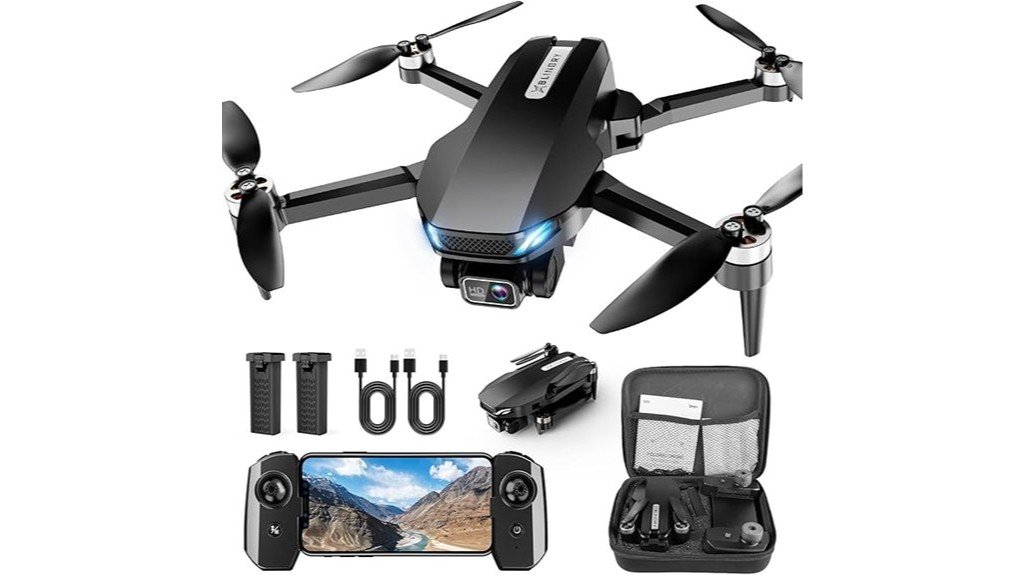
| Included items | Drone, remote, 3 batteries, carrying bag, charging cable, spare propellers and basic setup parts; confirm current bundle |
| Camera/phone connection | Wi-Fi live view through the PLRC app; remote flies the drone |
| Primary uses | Basic flight practice and short-range recreational footage |
| Important limit | No confirmed GPS return-to-home or mechanical gimbal stabilization |
What Is the PLEGBLE PL-511?
The PLEGBLE PL-511 is a small, folding quadcopter with a phone-based first-person-view (FPV) camera feed. It is designed for you to learn takeoff, hovering, steering, and landing without buying a separate camera. You steer with the RF remote and use your phone for the live camera view.
Unlike a GPS-focused camera drone, it relies on features such as altitude hold and optical-flow positioning to help with basic hovering. The three-battery bundle is the main practical advantage: you can make several shorter flights while learning instead of stopping after the first battery runs down.
Its 4K, flight-time, and range figures are product claims, not results from an independent hands-on test in this review. Treat them as a starting point for comparison and leave room for shorter flights and less stable video in real conditions.
Who Should Buy It?
Best For
- First-time pilots who want one-key takeoff, altitude hold, and headless mode.
- Casual users who want to try an advertised 4K camera without paying for advanced GPS automation.
- Travelers who value a foldable body, carrying bag, and three-battery setup.
Skip If
- You need long-distance video transmission or a professional aerial camera platform.
- You need dependable hovering in gusty wind or stabilized footage straight from the camera.
- You want confirmed GPS return-to-home, Follow Me, or planned flight routes.
Before You Buy: An advertised weight under 249 g is not a blanket FAA exemption. Purely recreational flights under the statutory exception may avoid registration below 250 g, but Part 107 flights require it at any weight. Confirm the actual takeoff weight, and check airspace rules before flying.
Features and Flight Experience
4K Camera, Lens Angle, and Video Limits
The PL-511 is advertised with 4K recording, an 8.3 MP effective still-image rating, a 120° field of view, and a camera that tilts through 90°. The wide view helps fit more scenery into a short-range shot. The tilt range helps you aim lower for an overhead-style view, although the listing does not establish how smooth the tilt adjustment is.
Higher pixel count does not guarantee steady footage. There is no independently confirmed three-axis gimbal specification for this model, and this review does not include recorded sample-file testing. For sharper clips, fly slowly in bright conditions, pause before recording, and compare actual sample footage before you buy if video quality is your top concern.
Wi-Fi FPV Range and Remote Control
Your phone connects to the drone for the live first-person-view feed, while the handheld remote handles flight controls. The listed FPV range is up to 230 feet, or about 70 meters. That number describes the phone video link; it should not be treated as a verified maximum control distance.
The source listing also describes a beyond-range warning around 328 to 393 feet. Because the warning distance is greater than the advertised FPV distance, do not use it as your cue to turn around. Stay much closer than either number while learning, and keep the aircraft within visual line of sight.
Three Batteries and Advertised Flight Time
Three modular batteries are listed at 1200 mAh each, with about 15 minutes of flight per battery. The advertised 45 minutes is a combined total after swapping packs. It does not mean the PL-511 can stay aloft for 45 minutes on one battery.
Expect less time when you make frequent turns, fly into wind, or stop early to retain a safe landing reserve. Check the exact charging plug and supplied cable in your current seller’s package. Public descriptions differ on that detail, so a specific USB-C certification or charging standard should not be assumed.
Brushless Motors, Altitude Hold, and Optical Flow
Brushless motors are an advantage over basic brushed designs because they typically need less motor maintenance and respond well to changing throttle. The PL-511 also lists altitude hold and optical-flow positioning to assist with hovering near the ground.
Optical-flow systems work best over surfaces with visible texture and in adequate light. Plain, reflective, or poorly lit ground can reduce their usefulness, and neither feature locks the drone in place during gusts. Practice making small corrections rather than expecting hands-free hovering.
Beginner Controls and Flight Modes
One-key takeoff and landing, headless mode, three speed modes, an emergency-stop command, and 360° flips are part of the listed feature set. Low speed is useful while you learn the stick layout. Headless mode can simplify orientation, but learning which way the drone faces will help you fly other aircraft later.
Use the emergency-stop function only when needed for safety. Stopping the motors in the air can cause the aircraft to fall. Save flips and faster modes for a clear open area after you can take off, hover, and land with control.
Pros and Cons
Pros
- Advertised 4K camera, wide 120° view, and 90° angle adjustment.
- Three included 1200 mAh batteries mean several short flight sessions.
- Brushless motors offer a practical benefit over entry-level brushed designs.
- One-key takeoff, headless mode, altitude hold, and three speeds suit beginners.
- Foldable under-249g design is easy to carry and store.
Cons
- The advertised 230-foot FPV link is short for filming larger areas.
- Optical-flow hover can drift in wind, poor light, or over uniform surfaces.
- Mechanical gimbal stabilization and GPS return-to-home are not confirmed.
How It Performs in Real Use
Learning in a Large Open Area
For your first flights, the one-key start and low-speed mode reduce the number of things you must manage. Start with gentle steering and repeated landings within a short distance. If the drone feels too lively, reduce stick movement and fly in calm conditions rather than pushing farther away.
Taking Backyard or Park Videos
For brief scenic clips, the wide lens can frame a lawn, open field, or nearby landscape without flying far. Keep movements slow and avoid fast turns. The advertised 4K resolution may give you more image detail, but without verified gimbal stabilization, your flight smoothness matters as much as the camera claim.
Practicing Outdoors on a Breezy Day
The brushless motors do not eliminate wind drift. Light gusts can move a small aircraft even with altitude hold enabled, and optical-flow positioning may work less well over grass with little contrast. If you need large stick corrections to hold position, land and try another time.
Traveling With the Three-Battery Kit
A folding body and carrying bag help protect the drone during trips. Plan several short flights and allow time to change packs and recharge them. For air travel, keep spare lithium batteries in carry-on luggage with terminals protected, and check your airline’s battery policies. FAA PackSafe guidance explains the U.S. rules.
Setup Tips Before Your First Flight
- Confirm the correct kit: Before your first flight, check for three batteries, the remote, a suitable charging cable, spare propellers, and the carrying case. Bundle contents may change.
- Charge and inspect the packs: Follow the supplied manual and charger instructions. Do not use swollen, damaged, or unusually hot batteries.
- Check each propeller: Replace a cracked or bent propeller before takeoff and make sure every arm is fully unfolded.
- Calibrate as directed: Use level ground and follow the exact calibration steps in the manual or app, especially if the drone drifts in calm conditions.
- Set up the FPV feed: Connect to the drone’s Wi-Fi, open the PLRC app listed for the reviewed setup, and confirm the picture before takeoff. Check the current instructions for app changes.
- Use short practice hops: Start in low-speed mode, stay close, avoid overhead obstacles, and leave enough battery to land safely.
- Learn emergency controls: Identify the emergency-stop button before flight, but avoid using it as a normal landing control.
Pro Tip: Use the first battery for takeoff, hover, small turns, and landing practice. Save filming for later batteries, once you can fly a simple square and land where you planned.
Flight Safety and Registration Notes
In the United States, a drone weighing less than 250 g generally does not need FAA registration only when it is flown under the limited recreational exception. Commercial or other Part 107 flights require registration at any weight. A drone that must be registered, or is registered, generally needs Remote ID compliance unless an allowed exception applies. Do not assume this model has built-in Remote ID without verifying its documentation.
Even recreational pilots need to take the free FAA TRUST test, carry proof of passing, follow airspace restrictions, and keep the drone in visual line of sight. Use a visual observer when the flight method requires one, and avoid people, traffic, and obstacles. Check the FAA recreational-flyer rules and registration guidance before flying.
For battery safety, charge on a clear, suitable surface using the cable and power source specified by the instructions. Never fly with a damaged pack, and allow warm batteries to cool before recharging. For travel, protect spare battery terminals against short circuits.
What Buyer Feedback Suggests
The original review describes positive comments about basic controls, the camera feature set, and having three batteries. It also mentions reports of sensitive steering and uneven hovering. These accounts are useful cautions, but the individual reviews and their dates could not be independently checked against the live Amazon listing during this update.
This is a specification-based editorial assessment, not a hands-on flight test. The quoted 4K capture, maximum flight time, FPV reach, and hover behavior should be treated as advertised or reported, not independently measured performance. Check recent verified buyer videos and the return policy before purchasing if camera footage or stable hover is a deciding factor.
Is It Worth the Price?
The PL-511 is positioned as a budget-minded training and casual camera drone. Its appeal is the set of three batteries, brushless motors, foldable body, and beginner controls in one package. That matters if you want several practice sessions without immediately shopping for a second battery.
It is worth considering for a first drone if short flights and basic video experiments are enough. It becomes a weaker fit if you mainly want smooth, polished camera footage, GPS-guided return-to-home, or a long-distance live feed. Check the current price and exact included accessories against those priorities instead of judging the purchase by the 4K label alone.
How It Compares to Alternatives
The Holy Stone HS440 is a straightforward beginner alternative with a 1080p camera and brushed motors, according to Holy Stone. The PL-511 offers a higher advertised recording resolution and a three-battery package, while the HS440 may be enough if you only want basic FPV practice.
The PLEGBLE PL-715 is worth comparing if its advertised GPS return, Follow Me, and Tap Fly modes appeal to you, but confirm the current listing and controller features. For more advanced video stabilization, the DJI Neo has manufacturer-documented 4K recording with electronic stabilization and a single-axis gimbal. Those are more meaningful differences than a simple 4K-versus-4K label.
Frequently Asked Questions
How long does the PLEGBLE PL-511 fly per battery?
The advertised flight time is about 15 minutes per battery. Three supplied batteries give up to 45 minutes in total after two battery swaps, but wind, flying style, and landing reserve can shorten each flight.
Is the PL-511 suitable for a complete beginner?
It has one-key takeoff and landing, headless mode, altitude hold, optical-flow positioning, and three speeds. Start close in a wide open area because it still requires active steering and safe landing practice.
Does the PL-511 record true 4K video?
PLEGBLE markets the camera as 4K, with an 8.3 MP still-image listing, a 120° field of view, and 90° angle adjustment. This review did not independently inspect original recorded files or verify gimbal stabilization.
What is the difference between FPV range and control range?
The advertised FPV live-video range is up to 230 feet. That is not a verified maximum remote-control range, and the separate beyond-range warning is not a reason to fly farther. Keep the drone within visual line of sight.
Does it have GPS return-to-home or a stabilized gimbal?
Neither GPS return-to-home nor a mechanical stabilization gimbal was confirmed for this PL-511 configuration. If those features matter for your flying, choose a model whose manufacturer specifically documents them.
Do you need FAA registration to fly it in the United States?
An under-250g drone used only under the recreational exception generally avoids registration. Part 107 flights require registration regardless of weight, and other FAA rules still apply. Recreational flyers must also complete TRUST.
How can you improve a drifting or unstable hover?
Calibrate as the manual instructs on level ground, check for damaged propellers, and try a textured, well-lit surface in calm weather. If it still drifts or needs large corrections, land instead of trying to fight the wind.
What comes in the box, and which charging cable does it use?
The reviewed package lists the drone, remote, three batteries, a carrying bag, a charging cable, spare propellers, and basic setup items. Public descriptions differ on the cable connector, so verify the current bundle and charger with the seller before buying.
The Bottom Line
The PLEGBLE PL-511 earns a cautious recommendation for first-time pilots who want a foldable short-range drone, three batteries, and easy basic controls. Choose it for practice and casual clips, not verified professional stabilization, long FPV range, or GPS-guided flights. Confirm the current bundle and price before ordering.