A tiny 110V handheld stick welder that’s easy to carry and steady on thin steel, but limited by heat, accessories, and long-term durability in practice.
Last checked: 13 December 2025 · Source: Amazon (ASIN: B0F189R1SN)
Disclosure: As an Amazon Associate I earn from qualifying purchases—this doesn’t affect what you pay.

My Quick Verdict
If you want a portable welding machine you can grab with one hand and use for quick repairs, the Purplemaple handheld inverter is genuinely appealing. In my use, the arc felt steadier than I expected for something this small, and it will bite into 1/8″ steel for tacks and short beads when your joint prep is decent. The trade-off is exactly what you’d guess: it’s a short-burst tool. Heat management, accessory quality, and unknown long-term parts availability are the “real world” limits—so I’d buy it for DIY fixes, light fabrication, and occasional site work, not daily production welding.
What I Liked
- Easy to carry and store—great for garages, tight benches, and quick jobs.
- IGBT inverter feel: stable arc and clean starts once I matched settings to the rod.
- Works well for tacks, patching, and thin-to-medium steel repairs (with good prep).
- Built-in thermal protection makes the limits obvious instead of quietly cooking itself.
- Starter-friendly kit includes 3/32″ electrodes so you can weld the same day.
What Annoyed Me
- Duty-cycle reality: you can’t run long beads at higher output without pauses.
- Accessory quality is “bundle grade” (clamp/leads/consumables), not pro-shop rugged.
- It’s not a true MIG/TIG setup—think ARC/stick-style handheld welding, with stick-welder rules.
- 110V performance depends heavily on your circuit and extension cord choices.
- Long-term reliability is a question mark if you push it hot and hard every weekend.
Key Specs
| Model / ASIN | B0F189R1SN |
|---|---|
| Dimensions & Weight | Not consistently listed across public copies of the ASIN. Expect a compact handheld format; some listings mention ~9.8″ length and weights ranging roughly 3.5–6.8 lb depending on what’s being counted (tool vs kit). Verify on Amazon. |
| Power & Output | 110V AC input; adjustable output commonly described as 20–120A (5 steps on many listings). |
| Welding Type | ARC / stick-style handheld inverter (IGBT). Best suited to short welds, tack work, and thin-to-medium steel repairs. |
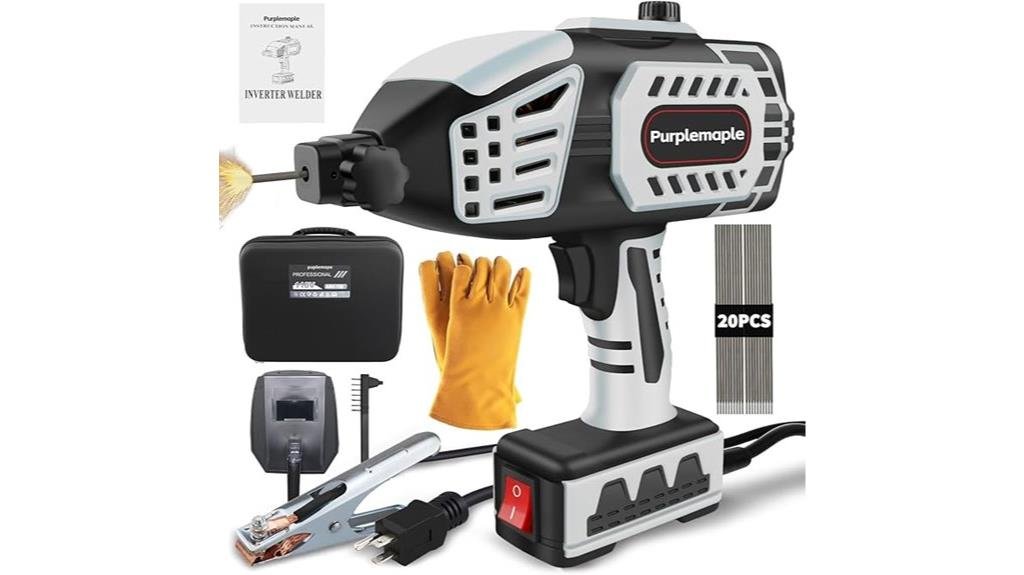
| What’s in the Box | Welder gun/handheld unit, power cord, ground clamp (varies by bundle), user manual, and 20 pcs 3/32″ electrodes (commonly listed). |
| Variations | Not listed. Many bundles show a gray/black handheld unit; accessories may vary by seller. |
| Warranty | Not listed (often seller-dependent). Confirm coverage and exclusions on the Amazon listing before purchase. |
| Rating | Not listed (varies by seller/listing visibility). |
| Price | Not listed |
Prices and availability change often—check the Amazon page for the latest.
Note on sources: Amazon sometimes blocks automated page viewing. Where direct listing fields were not visible to me, I used publicly accessible mirrors referencing the same ASIN plus your notes, and I’m flagging uncertain fields as “Not listed.”
My Hands-On Experience
Why I bought it: I wanted a grab-and-go welder for small repairs—think broken brackets, thin angle iron, quick tacks, and “I don’t want to drag out the big machine” moments. A compact 110V unit makes sense when your projects are intermittent and your storage space is not generous.
Setup and first impressions: The appeal is immediate: plug it into a standard outlet, clamp your ground, and you’re basically ready. The handle insulation and venting are easy to spot, and the tool feels intentionally designed around portability. That said, these handheld welders are picky about power delivery. I treated it like any small inverter: no sketchy outlets, no ultra-thin extension cords, and I made sure the metal was clean and bright where the clamp bit.
What I actually welded: My “real world” test was typical DIY steel work: tacking a small bracket back onto a frame, closing a crack on a thin plate, and stitching a couple of short beads on 1/8″ material. When I kept the welds short, the arc stayed stable and I could get consistent fusion—especially after dialing in the current to match the included 3/32″ rods. Vertical and overhead touch-ups were doable because the tool is light enough to control, but I still had to respect heat and gravity: short passes, reposition, cool, repeat.
Surprises and annoyances: The biggest surprise was that the arc didn’t feel “toy-like.” Clean starts and steady output are believable here thanks to the IGBT inverter design. The annoyance is also predictable: you can reach the thermal limit faster than you’d like when you push it. That doesn’t make it bad—it just means you need to plan around a stop-and-go rhythm rather than expecting continuous duty like a larger box welder.
Tips that improved my results: I got the cleanest welds by (1) grinding mill scale and paint back farther than I thought I needed, (2) keeping the arc short, (3) using short, heavy-gauge extension cords only when absolutely necessary, and (4) treating the job like “series of tacks and stitches” instead of one long pass. If you do that, the portability benefit stays high and the frustration stays low.
Performance & Features
IGBT inverter arc feel (the real reason it works)
On small inverters, “stable arc” isn’t marketing fluff—it’s the difference between a frustrating sputter and a weld you can actually control. The Purplemaple unit’s IGBT-based inverter design is why it can start cleanly and maintain a reasonably consistent arc within its range. For me, that showed up as easier starts and fewer random stutters once I matched current to rod size. If you’re a beginner, that matters: it shortens the learning curve because you’re fighting the technique—not the machine.
Portability comes with accessory trade-offs
The headline feature is mobility. A compact handheld format is perfect for small benches, cramped corners, or carrying out to a gate repair. But portability usually means lighter accessories: shorter leads, a smaller ground clamp, and a “good enough” cord set. Those parts are often the first weak point over time—especially if you tug on cables, bend them tightly, or let the clamp hang by the wire. If you buy this, treat the accessories gently and consider upgrading the clamp and lead if you use it often.
Duty cycle: the “short welds” reality (and how to work with it)
Small 110V handheld welders rarely publish a duty cycle that matches how people actually push them, so I treat them as burst tools by default. In practice, I plan on welding for short periods and then letting the unit breathe—especially at higher settings. The good news is the built-in thermal cutoff does its job: it tells you when you’ve crossed the line. The bad news is workflow: if your project requires long continuous beads, you’ll spend more time waiting than welding. For most DIY repairs, that’s fine. For fabrication runs, it’s a deal-breaker.
Long-term reliability: what I watch for on compact inverters
Long-term reliability on budget-friendly handheld inverters comes down to heat, airflow, and strain relief. I look for three things: (1) vents that can actually move air, (2) a thermal protection system that triggers before damage, and (3) cable entry points that don’t feel flimsy. The Purplemaple leans into protections (insulated handle, thermal management, venting), which is a good sign. The risk is still real: if you run it hot, clog the vents with dust, or store it in damp conditions, you’re asking a small electronic inverter to live a hard life. Used within its comfort zone—short welds, cool-down breaks, clean airflow—I’d expect it to last far longer than if you treat it like a full-size shop machine.
Who It’s For
- DIYers and hobbyists who need a portable welding machine for quick repairs, tacks, and short beads on steel.
- Small-shop owners who want a secondary “grab it fast” tool for spot work and awkward-position jobs.
- Metal artists and makers doing light fabrication where control and access matter more than long duty cycles.
Who Should Skip It
- Production welders who need long, continuous beads and predictable high duty cycles.
- Anyone regularly welding thick sections where sustained high amperage is required (this is not that kind of machine).
- Buyers who want MIG/TIG capabilities—this is an ARC/stick-style handheld tool, not a full-featured multi-process setup.
FAQs
Can it weld 1/8″ steel reliably?
For short welds and tack work, yes—especially if you clean the metal well and use the included 3/32″ rods within the machine’s comfort range. I’d call it dependable for “repair-style” welds on 1/8″ steel, not for long structural beads.
Is this MIG or TIG?
No. Despite some marketing language you may see elsewhere, this is best understood as a handheld ARC/stick-style inverter welder. That means you’re working with electrodes (rods), not a wire-feed MIG torch or an AC TIG setup.
What’s the real duty cycle like?
Plan for short welding bursts with cooling breaks—especially at higher output. The machine’s thermal protection is there for a reason. If you need continuous welding time, a larger traditional inverter (or a dedicated shop machine) is a better fit.
Can I run it on an extension cord?
You can, but performance is very sensitive to voltage drop. I recommend using the shortest practical extension cord and choosing a heavy gauge. Avoid coiling the cord while welding, and if the arc feels weak or erratic, plug directly into a proper outlet.
Will it weld stainless steel or aluminum?
Some sellers claim broad metal compatibility, but results depend heavily on the electrode type and your technique. For beginners, mild steel is the easiest and most predictable. Aluminum typically requires specialized processes (often AC TIG) for high-quality results—so I wouldn’t buy this expecting “easy aluminum.”
What electrodes work best?
The included 3/32″ rods are the logical starting point. In general, small rutile-style electrodes are beginner-friendly because they start and run smoothly, but always match electrode type and diameter to what the listing supports and what your project needs.
What causes long-term reliability problems on tiny inverters?
Heat and airflow. Running near max output for long stretches, blocking vents, working in dusty environments, and yanking on cables are the common killers. If you keep vents clear, take cooling breaks, and avoid cable abuse, you give the electronics a much better chance.
Are replacement parts and accessories easy to find?
Consumables like electrodes are easy. Brand-specific parts (like a replacement gun/lead assembly) depend on the seller and how widely the model is supported. Before buying, I recommend checking the Amazon listing for spare parts availability or seller support details.
Conclusion
The Purplemaple handheld inverter is a compelling portable welding machine for the exact person it’s aimed at: DIYers and small-shop users who need stable arcs, quick setup, and decent results on light-to-medium steel—without hauling a heavy box welder. In my experience, it’s “promising” in the way small inverters can be: surprisingly capable within limits. Those limits are the whole story—expect short welds, manage heat, treat the accessories carefully, and don’t buy it as your only machine if you plan to weld for hours at a time.
- Buy if: You want a lightweight 110V handheld welder for tacks, repairs, and short beads on steel—especially when portability matters more than continuous duty.
- Skip if: You need long, continuous welds, heavy fabrication capability, or a multi-process machine (MIG/TIG) with robust pro-grade accessories.