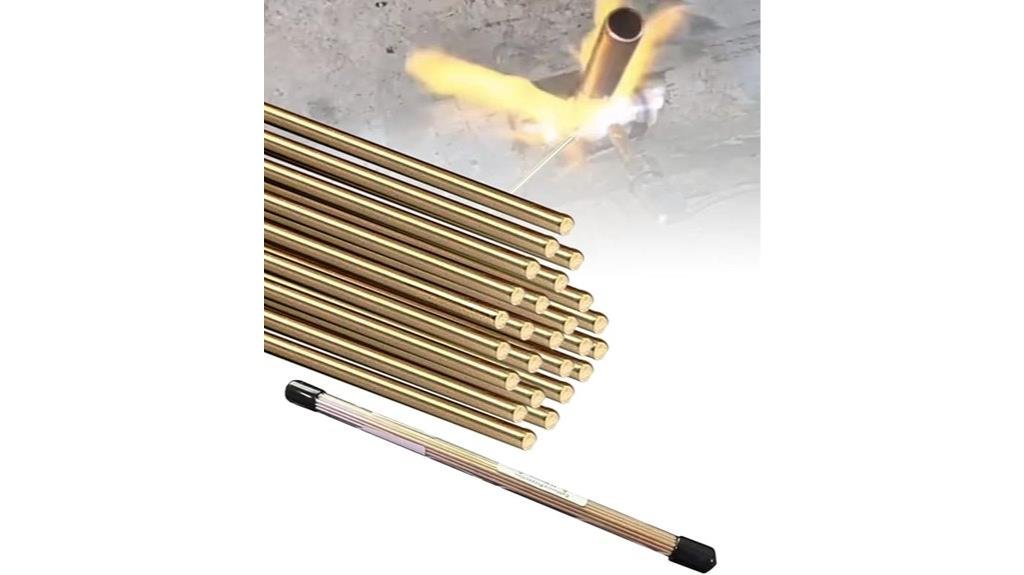
This review examines the 15 Rods brazing rods with an impartial, professional eye, highlighting size, alloy, and performance data for practical decision-making. The rods measure 1/16″ diameter and 9.84″ long, show a brazing range of 1634–1661°F, and a tensile strength of 130 N/mm²; composition includes tin and silicon for improved fluidity. Who benefits most—HVAC techs, metalworkers, hobbyists—and what trade-offs should be weighed?
Key Takeaways
- Product contains 25 brass brazing rods (1/16″ × 9.84″), offering more quantity than a 15-rod pack.
- Alloy (59–61% Cu, balance Zn, plus Sn, Si, trace Pb) delivers good fluidity, wetting, and controlled melting.
- Suitable for oxyacetylene/torch brazing on copper alloys and carbon steel, not for TIG on brass.
- Recommended joint gap 0.02–0.08″ with preheating and matching rod size for reliable capillary action.
- Store dry in supplied PVC tube at 20–25°C, humidity <50%; use PPE and ventilation to mitigate fumes and burns.
Product Overview and Key Specs
One compact pack contains 25 brass brazing rods, each measuring 1/16″ in diameter and 9.84″ long, designed for oxyacetylene gas welding and general repair work.
The reviewer notes intended applications: copper alloy and carbon steel joints, decorative inlays, DIY projects.
Key specs: brazing temperature ~1634–1661°F, tensile strength 130 N/mm², hardness 100 N/mm².
Questions a user might ask:
- How to use? Follow standard brazing techniques, control heat, flux choice.
- How to store? Rod maintenance: keep dry in the PVC tube, avoid contamination.
Practical tip: match rod size to joint gap for consistent capillary action.
Chemical Composition Explained
The brazing rods’ alloy is a carefully balanced brass formulation, composed primarily of copper (Cu 59%–61%) with zinc as the balance, plus measured additions of tin (Sn 0.8%–1.2%) and silicon (Si 0.15%–0.35%), and trace lead (~105 mg/kg). Readers learn chemical properties: tin improves fluidity, silicon limits zinc evaporation and porosity, copper provides strength. What are alloy benefits? Better wetting, controlled melting range (1634–1661°F), and consistent tensile strength (130 N/mm²).
| Component | Range | Role |
|---|---|---|
| Cu | 59%–61% | Matrix, strength |
| Sn/Si/Pb | 0.8%/0.15%/~105mg/kg | Fluidity, deoxidation, trace lead |
Physical Dimensions and Packaging
Size and packaging matter when choosing brazing rods, especially for portability, storage, and fit with common torches. The set contains 25 rods, each 1/16″ x 9.84″, offering consistent length for torch holders and repeatable feed.
How durable are they? Physical durability is supported by brass alloy composition and a PVC tube that resists moisture, bending, and surface damage.
What about packaging design? The tube enhances portability, organization, and visibility while fitting toolboxes.
Practical considerations: rod diameter for heat control, length for reach, tube dimensions for storage, and ease of extraction for fast workflows.
Recommended Applications
For hobbyists and professionals alike, these 1/16″ x 9.84″ brass brazing rods suit a range of tasks where moderate strength, good flow, and corrosion-resistant joints are needed.
They work best on copper alloys, carbon steel, and many alloy steels, but are not intended for argon-arc (TIG) welding of copper-zinc alloys.
The rods support common crafting techniques, precise repairs, and small fabrication runs, offering 25-piece convenience in a PVC tube.
Ideal for crafting, precise repairs, and small fabrication runs — 25 brass brazing rods neatly housed in a PVC tube.
Practical uses include decorative inlays and whirligigs, HVAC repair, and jewelry prototyping.
Consider joint fit-up, heat source, and clearance to ensure proper capillary action.
- Decorative inlays, small sculptures
- HVAC and plumbing repairs
- Jewelry and metalcraft prototyping
- Automotive trim and light fabrication
Brazing Temperature and Phase Data
Although brazing often seems straightforward, understanding the precise temperature window and phase behavior of these brass rods is essential for reliable joints. The reviewer notes a solidus at 1634°F and liquidus at 1661°F, so temperature control matters; maintain even heat, avoid overheating. Which brazing techniques suit this alloy? Oxyacetylene works well for copper alloy and steel joints; watch flux and gap. Practical tips: preheat larger parts, monitor puddle fluidity, limit zinc loss. Table summarizes key phase data and guidance.
| Parameter | Value | Notes |
|---|---|---|
| Solidus | 1634°F | Start melting |
| Liquidus | 1661°F | Fully molten |
| Range | 27°F | Narrow control needed |
| Recommended method | Oxyacetylene | Good heat input control |
Mechanical Performance Metrics
Having established the narrow 1634–1661°F melting window and the need for careful heat control when brazing, the discussion now turns to quantifiable mechanical performance metrics that determine joint reliability.
The rods yield a tensile strength of 130 N/mm², elongation about 25%, and a hardness measurement near 100 N/mm²; these values inform load capacity, ductility, and wear resistance.
The rods deliver ~130 N/mm² tensile strength, ~25% elongation and ~100 N/mm² hardness, indicating reliable load capacity, ductility, and wear resistance
What should the user expect in service? Consistent metallurgy, proper fluxing, and correct joint clearance produce repeatable results.
Practical checks include destructive testing and portable hardness tests, correlating lab numbers with field performance.
- Tensile strength: 130 N/mm², confirm with pull tests
- Hardness measurement: ~100 N/mm², use portable testers
- Ductility: 25% elongation, important for vibration resistance
- Practical considerations: joint clearance, flux, heat control
Advantages for DIY Projects
Because the 25-piece brass brazing rod pack combines a narrow melting range (1634–1661°F), a moderate tensile strength (130 N/mm²), and good ductility (≈25% elongation), it suits many DIY metal-joining tasks that require neat, repeatable joints and some mechanical resilience.
The kit supports DIY creativity and project versatility: small decorative inlays, whirligigs, light structural repairs.
Practical notes: rods are 1/16″×9.84″, PVC tube for portability, compatible with oxyacetylene.
Q: Who benefits? A: Hobbyists and beginners seeking predictable flow and clean fillets.
A: What to consider? Heat control, joint fit, and ventilation for safe, quality results.
Limitations and Compatibility Notes
The same predictable flow and neat fillets that make the 25-piece brass brazing rod pack appealing for hobby projects also bring limits and compatibility considerations that users should weigh.
The review notes specific compatibility issues and clear usage limitations: not suitable for argon arc welding with copper-zinc alloys, brazing range 1634–1661°F, rod size 1/16″ x 9.84″, and composition Cu 59–61%, Si 0.15–0.35%, Sn 0.8–1.2%.
Practical questions: Will it join stainless? Rarely; tensile 130 N/mm² limits structural use.
Consider heat source, base metal, and filler chemistry before selection.
- Not for argon arc welding applications
- Avoid stainless fusion joints
- Check thermal budget, 1634–1661°F
- Match alloy chemistry to base metal
Handling and Storage Tips
When stored and handled correctly, the 25-piece brass brazing rods retain predictable flow, low porosity, and consistent performance; users should follow simple steps to protect the rods from moisture, contamination, and mechanical damage.
Recommended storage conditions: keep rods in the supplied PVC tube, dry cabinet at 20–25°C, relative humidity <50%, away from acids and dust.
Store rods in their PVC tube in a dry cabinet at 20–25°C, RH under 50%, away from acids and dust.
Handling techniques: wear clean gloves, avoid touching tips, use soft clips or ceramic rests.
Q: How long do they last?
A: Indefinitely if sealed; months if exposed.
Practical tip: label batches with date, inspect for corrosion, discard compromised rods.
Ease of Use for Beginners and Pros
Although novice users may be cautious about gas brazing, these 1/16″ × 9.84″ brass brazing rods are engineered to make the process approachable for both beginners and experienced fabricators.
The rods, packaged in a PVC tube, suit DIY projects and small repairs; recommended brazing range: 1634–1661°F, tensile strength 130 N/mm².
What should a new user know?
beginner tips: preheat evenly, clean joints, control flame size.
How do pros adapt? Use steady feed, flux selection, and professional techniques for tight fillets.
- Preheat guidelines, gap clearances, and joint fit tolerances.
- Flux and cleaning routines for consistent flow.
- Flame control, rod angle, and travel speed.
- Safety gear, ventilation, and storage in the PVC tube.
Comparison With Similar Brass Rods
Having covered beginner and pro handling tips, it helps to compare these 1/16″ × 9.84″ brass brazing rods against similar alloys to see where they stand for common shop and hobby tasks.
A concise brass rod comparison follows, noting composition Cu 59–61%, Sn 0.8–1.2%, Si 0.15–0.35%, Zn balance.
How do they differ?
Pros: brazing temperature 1634–1661°F, tensile 130 N/mm², elongation 25% — good for copper alloy and carbon steel.
Cons: limited for argon arc on copper-zinc alloys.
Practical tip: match rod to base metal and intended welding techniques, oxyacetylene favored for best wetting.
Safety Precautions and Best Practices
Why prioritize safety with these 1/16″ × 9.84″ brass brazing rods? The reader should assess risks before brazing: molten filler, flux fumes, and hot work surfaces demand proper precautions.
Why prioritize safety with these 1/16″ × 9.84″ brass brazing rods? Assess risks: molten filler, flux fumes, and hot surfaces.
Recommended safety gear includes gloves, eye protection, and respirators; confirm ratings for heat and particulate capture. Maintain workspace organization: clear combustibles, use fire-resistant mats, and keep a Class B/C extinguisher within 3–5 feet.
How to proceed safely? Follow these practices:
- Verify ventilation rate, local exhaust, or fume extractor placement.
- Inspect rods and tube packaging for contamination before use.
- Use temperature control, monitor 1634–1661°F brazing range.
- Keep first-aid and emergency contact info accessible.
Typical Use Cases and Examples
When planning a project that uses 1/16″ × 9.84″ brass brazing rods, the reader should match the rod’s properties—melting range 1634–1661°F, tensile strength 130 N/mm², and diameter 1/16″—to the job requirements and heating method.
Typical use cases include joining copper alloy tubing, repairing carbon steel fittings, and decorative metalwork.
Project ideas: DIY whirligigs, decorative inlays, small plumbing repairs.
Which welding techniques suit this rod? Oxyacetylene and torch brazing work best; not recommended for argon arc with copper-zinc alloys.
Practical tips: preheat, control gap to 0.02–0.08″, clean surfaces thoroughly.
Customer Support and Warranty Info
After outlining suitable applications and welding techniques for the 1/16″ × 9.84″ brass brazing rods, attention now turns to customer support and warranty details that affect project planning and risk management.
The manufacturer offers clear channels for customer inquiries, prompt responses, and guidance on brazing temperature ranges (1634–1661°F), storage in the PVC tube, and compatibility notes.
Warranty details cover defects in material and workmanship, with specified remedy windows and return procedures. Questions like “What if a rod corrodes?” are handled case-by-case, with required photos, batch numbers, and purchase proof.
- Response time targets: 24–72 hours
- Required documentation: photos, batch ID, receipt
- Coverage period: specified limited warranty
- Remedies: replacement, refund, repair
Value for Money Assessment
How does the 1/16″ × 9.84″ brass brazing rod measure up in terms of value for money? The rod offers clear cost effectiveness: 25 rods per PVC tube, tensile strength 130 N/mm², brazing range 1634–1661°F, suitable for copper alloy and steel tasks.
Is it worth buying? Yes for DIY and light professional work where size and composition fit the job.
Yes — ideal for DIY and light professional brazing when the rod’s size and composition suit the job.
Considerations: quantity per pack, 1/16″ diameter compatibility with tips, portability.
Investment durability is supported by quality materials and moisture-resistant packaging.
Buyers seeking heavy industrial use should compare higher-spec alternatives before committing.
Frequently Asked Questions
Can These Rods Be Used for Plumbing Potable Water Joints?
They should not be used for potable water joints because lead content and alloy composition may conflict with potable water safety and local plumbing regulations; a certified lead-free brazing alloy compliant with plumbing codes is recommended instead.
Do They Contain Any Allergenic Metals for Skin Contact?
They do not list common dermatological allergens; allergen identification shows Cu, Sn, Si, Pb (105mg/kg) and Zn balance. Skin sensitivity varies, so contact precautions and gloves are recommended for those with metal allergies.
Can I Cut the Rods With a Hobby Saw Without Special Blades?
Yes. He can cut the rods with a hobby saw, but cutting techniques matter; slow, steady strokes and firm clamping reduce burrs. Saw compatibility favors metal-cutting blades (fine-tooth), though standard blades may work with care.
Are There Color-Matching Options for Visible Decorative Work?
No; there are no color-matching options. The product offers limited color variations inherent to brass alloy, suitable for decorative applications where warm golden tones are acceptable, though post-brazing patinas or plating enable closer matches.
Do These Rods Emit Fumes That Require Specialized Ventilation?
Clearly cautious, craftsmen consider fume safety: brazing releases fumes needing adequate ventilation requirements. The material’s zinc, tin and flux can produce hazardous vapors; recommended: local exhaust, fresh airflow and respirators for prolonged or enclosed work.
Conclusion
The 15 Rods brazing rods combine practical specs—1/16″ diameter, 9.84″ length, 1634–1661°F brazing range, 130 N/mm² tensile strength—with tin and silicon-enriched chemistry that improves fluidity and reduces porosity. Is this right for copper alloys, carbon steel, HVAC work, and decorative inlays? Yes, for small to medium joints. Consider flux, joint fit, and furnace or torch control. Like a reliable compass, they guide precise joins with predictable performance.