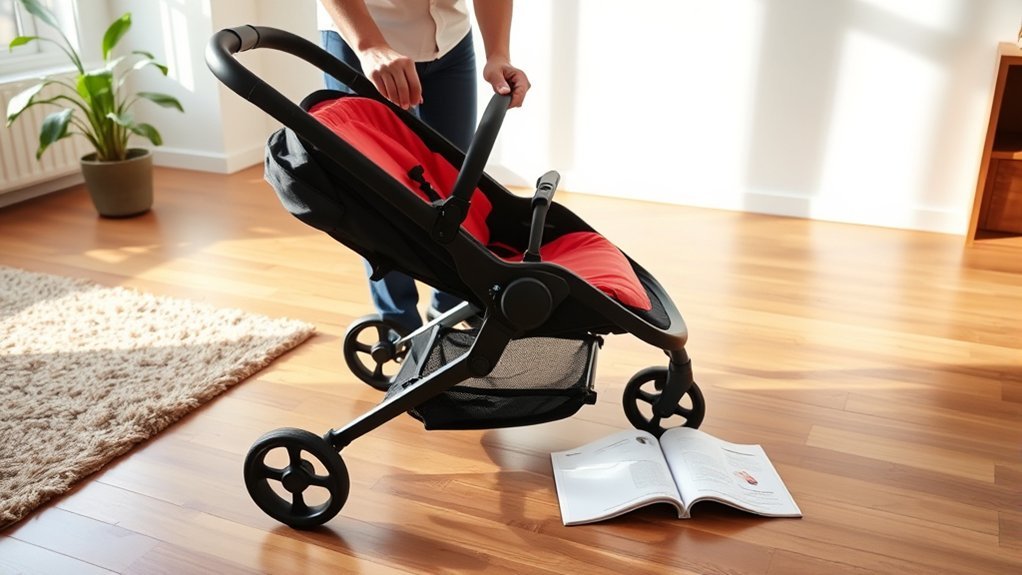
When your stroller will not latch after folding, the problem may be a blocked transport latch or a deeper fault in the folding mechanism. Start with an empty stroller, level ground, and the exact model manual. A compact fold is useful, but the frame must also open and lock securely before your child rides.
Quick Answer
Remove your child, set the brake on level ground, and reopen the stroller fully. Clear fabric, straps, basket items, and wheel obstructions, then refold it exactly as the manual shows. If the stroller will not lock open, or you see bent, cracked, loose, or missing parts, stop using it and contact the manufacturer.
Key Takeaways
- A folded transport latch and the lock that holds the stroller open perform different jobs.
- Remove your child and clear the folding path before testing any latch or hinge.
- Use only the folding sequence and lubricant approved for your exact stroller model.
- Stop using the stroller if its open-frame lock fails or you find structural damage, missing fasteners, or broken internal parts.
- Check the model number for recalls before ordering replacement parts or attempting a repair.
At a Glance
| Time Required | About 10–20 minutes for a basic obstruction, alignment, and cleanliness check |
| Difficulty | Easy for basic inspection; professional service may be needed for internal or structural faults |
| Tools Needed | Model manual, flashlight, soft brush, damp cloth, and mild soap |
| Cost | Usually $0 for inspection and basic cleaning; approved parts or professional service vary by model |
Quick Safety Check Before Troubleshooting
Stroller latches and folding mechanisms are part of the safety system, not only a storage feature. The U.S. Consumer Product Safety Commission’s carriage and stroller guidance identifies latching mechanisms, pinching hazards, parking brakes, stability, restraints, and other requirements under the federal stroller framework in 16 CFR Part 1227.
- Take your child out before checking the fold, latch, hinge, or frame.
- Set the parking brake and place the stroller on firm, level ground.
- Keep fingers away from hinges, sliding tracks, and scissor-like joints.
- Do not force the frame if it needs heavy pressure or twists unevenly.
- Do not place a child in a stroller that does not open and lock securely.
- Check the exact model against the CPSC recall database if the latch, hinge, frame, or adapter appears damaged.
Warning: Stop using the stroller immediately if the frame can collapse while open, the open-frame lock does not engage, a hinge is cracked, metal is bent, a fastener is missing, or the frame moves unexpectedly. Do not place your child back inside for another test.
Is It the Transport Latch or the Open-Frame Lock?
Identify which part is failing before you troubleshoot. The folded transport latch keeps the stroller compact for carrying or storage. The open-frame lock holds the stroller securely open while your child is riding.
| What Fails | What It Affects | Safe Response |
|---|---|---|
| Folded transport latch | Keeping the folded stroller closed during carrying or storage | Inspect the folding path and latch without your child present. Do not tie, bend, or force the frame shut. |
| Open-frame lock | Preventing the stroller from collapsing during use | Stop using the stroller and contact the manufacturer or an authorized repair provider. |
| Both systems or the main hinge | Folding, carrying, opening, and structural stability | Remove the stroller from service until the exact fault is identified and corrected. |
A stroller that folds neatly is convenient. A stroller that opens and stays locked is essential.
Common Reasons for Stroller Latching Issues
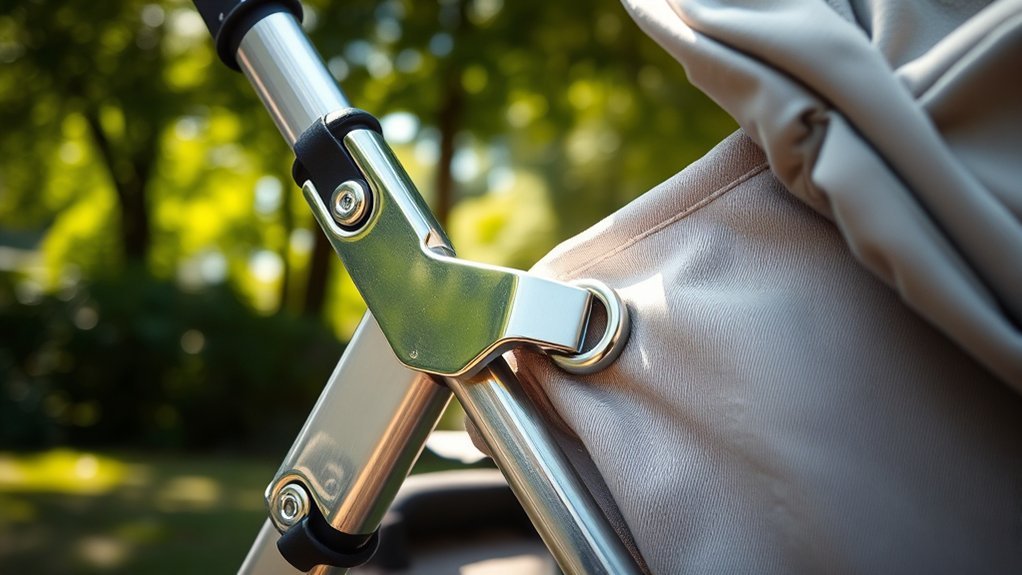
When your stroller won’t latch when folded, begin with simple obstructions before assuming the latch is broken. Common causes include a toy in the basket, bunched fabric, a twisted strap, a wheel in the wrong position, an unreleased safety lock, dirt in a joint, or a seat that is not set for folding.
| Symptom | Likely Cause | Safe Next Step |
|---|---|---|
| Latch misses the catch | Frame, wheels, seat, or latch catch is not aligned | Reopen fully, confirm the required seat and wheel positions, and repeat the manual’s folding sequence. |
| Frame stops halfway | Fabric, harness straps, basket contents, an accessory, or a safety lock is blocking the fold | Empty the stroller and inspect the full folding path on both sides. |
| Latch feels gritty or stiff | Sand, crumbs, dried mud, hair, residue, or unsuitable old lubricant | Clean exposed areas and use lubricant only when the manual approves a specific type and location. |
| Fold handle or strap moves but the frame does not | Disconnected strap, jammed carabiner, unreleased tab, or internal lever fault on some models | Check the exact model manual or support page before moving, removing, or opening any part. |
| One side folds faster than the other | Caught fabric, uneven wheel position, bent linkage, or a one-sided internal fault | Stop forcing the fold. Reopen and inspect both sides for an obstruction or visible damage. |
| Gear teeth, screws, tabs, or structural parts look damaged | Damaged folding mechanism or frame hardware | Stop DIY troubleshooting and contact the manufacturer or an authorized repair service. |
For Baby Jogger City Select, Select 2, and LUX models, the named support guidance advises checking internal moving parts for damage or wear, loose or missing screws, missing gear teeth, and visible debris. These instructions are specific to those models and do not authorize opening the mechanism on a different stroller. Baby Jogger City Select fold troubleshooting
Inspecting the Latch Mechanism
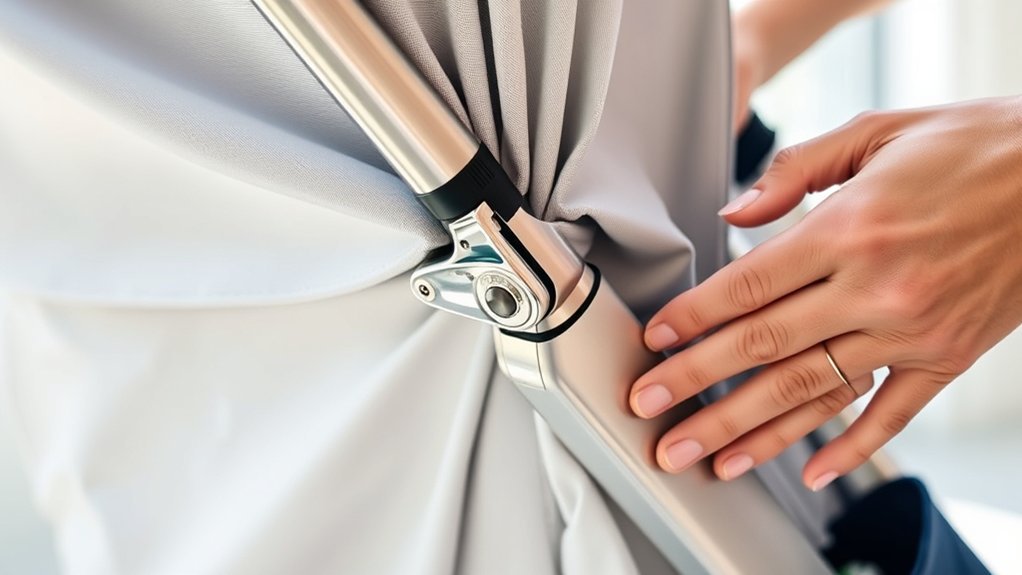
Inspect the stroller while it is empty. Look at the transport-latch hook, the receiving catch, both frame sides, and the areas that move during folding. A clean latch can still fail if the catch has shifted, the frame is twisted, a fastener is loose, or a spring-loaded part no longer returns normally.
| Inspection Item | What to Check | What to Do |
|---|---|---|
| Visible damage | Cracks, bent metal, split plastic, broken tabs, damaged rivets, or distorted tracks | Stop using the stroller until the manufacturer or an authorized provider evaluates it. |
| Fasteners | Loose, protruding, or missing screws, bolts, pins, rivets, or covers | Do not substitute generic hardware. Request the correct model-specific repair guidance. |
| Cleanliness | Sand, crumbs, dried mud, hair, fibers, or sticky residue | Clean exposed areas before repeating the model’s folding procedure. |
| Movement | A latch, tab, or lever that sticks, grinds, feels loose, or fails to return | Stop if movement remains abnormal after approved cleaning. Contact the manufacturer. |
| Alignment | The transport latch does not naturally meet its receiving catch after a correct fold | Check the seat, canopy, wheels, accessories, and both frame sides. Do not bend the latch into position. |
| Open-frame lock | The frame does not click, lock, or remain fully open during an empty test | Do not place a child inside. Remove the stroller from service and contact the brand. |
Reset and Fold the Stroller Correctly
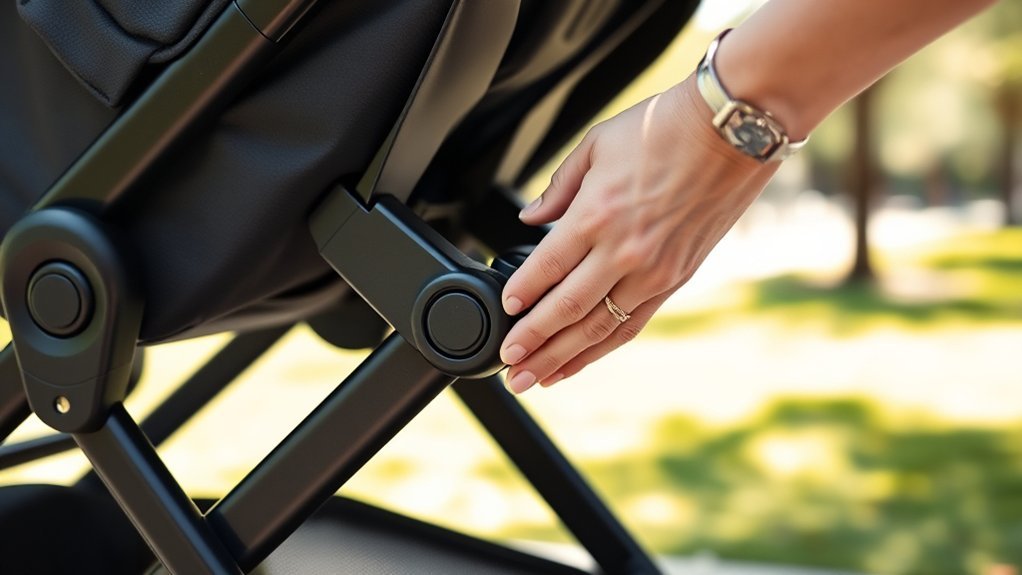
A stroller normally latches only after its frame collapses in the order designed for that model. Reopen it fully before trying again. This resets partially moved hinges, linkages, buttons, and safety tabs.
- Confirm the exact model. Check the frame label, model number, and manual so you do not follow instructions for a similar-looking stroller.
- Remove your child and empty the stroller. Clear the basket, tray, cup holders, footwell, seat pockets, hooks, and attached bags.
- Set the seat and fabric correctly. Close or position the canopy as directed, move loose harness straps away from hinges, and use the required seat angle or direction.
- Check the wheels and brake. Confirm whether the manual requires the front wheels to face forward, swivel freely, or lock before folding.
- Release the correct fold safety. Operate only the tabs, buttons, straps, handles, or frame latches shown for your model.
- Fold with steady, even pressure. Use the intended handle or pressure point. Do not stand on an unspecified frame part or twist one side down.
- Confirm the transport latch. It should meet its catch without tying, bending, prying, or compressing the frame with unusual force.
- Reopen it while empty. Confirm that the frame reaches its full open position and that its open-frame lock engages securely before future use.
Note: Folding instructions are not interchangeable. Maxi-Cosi, for example, publishes different button, latch, handle, foot-placement, and click-check steps for different stroller models. Follow the exact manual for the name and model number printed on your frame.
Maxi-Cosi stroller opening and folding guide
Cleaning and Lubricating the Latch
Clean the exposed latch and hinge areas before considering lubricant. Dirt and dried residue can restrict movement, but the wrong lubricant can attract grit, stain fabric, affect braking surfaces, or conflict with the manufacturer’s instructions.
| Step | Action | Important Caution |
|---|---|---|
| 1. Dry brush | Brush crumbs, sand, hair, and loose dirt away from exposed latch and hinge surfaces. | Brush outward so you do not push debris farther into an enclosed joint. |
| 2. Damp wipe | Wipe accessible plastic and metal with a damp cloth and a small amount of mild soap if needed. | Do not soak an enclosed mechanism or direct water into a joint. |
| 3. Dry fully | Allow the cleaned area to dry before moving the mechanism. | Moisture may attract more grit or contribute to corrosion. |
| 4. Check the manual | Confirm whether lubricant is permitted and identify the approved type and application point. | Do not assume that silicone spray, grease, oil, petroleum jelly, or a multipurpose product is universal. |
| 5. Apply only as directed | Use the smallest practical amount at the manufacturer-approved location. | Keep lubricant away from brakes, tires, wheel tread, harnesses, handles, and fabric. |
| 6. Cycle while empty | Gently operate the mechanism as directed and wipe away visible excess. | Stop if it still grinds, sticks, moves unevenly, or fails to lock. |
Model-specific support illustrates why universal lubricant advice is unsafe. City Select guidance discusses grease inside certain fold mechanisms, while City Mini, City Mini GT, and City Elite guidance describes spray lubricant at specified lever and joint locations. Use those instructions only for the models they name. Baby Jogger City Mini, GT, and Elite fold troubleshooting
Pro Tip: Take clear photos of the latch, hinge, and model label before cleaning. The photos can help you compare alignment afterward and give the manufacturer useful information if the problem continues.
Checking for Debris or Damage
If cleaning and a correct fold do not restore normal operation, inspect for damage that changes the frame’s alignment. A transport latch may miss its catch because one hinge is bent, a wheel fork is twisted, a sliding track is damaged, or an internal part no longer moves both sides together.
Stop troubleshooting if the frame is bent, a hinge is cracked, a screw or rivet is missing, a locking part is broken, or the stroller can fold unexpectedly while open.
Use a flashlight to inspect both sides of the folding path. Check accessible hinges, sliding tracks, pull straps, carabiners, spring tabs, screws, rivets, covers, and the latch catch. If one side folds faster than the other, reopen the stroller and look for caught fabric, uneven wheel positioning, or visible structural distortion.
Check More Closely After Travel, an Impact, or Unknown History
Perform a more cautious inspection if the problem began after the stroller was gate-checked, dropped, trapped under luggage, involved in a vehicle collision, or purchased secondhand. A sudden change in folding feel, alignment, noise, or lock engagement deserves manufacturer review even when the damage is not obvious.
Check the Model and Recall Information
- Find the model name, model number, manufacture date, and serial or product-identification number on the frame label.
- Search the CPSC recall database using the brand and exact model.
- Compare the model number and manufacture date with the recall notice, not only the product photo.
- Follow the official remedy if your stroller is included. Do not continue using a recalled product when the notice tells consumers to stop.
CPSC recalls have documented stroller hinge pinch hazards and unexpected folding during use. One example involved a folding side hinge that could pinch a caregiver and a stroller that could fold unexpectedly. CPSC stroller hinge and unexpected-fold recall example
Do Not Modify a Broken Stroller Latch
Do not remove required latch parts, grind gear teeth, drill the frame, install an unverified spring, tie the stroller shut for routine use, or bypass a safety lock. A folded-latch problem may be inconvenient, but altering the fold mechanism or open-frame lock can create a collapse, pinch, or structural failure risk.
For City Mini, City Mini GT, and City Elite models, the named support page points owners toward model-specific checks involving red locking tabs, the pull-to-fold strap, carabiners, trapped fabric, seat angle, and lever alignment. Those examples do not mean every stroller is safe to dismantle or straighten at home.
Follow a replacement procedure only when the manufacturer provides it for your exact model and you can complete it exactly as instructed. Use an authorized repair provider when the manual prohibits disassembly or when the repair involves rivets, structural metal, internal gears, or a safety lock.
Regular Maintenance Tips for Your Stroller
Simple maintenance can keep the fold smoother and help you notice a developing problem before the stroller becomes difficult to close in a parking lot, airport, or bus line.
- Before folding: empty the basket, close or position the canopy correctly, and move loose straps away from the hinges.
- After sandy or muddy trips: brush debris from accessible hinges, wheels, tracks, and latch points before placing the stroller in storage.
- During routine checks: look for loose hardware, cracked covers, damaged straps, wheel problems, and a transport latch that no longer aligns naturally.
- Before each outing: confirm that the stroller opens fully, the frame lock engages, the brakes work, and the wheels are secure.
- For lubrication: follow the manufacturer’s locations, product type, and service interval rather than using a universal schedule.
- During storage: keep the stroller dry and avoid stacking heavy objects on its folded frame.
A latch that occasionally needs a second careful fold may only have an obstruction or positioning issue. A latch that needs bending, heavy force, a tie, or repeated manipulation needs closer inspection and model-specific support.
When to Consult Manufacturer Guidelines
Check the manual as soon as the problem repeats or the folding sequence feels different. Strollers use different locks, buttons, hinges, straps, seat positions, wheel settings, and lubricant requirements. A procedure for one model can damage another.
Use the manufacturer’s manual or support team to confirm:
- the required seat and canopy position before folding;
- whether the front wheels should swivel, face forward, or lock;
- which fold-release button, strap, latch, or safety tab must move first;
- where your hands or foot should be placed;
- whether any lubricant is approved and where it may be applied;
- whether the folded transport latch can be replaced separately;
- whether a frame, hinge, or internal mechanism must be serviced by an authorized provider;
- whether the stroller is covered by a warranty, service campaign, or recall.
If you no longer have the manual, use the exact model name and model number on the manufacturer’s support site. Do not rely on a video for a similar-looking stroller unless its model and generation match yours.
Seeking Professional Assistance
Contact the manufacturer, retailer, or an authorized repair provider if the stroller still will not latch after you clear obstructions, clean approved areas, check alignment, and repeat the correct folding sequence. Seek help sooner when the stroller has visible damage, unknown secondhand history, or a problem that began after travel or impact.
Prepare the following information before contacting support:
- brand and exact model name;
- model number, manufacture date, and serial or product-identification number;
- clear photos of the latch, hinge, frame label, and any damaged part;
- a short video showing the problem with the stroller empty;
- the steps you have already tried;
- proof of purchase, if available;
- details about a drop, collision, flight, or other event that happened before the fault appeared.
Use model-specific replacement parts rather than universal latch hardware. Professional help is the safer choice when the issue involves internal gears, rivets, cracked plastic, bent metal, damaged linkage, or an open-frame lock that no longer clicks and holds securely.
Frequently Asked Questions
Why won’t my stroller latch when folded?
The frame may not be fully collapsed, or the seat, canopy, wheels, fabric, harness straps, basket contents, or safety locks may be blocking the folding path. The latch may also be dirty, misaligned, worn, or connected to a damaged folding mechanism. Reopen the stroller fully and repeat the exact model-specific sequence without forcing it.
Can I use my stroller while waiting for repairs?
Do not use it if the open-frame lock, hinge, frame, brakes, wheels, or folding mechanism is damaged or unreliable. A transport latch that only keeps the stroller folded serves a different purpose, but you should still get model-specific advice and avoid carrying the folded stroller where it could spring open.
What if the folded latch fails but the stroller locks open?
The immediate problem may be limited to carrying and storage, but do not assume the mechanisms are unrelated. Inspect the fold path, confirm that the frame opens and locks normally, avoid tying or bending the stroller shut, and ask the manufacturer whether the transport latch is separately replaceable.
What is the warranty coverage for latch issues?
Coverage depends on the brand, model, purchase date, warranty terms, and whether the fault is a manufacturing defect, accidental damage, misuse, or normal wear. Contact the manufacturer with the model number, serial number, photos, video, and proof of purchase before ordering parts.
Do different stroller brands use different latching mechanisms?
Yes. A stroller may use a side transport latch, frame-lock lever, button sequence, pull-to-fold strap, safety tab, carabiner, sliding rail, or another model-specific system. Match every troubleshooting and replacement step to the exact model and generation.
What lubricant should I use on a stroller latch?
Use only the lubricant named in your stroller manual or official support instructions, and apply it only at the specified location. Some mechanisms use grease, while some exposed lever points use a spray product. Keep lubricant away from fabric, brakes, harnesses, handles, tires, and wheel tread.
How can I prevent future latching problems?
Empty the basket before folding, set the seat and canopy correctly, keep straps away from hinges, remove sand and crumbs from moving areas, store the stroller dry, and stop when a fold feels unusually stiff or uneven. Follow the manufacturer’s inspection and lubrication schedule.
Is there a universal stroller latch replacement?
Do not assume a universal latch is safe or compatible. Use a part confirmed by the manufacturer or an authorized supplier for the exact model number. A latch that looks similar may have different dimensions, spring force, mounting points, or safety functions.
Conclusion
If your stroller won’t latch when folded, begin with a safe reset. Remove your child, empty the stroller, clear fabric and straps, check the required seat and wheel positions, clean accessible areas, and repeat the folding sequence from the exact model manual.
Stop troubleshooting and contact the manufacturer when you find broken gear teeth, bent frame parts, cracked hinges, missing fasteners, abnormal one-sided movement, or any failure of the open-frame lock. Never bypass a safety lock or force the stroller into alignment. Secure locking while open matters more than a compact fold.
Sources
- U.S. Consumer Product Safety Commission: Carriages and Strollers Business Guidance — federal safety framework, including latching, pinching, braking, stability, and restraint requirements.
- Electronic Code of Federal Regulations: 16 CFR Part 1227 — mandatory U.S. safety standard for carriages and strollers.
- CPSC Recalls and Product Safety Warnings — model-specific recall searches and official consumer remedies.
- CPSC Aria Child Stroller Recall — documented hinge-pinching and unexpected-folding hazards.
- Baby Jogger City Select Fold Mechanism Troubleshooting — model-specific inspection guidance for internal parts, fasteners, gear teeth, debris, and lubrication.
- Maxi-Cosi: How to Open and Fold a Stroller — examples showing that lock-release and folding procedures differ by stroller model.