
Stroller workouts are one of the most practical, time-efficient ways for fathers to build functional strength and cardiovascular endurance without sacrificing family time. By combining brisk walking or jogging intervals with targeted bodyweight and resistance exercises, you can develop full-body conditioning while your child enjoys fresh air and sensory stimulation. However, transforming a standard afternoon stroll into an effective, injury-free workout requires the right biomechanical form, age-appropriate pediatric safety measures, and a structured exercise plan.
Quick Answer
Stroller workouts for dads combine aerobic intervals (brisk walking, hill climbs, or jogging) with stationary strength drills (squats, walking lunges, and stroller-braced core work). For child safety, ensure your baby is at least 6 months old with established neck control before jogging, always wrap the safety wrist strap around your wrist, and firmly lock the stroller parking brake before any stationary exercise.
Key Takeaways
- Pediatric Readiness: Only walk on flat ground with infants under 6 months; wait until 6 to 8 months of age with full head control before jogging in an approved running stroller.
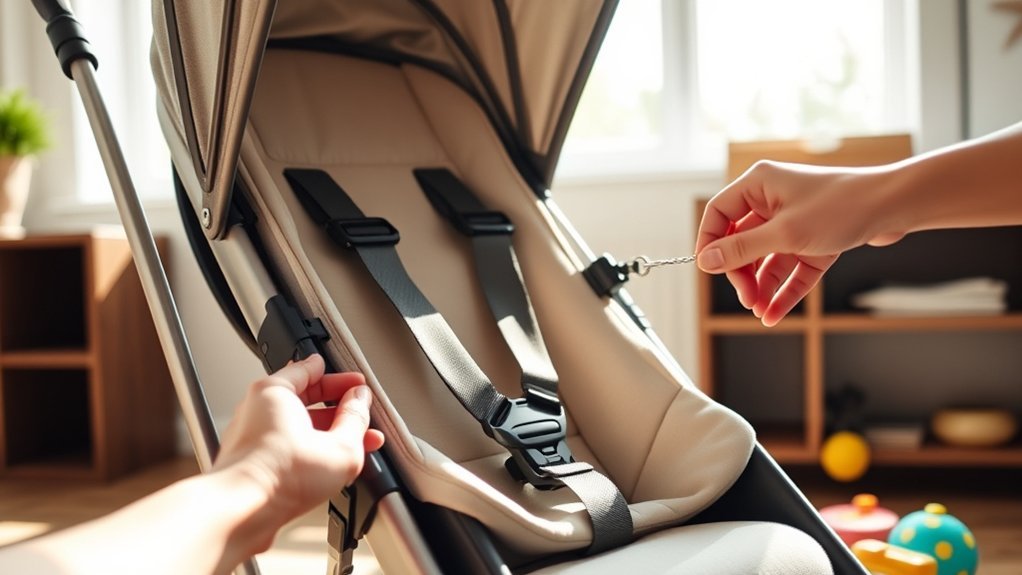
- Hardware Rules: Never push a workout stroller without attaching the wrist tether strap and inspecting the 5-point safety harness.
- Functional Calorie Burn: Pushing a stroller adds resistance, increasing metabolic expenditure by 15% to 20% compared to unweighted walking or running.
- Postural Correction: Keep your chest proud and spine neutral to counteract the rounded-shoulder “dad slump” caused by carrying infants.
At a Glance
| Time Required | 30 to 45 minutes |
| Difficulty | Beginner to Intermediate |
| Tools Needed | Sturdy stroller with wrist tether, supportive running shoes, water bottle, looped resistance band (optional) |
| Cost | Free (using existing baby gear) |
Benefits of Stroller Workouts for Dads

Fatherhood often introduces drastic schedule changes, chronic sleep disruption, and increased physical strain from lifting infants, car seats, and diaper bags. Stroller workouts offer a structured, outdoor outlet that simultaneously enhances cardiovascular fitness, builds functional lower body strength, and counteracts paternal postural issues without taking you away from family responsibilities.
Pushing a stroller modifies standard human gait and locomotion mechanics. According to exercise science data from the American Council on Exercise (ACE), pushing external mass while walking or jogging raises physiological demand, elevating heart rates and metabolic expenditure significantly beyond unweighted locomotion.
A 180-pound adult walking briskly at 3.5 to 4.0 mph while pushing a stroller expends approximately 280 to 360 calories per hour—a 15% to 20% increase in energy expenditure compared to standard walking.
Beyond caloric metrics, stroller sessions provide vital physical and psychological advantages for men:
- Combats the “Dad Slump”: Carrying babies on one hip or hunching over cribs causes protracted shoulders and tight hip flexors. Stroller locomotion demands an upright posture, engaging your rhomboids, latissimus dorsi, and posterior chain.
- Cardiorespiratory Reconditioning: Quick intervals of power walking and hill pushes provide high-intensity aerobic stimulus that protects heart health without requiring a gym membership.
- Paternal Mental Health: Paternal postpartum depression and elevated cortisol affect up to 10% of new fathers. Natural daylight, aerobic exertion, and park environments trigger endorphins and reduce systemic stress.
- High-Value Bonding: You provide your child with fresh sensory exposure, outdoor exploration, and direct developmental engagement while giving your partner valuable personal rest time.
Warning: The American Academy of Pediatrics (AAP) advises that infants should not be taken on jogging or running stroller workouts until they are at least 6 to 8 months old and demonstrate independent neck and head control. For babies younger than 6 months, restrict stroller workouts strictly to smooth, flat walking paths using an approved bassinet or car-seat frame system.
Essential Warm-Up Exercises

Diving directly into high-intensity pushes or deep resistance movements with cold muscles increases the risk of hamstring pulls, Achilles irritation, and lower-back spasms. A 5- to 8-minute progressive warm-up lubricates your joints, primes the nervous system, and gives your baby time to settle comfortably into the ride.
Importance of Warming Up
A systematic warm-up raises intramuscular temperature, increases blood flow to working muscle groups, and activates stabilizing muscles along your pelvic girdle and spine. For fathers who spend hours sitting at work or rocking a baby to sleep, tight hip flexors and inactive glutes are common. Taking 5 minutes for dynamic mobility prevents compensatory injuries and ensures your core bears the pushing load rather than your lower back.
Effective Warm-Up Techniques
Perform these movements sequentially before increasing your pace:
- Easy Posture Stroll (3 minutes): Walk at a moderate pace (2.5 to 3.0 mph). Focus on keeping your shoulder blades pulled down and back, chest broad, and wrists neutral on the handlebar. Do not slouch forward over the carriage.
- Ankle & Heel-to-Toe Rollaways (1 minute): As you walk, exaggerate your stride by rolling smoothly from the heel through the ball of the foot and driving off the big toe to fire your calves and plantar stabilizers.
- Stationary Stroller Squats (1 to 2 minutes): Find a flat clearing. Engage the stroller foot brake. Lightly place your fingertips on the handlebar for balance. Stand with feet shoulder-width apart, send your hips backward, and lower into a squat until your thighs are parallel to the ground. Return to standing by squeezing your glutes. Complete 15 controlled repetitions.
- Pace-Shift Intervals (2 minutes): Disengage the brake. Alternate 30 seconds of brisk power walking (pushing hard through your heels) with 30 seconds of conversational walking to elevate your heart rate toward the training zone.
Engaging Your Baby
Your child is not passive cargo—they are your workout partner. When performing stationary warm-ups like stroller squats, drop down to make direct eye contact with your child and count reps aloud. During walking intervals, alternate your pace while narrating what you see in the park (“Look at that dog,” “Notice the tall oak tree”). This verbal interaction stimulates infant language acquisition while keeping them engaged and cooperative throughout the session.
Pro Tip: Avoid the “death grip” on the handlebar. Gripping the handle too tightly spikes your blood pressure and tightens your traps. Rest your palms comfortably, keep your elbows slightly bent, and push through your lower body rather than shoving with your arms.
Lower Body Strengthening Techniques

Your legs and hips provide the mechanical engine for pushing external loads. Integrating compound lower-body exercises builds muscular endurance in the quadriceps, glutes, hamstrings, and calves, improving athletic capacity and daily carrying ergonomics.
Execute this 15-minute circuit 2 to 3 times per week:
- Walking Lunges Behind the Stroller: Take a long step forward with your right leg while pushing the stroller ahead. Lower your hips until both knees form 90-degree angles, ensuring your front knee stays tracked directly over your ankle, not shooting past your toes. Drive through the front heel to step forward into the next lunge with your left leg. Perform 20 total strides (10 per leg).
- Brisk Power Walking & Incline Hill Climbs: Locate a gradual hill in your neighborhood or park. Hinge forward slightly at the hips while maintaining a straight spine. Drive aggressively through your heels and glutes for 3 minutes continuously. Hill pushing recruits the gluteus maximus and calf complexes up to 30% more intensely than flat terrain.
- Stationary Reverse Lunges (Brakes Locked): Lock the stroller parking brake on flat ground. Place both hands lightly on the handlebar. Step your right leg backward and drop your back knee toward the grass. Return to standing and alternate legs. Complete 3 sets of 12 reps per side to build single-leg stability without stroller movement.
- Calf Raise & Hold (Brakes Locked): Standing behind the parked stroller, rise onto the balls of both feet, hold the contraction at the peak for 2 seconds, and slowly lower over a 3-second count. Perform 20 reps to strengthen the Achilles tendon and lower leg complexes.
Engaging Core and Flexibility Routines
A strong core is essential for dads to protect the lumbar spine during heavy parenting tasks like lifting toddlers out of car seats or cribs. Rather than doing dangerous movements that compromise stroller stability, rely on standing anti-rotation drills, isometric carries, and dedicated cool-down mobility.
Incorporate these core stability and flexibility movements:
- Single-Arm Stroller Power Walk: While maintaining brisk walking speed on a smooth, flat path with the safety wrist strap secured, push the stroller with only your right hand for 60 seconds while keeping your shoulders square to the front. This forces your internal and external obliques to resist rotational torque. Switch hands and repeat for 60 seconds.
- Standing Core Anti-Rotation Band Press: Lock the stroller brake completely. Loop a resistance band securely around the lowest point of the stroller’s central wheel axle or frame. Stand sideways to the stroller, hold the band with both hands at your chest, and press the band straight out in front of you. Hold for 3 seconds while your deep transverse abdominis resists the sideways pull. Complete 12 reps per side.
- Supported Hamstring & Posterior Chain Stretch: Lock the parking brake. Place your hands on the handlebar, step your feet back 3 feet, and hinge forward at your hips until your torso is parallel to the ground. Press your chest gently toward the floor while keeping your knees soft. Hold for 30 seconds to lengthen tight hamstrings and latissimus dorsi.
- Standing Chest & Shoulder Opener: Lock the brake, stand sideways, hold the stroller handle with one hand, and gently rotate your chest away until you feel an opening across your pectorals and anterior deltoids. Hold for 25 seconds per side.
Note: Never perform exercises on a stroller that use the handle as a pull-up bar or suspension anchor. Strollers are engineered for forward rolling stability and can tip backward if your bodyweight is pulled against the handlebars.
Safety Tips for Stroller Workouts
Parenting fitness only works when child safety remains the absolute priority. Strollers traveling at rapid walking or running speeds carry momentum, making equipment awareness and path selection critical.
- Fasten the 5-Point Harness Every Time: Never rely on a lap belt alone. An excited or squirming toddler can lean over the side or slip downward when you hit an unexpected bump.
- Always Wear the Wrist Tether Strap: A sudden stumble, trip, or distraction can cause you to lose your grip. The wrist strap guarantees the stroller remains physically attached to you at all times, especially on declines.
- Lock the Front Swivel Wheel for Running: If you are moving faster than a walk with a jogging stroller, lock the front wheel into its fixed position. A swiveling front wheel that hits a pebble or crack at high speed can violently jerk sideways and cause a rollover.
- Test the Brakes Prior to Departure: Check both the parking foot brake and the handlebar caliper hand brake (if equipped) before heading out. Confirm that parking brakes lock both rear wheels securely.
- Monitor Weather & Sun Angles: Because you are exerting yourself, you will feel warmer than your passenger. Check on your child frequently to verify they are shielded from direct UV rays with a canopy and dressed appropriately for wind chill.
- Stick to Dedicated Pedestrian Pathways: Avoid narrow roads without sidewalks, high-traffic intersections, and uneven trails with loose gravel or exposed tree roots that could catch small wheels.
Building a Supportive Fitness Community
Staying consistent with fitness while managing newborn or toddler demands is challenging. Connecting with other fathers facing identical sleep schedules and parenting hurdles creates accountability and camaraderie.
Encouraging Group Participation
Organized stroller fitness groups are frequently geared toward mothers, but dad-focused walking and workout meetups are rapidly growing. Look for local dad clubs on neighborhood forums, community park boards, or running clubs. Training in a group allows dads to share practical parenting advice, benchmark functional fitness milestones, and normalize active parenting in public spaces.
Sharing Progress Together
Track your sessions using standard GPS fitness apps to monitor your pace, distance, and elevation gain over time. Sharing routes and scheduling weekly weekend morning park workouts turns solitary exercise into a healthy social tradition for both fathers and kids.
Frequently Asked Questions
Can I do stroller workouts with twins or multiple children?
Yes. You can perform stroller workouts with a double stroller, but you must account for the substantial increase in rolling mass. A double stroller carrying two toddlers can easily weigh 60 to 80 pounds combined. Reduce your initial speed, shorten your stride during lunges, and double-check your stroller’s braking capacity and tire pressure before handling steep hills.
What type of stroller is best for workouts?
A dedicated jogging stroller with large pneumatic (air-filled) bicycle tires, built-in rear shock absorbers, a lockable front wheel, a wrist tether strap, and a 5-point harness is optimal. Standard umbrella strollers or four-wheeled travel systems lack the wheelbase stability, rolling clearance, and vibration damping needed for vigorous power walking or running.
How often should I do stroller workouts each week?
Aim for 3 to 4 sessions per week lasting 30 to 45 minutes each. This schedule satisfies the American College of Sports Medicine (ACSM) recommendation of at least 150 minutes of moderate-intensity cardiovascular exercise weekly, while allowing adequate recovery days for your joints and muscles.
Are stroller workouts suitable for beginners?
Yes, stroller workouts are beginner-friendly because you control the speed and mechanical resistance. Beginners should start with 20 minutes of brisk flat walking combined with basic bodyweight squats and calf raises while the brake is locked, gradually introducing hills and longer intervals as cardiovascular endurance improves.
Can I incorporate stroller workouts into my regular fitness routine?
Stroller workouts integrate seamlessly into any training regimen as active recovery, steady-state cardio (LISS), or targeted lower-body conditioning. Depending on your body weight, walking pace, and route elevation, pushing a loaded stroller burns roughly 280 to 400 calories per hour for power walking, and up to 500 to 600 calories per hour during sustained jogging intervals.
Sources
- American Academy of Pediatrics (AAP) — Pediatric stroller safety guidelines and infant cervical development standards.
- American Council on Exercise (ACE) — Exercise biomechanics and metabolic expenditure analysis of stroller running and power walking.
- American College of Sports Medicine (ACSM) — Physical activity guidelines for aerobic conditioning and muscular fitness.
- PubMed / National Institutes of Health (NIH) — Physiological and biomechanical demands of pushing wheeled carriages during walking and running.
Conclusion
Stroller workouts provide fathers with an effective, practical way to stay physically conditioned, manage the stresses of parenting, and build lifelong bonds with their children. By prioritizing pediatric safety standards—such as honoring the 6-month developmental threshold for running and always utilizing safety wrist tethers—you can turn any trip to the park into a high-yield training session. Lock in proper upright posture, perform your strength reps with the brakes securely engaged, and model an active, health-conscious lifestyle for your child from day one.