This review covers the original EMAX TinyHawk RTF kit linked under ASIN B07M9ZGV1Q. The listing is for an older generation, so confirm the seller, package contents, and product condition before ordering.
Tiny Hawk RTF Drone Review
Starting FPV can get expensive when you need a drone, goggles, radio, charger, batteries, and spare parts before your first flight. The EMAX TinyHawk RTF kit puts those core items in one carry case and uses a small 75 mm ducted quad for indoor practice. Its strengths are simple setup, protected propellers, and three flight modes that support gradual learning. Its main limits are the short battery runtime, basic analog video, and the age of this original model.
Quick Verdict
Rating: 7.5/10, recommended with caveats
Best For: First-time FPV pilots who want a complete indoor practice kit
Bottom Line: The TinyHawk RTF makes learning true analog FPV easier because the drone, goggles, controller, battery, charger, and basic spares come together. You should expect short 3 to 4 minute flights and older entry-level hardware.
Before You Buy: This page covers the original TinyHawk RTF, not the TinyHawk II, TinyHawk III, TinyHawk Lite, or a Freestyle version. Amazon currently shows no featured offer, and the original EMAX product page lists the kit as out of stock. Check the seller and exact generation before paying.
Key Specifications
| Specification | Detail |
|---|---|
| Brand | EMAX |
| Model | Original TinyHawk RTF kit |
| ASIN | B07M9ZGV1Q |
| Product Type | Ready-to-fly analog FPV indoor racing kit |
| Drone Size | 75 mm motor to motor; approximately 110 × 95 × 39 mm |
| Weight | 29 g dry; approximately 42 g with the included 1S battery |
| Frame | Polypropylene frame with integrated propeller guards and inverted motor layout |
| Propellers | 40 mm AVAN TinyHawk three-blade press-fit props |
| Motors | 8 mm brushless plug-in motors |
| Flight Electronics | F4 flight controller, 4-in-1 3A ESC, and FrSky-compatible receiver |
| Flight Modes | Level, Horizon, and Full Acrobatic modes |
| Camera | 600TVL CMOS analog FPV camera |
| Video Transmitter | 25 mW VTX with SmartAudio and 5.8 GHz analog video |
| Battery | 1S 4.35V HV 450 mAh LiPo with JST-PH2 connector |
| Flight Time | Up to about 4 minutes; aggressive throttle use can reduce runtime |
| Goggles | EMAX Transporter 40-channel analog FPV goggles, 480 × 272 display, single 18650 battery |
| Controller | EMAX E6 six-channel gamepad-style transmitter, FrSky D8 compatible, single 18650 battery |
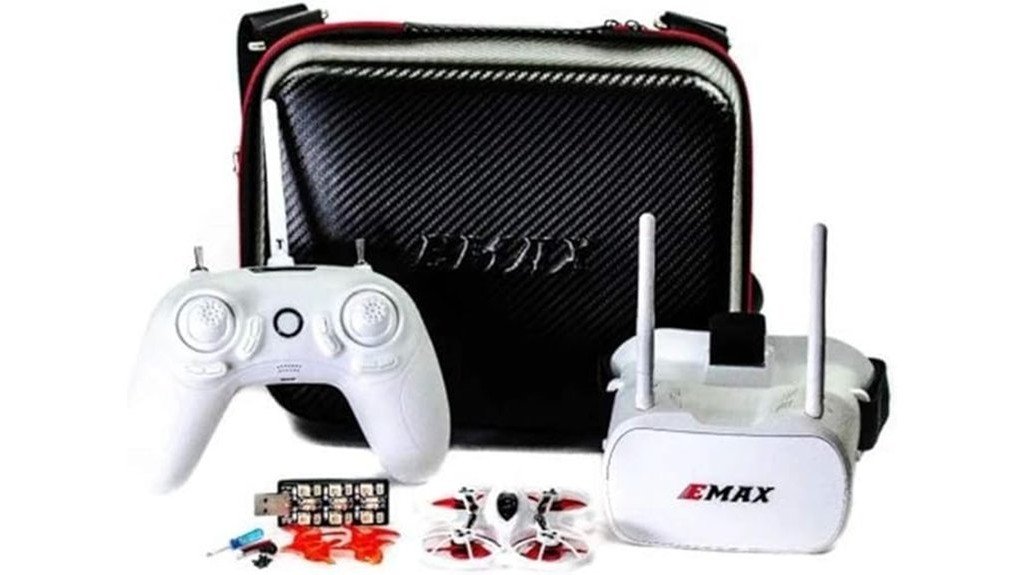
| Included Gear | Drone, goggles, E6 transmitter, 450 mAh battery, USB HV charger, charging cable, spare props, screwdriver, parts bag, and carry case |
| Package Note | The Amazon description and EMAX archive disagree on whether the charger has four or six ports. Confirm the current seller package before ordering. |
What Is the EMAX TinyHawk RTF Kit?
The original EMAX TinyHawk RTF is a complete analog FPV package built around a 75 mm indoor “whoop” style quadcopter. RTF means ready to fly, so the drone, E6 radio, and Transporter goggles are intended to arrive bound and configured for basic operation.
This is not a GPS camera drone. It does not focus on stabilized aerial photography, automatic return-to-home functions, or phone-based control. You fly from the live 5.8 GHz analog camera feed and manage throttle, pitch, roll, and yaw with the included controller.
The kit makes the most sense for a beginner who wants to learn FPV orientation indoors without selecting separate radio and video systems. Experienced pilots may also use it as a low-cost indoor trainer, but the older FrSky D8 ecosystem and entry-level goggles may feel restrictive.
Who Should Buy It?
Best For
- New FPV pilots who want the drone, goggles, controller, charger, and battery in one kit.
- Indoor flyers practicing around gates, hallways, furniture, or a small club course.
- Hobbyists who want Level, Horizon, and Acro modes in one learning platform.
Skip If
- You want stabilized HD or 4K footage, GPS, or automated camera-drone features.
- You mainly fly outdoors in wind or want the power of a larger freestyle quad.
- You want a current radio protocol and easier access to newer replacement parts.
Feature-by-Feature Review
Design and Build Quality
The 75 mm polypropylene frame surrounds the 40 mm propellers with ducts. Those guards reduce direct prop contact with walls, chair legs, and other objects during low-speed indoor bumps. The frame still can crack after repeated hard impacts, so “protected” does not mean crash-proof.
EMAX uses an inverted motor layout to keep the profile and center of gravity low. The all-up weight is about 42 g with the 450 mAh battery, which helps the drone feel responsive in a small room. Fans, open doors, and outdoor wind can affect its flight path.
Flight Controls and Learning Modes
The included E6 transmitter offers six channels and a gamepad-style shape. Its mode switch provides Level, Horizon, and Full Acrobatic control. Level mode self-levels when you release the sticks, making it the best starting point for basic hovering and slow circuits.
Horizon mode allows more aggressive movement while retaining leveling assistance near center stick. Full Acro removes self-leveling and gives you direct attitude control. Acro supports advanced FPV skills, but it has a steeper learning curve and causes more early crashes.
Analog FPV Video and Goggles
The 600TVL CMOS camera sends video through a 25 mW transmitter to the included EMAX Transporter goggles. This is true analog FPV and does not require a phone, app, Wi-Fi, or Bluetooth connection. The immediate video response is useful for learning lines and timing turns.
Image quality is the compromise. The 480 × 272 goggle display and analog feed look soft beside current digital FPV systems. Interference, antenna position, nearby electronics, and channel choice can affect clarity. The kit is designed for piloting, not recording polished video.
Battery Life and Charging
The drone uses one 1S 4.35V HV 450 mAh LiPo. EMAX rates flight time at up to about four minutes, and fast throttle changes can shorten that. One included battery is enough to learn the controls, but it creates long pauses between short flights.
Extra compatible 1S HV packs make a larger difference than most early upgrades. Match the voltage, connector, physical size, and weight rather than buying any battery labeled “1S.” The linked battery article covers another product category, so use the TinyHawk manual and pack label for compatibility.
Maintenance and Repairability
Plug-in motors reduce the need to solder during basic motor replacement. The kit also includes spare AVAN three-blade props, a screwdriver, and a small parts bag. These parts cover common prop damage and loose hardware after indoor practice.
Inspect the ducts, propellers, canopy, motor plugs, antenna, and battery connector after a hard crash. Replace bent or cracked props before flying again. Basic small tools help with hobby maintenance, but keep heat tools away from LiPo batteries and plastic parts.
How It Performs in Real Use
First Flights in a Living Room
Level mode, low altitude, and a wide oval route give you the safest learning setup. The prop guards make light taps less disruptive than they would be on an open-prop freestyle drone. A small room still feels fast through goggles, so begin with gentle stick inputs.
Indoor Gate Practice
The TinyHawk suits basic whoop gates and furniture-based practice lines. Its compact dimensions let you build a course in a basement, hall, garage, or quiet club space. The analog feed is good enough to judge openings, though low light and clutter can make details harder to read.
Outdoor Flying in Calm Conditions
You can fly outside when the air is still and the area is safe. The 42 g flying weight and small propellers do not handle wind well. Keep the route close and avoid treating the manufacturer’s maximum range claims as a target, since obstacles and radio conditions change signal performance.
Longer Practice Sessions
Battery rotation is the main bottleneck. One pack flies for only a few minutes, while charging and cooling take longer. Several compatible packs, numbered for tracking, make practice more productive and help you retire a battery that begins to swell, overheat, or lose performance.
Setup Tips Before Your First Flight
- Confirm the exact model. Check the box and drone markings so you do not follow TinyHawk II or TinyHawk III instructions by mistake.
- Charge each device correctly. The drone LiPo, radio battery, and goggle battery are separate power systems. Follow the included manual and charger labels.
- Inspect the props. Confirm every prop is fully seated, undamaged, and free to spin inside its duct.
- Start in Level mode. Practice arming, hovering, landing, and slow turns before switching to Horizon or Acro.
- Choose a clear video channel. If the picture breaks up indoors, move away from interference and use the supported channel controls rather than flying through a poor feed.
- Create a safe flight zone. Keep people, pets, fragile objects, ceiling fans, and loose cables away from the course.
Pro Tip: Set a simple two-gate route and fly it slowly in both directions. Repeating the same line builds throttle control faster than changing the course after every battery.
Compatibility and Safety Notes
The original non-S TinyHawk is designed for 1S LiPo operation. Do not connect a 2S pack, even if you can adapt the plug. EMAX states that using 2S on this model can damage the drone and void warranty coverage.
Use only a charger that supports the battery’s 1S high-voltage chemistry and connector. Charge LiPo batteries on a nonflammable surface, stay nearby, and stop using a pack that is swollen, punctured, unusually hot, or physically damaged. Let a warm battery cool before charging it again.
The prop guards lower contact risk but do not make the spinning props harmless. Keep hands, hair, pets, and children clear whenever the drone is armed. Fly only where you have permission, maintain control, and follow the current drone and radio rules that apply in your location.
Pros and Cons
Pros
- Complete RTF bundle reduces the number of separate parts a beginner must match.
- 75 mm ducted frame fits indoor rooms and protects the propellers during light bumps.
- Level, Horizon, and Acro modes support a clear learning path.
- True 5.8 GHz analog FPV works without a phone or Wi-Fi connection.
- Plug-in motors and included spare props simplify common repairs.
Cons
- One 450 mAh battery provides only about 3 to 4 minutes of typical flying.
- Entry-level analog video and box goggles look dated beside current digital kits.
- The original model is out of stock through EMAX, and package details can vary by seller.
Is It Worth the Price?
The original TinyHawk RTF can still offer reasonable value when a trustworthy seller provides a complete kit in good condition. You receive a usable drone, radio, goggles, battery, charger, case, and basic spares instead of building an FPV setup piece by piece.
Value drops quickly if the package is incomplete, heavily used, or priced close to a current-generation kit. Older FrSky D8 controls, a basic analog display, and limited original-model parts support matter more once you move beyond beginner practice.
It is worth considering for low-cost indoor learning. It is not the best fit when a newer TinyHawk or BetaFPV starter package costs only slightly more and provides a current radio system, newer batteries, or improved goggles.
What to Check on the Seller Listing
- Generation: Confirm it is the original TinyHawk RTF tied to ASIN B07M9ZGV1Q.
- Package contents: Verify the goggles, E6 transmitter, charger, one 450 mAh battery, spare props, case, cable, and small parts.
- Condition: Check whether the kit is new, used, renewed, or sold through a third party.
- Support: Review the seller’s return terms and ask about battery condition when buying older stock.
How It Compares to Alternatives
The TinyHawk Freestyle 2 is better suited to outdoor acro practice, but its open propellers and higher performance demand more space. The TinyHawk III Plus RTF line offers newer hardware and a clearer upgrade path, making it the stronger choice when the price difference is modest.
The BetaFPV Cetus family is another beginner-focused option with complete-kit versions and training features. The original TinyHawk still makes the most sense when you specifically want a compact analog indoor kit and can buy a complete package at a fair price.
Frequently Asked Questions
Is the original EMAX TinyHawk RTF good for absolute beginners?
Yes, the complete bundle and Level mode reduce the setup burden for a first-time FPV pilot. You still need patience because flying through goggles feels different from watching a drone directly, and early crashes are normal.
How long does one TinyHawk battery last?
Expect roughly 3 to 4 minutes from the included 1S 450 mAh HV pack. Fast acceleration, worn batteries, and cold conditions can shorten the session.
Can you use a 2S battery for more power?
No. EMAX support identifies the original non-S TinyHawk as a 1S-only model and warns that 2S use can void warranty coverage. Match the original voltage, connector, physical size, and weight when buying extra packs.
Do the goggles need a phone or Wi-Fi?
No. The drone sends a 5.8 GHz analog video signal directly to the Transporter goggles. A phone, app, Wi-Fi network, and Bluetooth pairing are not part of normal flight.
Can the TinyHawk RTF fly outdoors?
It can fly outside in calm conditions, but the light frame and small propellers struggle in wind. Keep it close, choose an open safe area, and bring it indoors when the video or control link becomes unreliable.
What should come in the original RTF box?
The documented kit includes the drone, Transporter goggles, E6 controller, one 450 mAh battery, USB HV charger, charging cable, spare props, screwdriver, parts bag, and carry case. Charger port count differs between the Amazon description and EMAX archive, so verify the seller’s exact package.
Can the included goggles work with another FPV drone?
They may receive video from another compatible 5.8 GHz analog transmitter on a supported channel. They will not display digital-only systems such as DJI, HDZero, or Walksnail without separate compatible hardware.
What accessories should you buy first?
Start with several compatible 1S HV batteries, spare AVAN props, and a LiPo-safe charging and storage setup. A second charger is less useful until you confirm the battery type and charging limits.
The Bottom Line
The original EMAX TinyHawk RTF is a practical entry point for indoor FPV because it combines a protected 75 mm drone with the radio, goggles, charger, battery, and spares needed to begin. Buy it when the seller offers a complete, correctly identified kit at a fair price. Skip it when you want current radio technology, longer flights, digital video, or stronger outdoor performance.
Ready to Buy?
Check the seller, package contents, condition, and latest product details before you decide.