Two Tacomas. One $20,000 price gap. One question: is the TRD Pro worth the premium? I spent time in both the 2026 Toyota Tacoma TRD Off-Road and the TRD Pro to answer that — not by reciting spec sheets, but by testing how each feels in daily driving, off-road use, and ownership reality. Below you’ll find a practical breakdown of why the Pro commands such a premium, where the Off-Road holds its own, and how to decide which one should live in your driveway.
Quick Answer
The 2026 Toyota Tacoma TRD Off-Road is the smarter financial choice for most buyers, offering core 4×4 capability, excellent daily comfort, and a ~$45,000 base price. The $65,000 TRD Pro justifies its $20,000 premium with its standard 326-hp i-FORCE MAX hybrid powertrain, high-speed FOX 2.5-inch QS3 internal bypass shocks, IsoDynamic front seats, integrated light bar, and turn-key desert performance.
Key Takeaways
- Standard Powertrains: TRD Pro comes exclusively with the 326-hp / 465 lb-ft i-FORCE MAX hybrid; TRD Off-Road offers the standard 278-hp gas turbo with hybrid optional.
- Dampers & Ride: TRD Off-Road uses daily-friendly Bilstein monopipe dampers; TRD Pro features high-speed FOX 2.5-inch QS3 internal bypass shocks with remote reservoirs.
- Towing & Payload: The non-hybrid TRD Off-Road actually hauls more (up to 6,500 lbs tow / 1,705 lbs payload) than the heavier TRD Pro (6,000 lbs tow / 1,680 lbs payload).
- Innovations: TRD Pro includes IsoDynamic Performance front seats with air-over-oil shock absorbers, though they reduce rear passenger legroom slightly.
2026 Tacoma Trim Comparison at a Glance
| Feature / Metric | TRD Off-Road | TRD Pro |
| Starting MSRP | ~$45,000 (Gas) / ~$49,000 (Hybrid) | ~$65,000 (Hybrid Standard) |
| Standard Powertrain | 2.4L i-FORCE Turbo (278 hp / 317 lb-ft) | 2.4L i-FORCE MAX Hybrid (326 hp / 465 lb-ft) |
| Suspension Systems | Bilstein Monopipe Dampers | FOX 2.5-in QS3 Internal Bypass Dampers |
| Stock Wheel & Tire | 17 or 18-in / 32-in Tires (265/70R17) | 18-in TRD / 33-in Goodyear Territory RT |
| Max Towing Rating | Up to 6,500 lbs | Up to 6,000 lbs |
| Key Off-Road Hardware | Rear Locker, Crawl Control, Composite Bed, 400W/2400W Inverter | IsoDynamic Seats, RIGID Light Bar, ARB Bumper, Power Tailgate, 2400W Inverter, SDM |
🔋 Powertrains and real-world performance
The simplest place to start is under the hood. The Off-Road offers two options: a turbocharged 2.4-liter i-FORCE four-cylinder paired to Toyota’s Direct-Shift eight-speed automatic, or a more powerful i-FORCE MAX hybrid version. The non-hybrid turbo returns EPA fuel economy around 19 mpg city / 23 mpg highway and develops 278 hp and 317 lb-ft of torque.
The TRD Pro, however, comes standard only with the i-FORCE MAX hybrid turbo 2.4. That hybrid system pairs the turbo engine with an electric motor integrated inside the transmission, bumping output to 326 hp and a massive 465 lb-ft of torque while improving fuel economy slightly to about 22 mpg city / 24 mpg highway. The Pro’s standard hybrid powertrain is a primary driver of its higher sticker price: you are paying for Toyota’s flagship midsize engine right out of the gate.
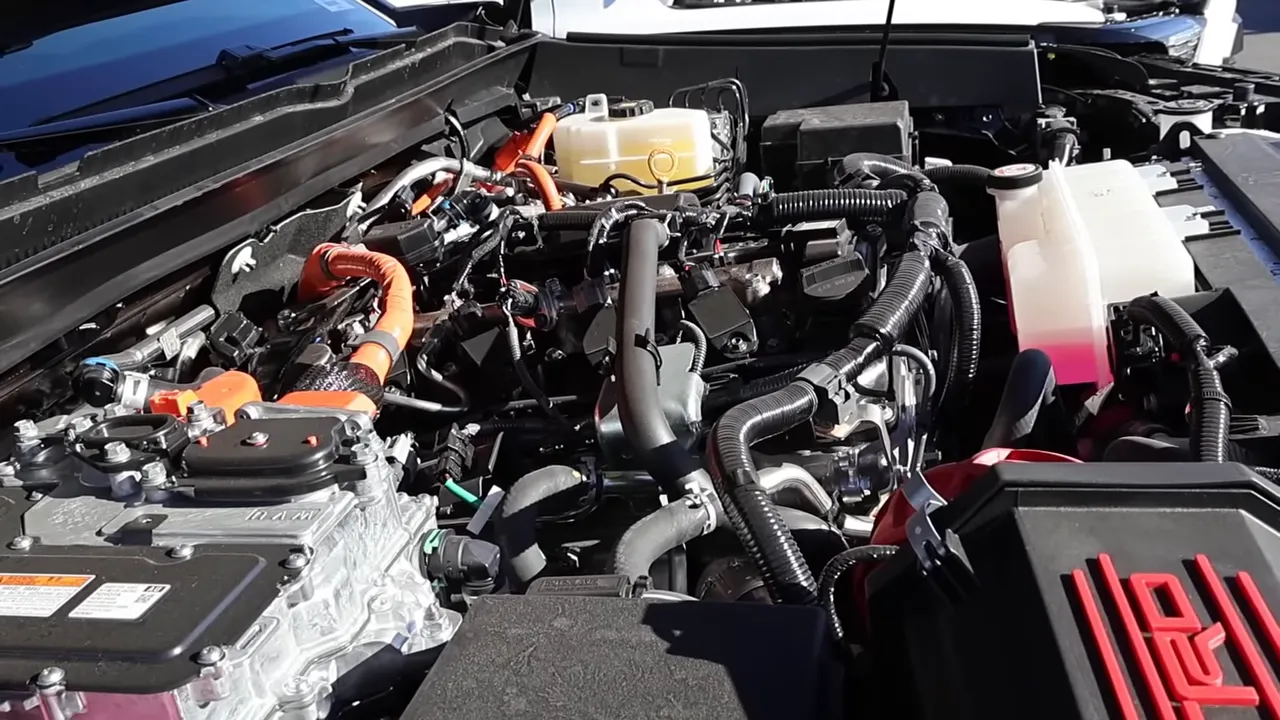
“The TRD Pro’s i-FORCE MAX hybrid delivers a massive 465 lb-ft of low-end torque starting at just 1,700 RPM—giving it effortless rock-crawling punch and diesel-like towing responsiveness.”
How this translates to driving: the hybrid delivers a wave of low-end torque that feels diesel-like if you ride the power band. In everyday use that means immediate off-the-line response and effortless passing power. The non-hybrid turbo in the TRD Off-Road is perfectly competent for most drivers — it engine-brakes predictably on descents and feels light on its feet, while saving you several thousand dollars at purchase.
🎨 Styling and exterior differences
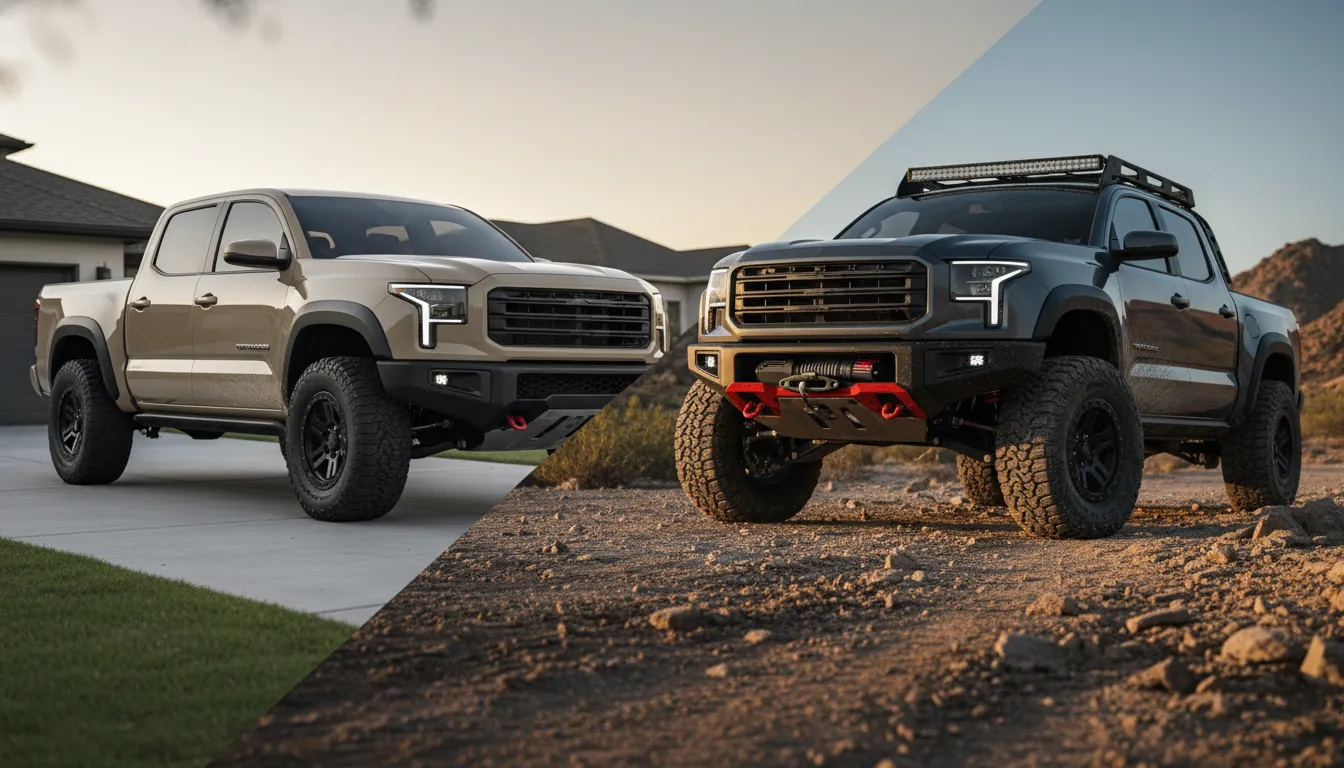
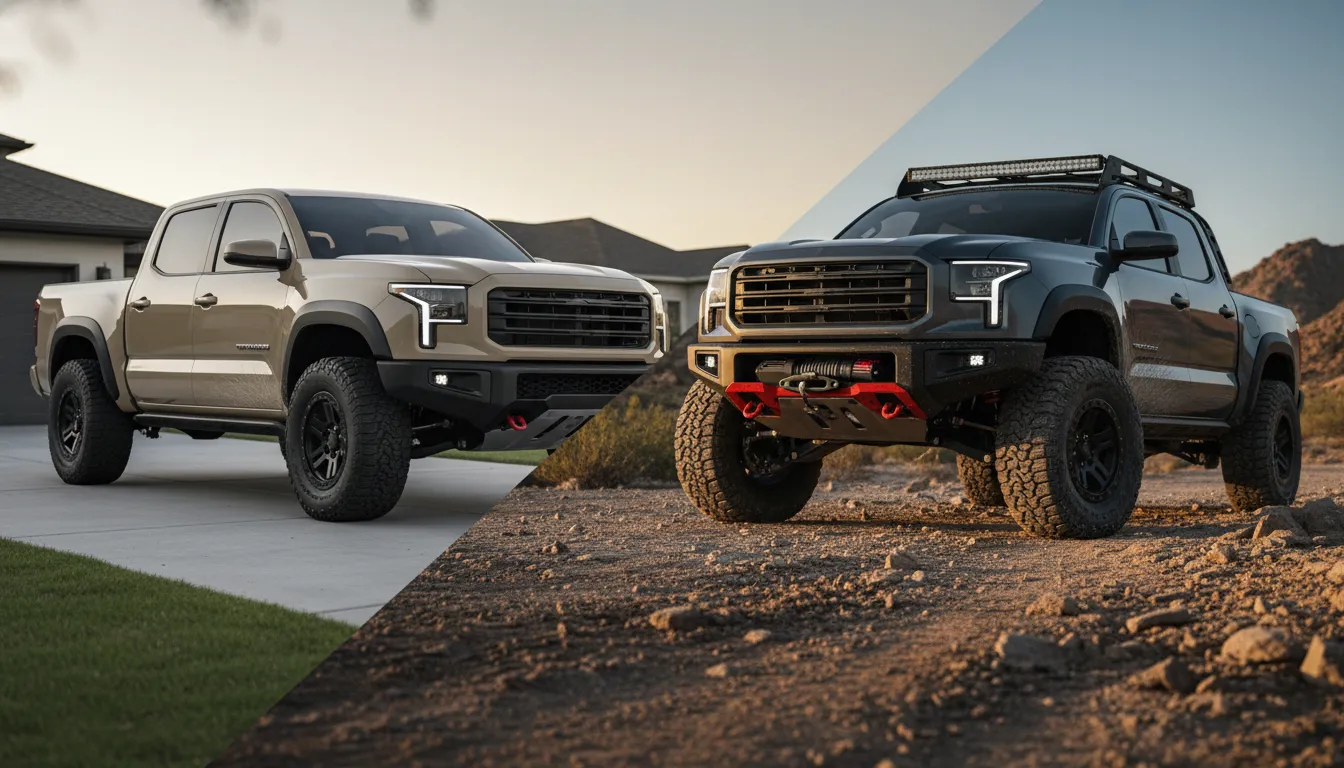
Styling is where the TRD Pro makes an unmistakable statement. The Pro introduces aggressive visual cues: a prominent hood scoop, an integrated RIGID Industries LED light bar in the heritage grille, painted red recovery hooks, high-clearance black fender flares, and a taller, wider stance. It’s designed to command attention wherever it parks.
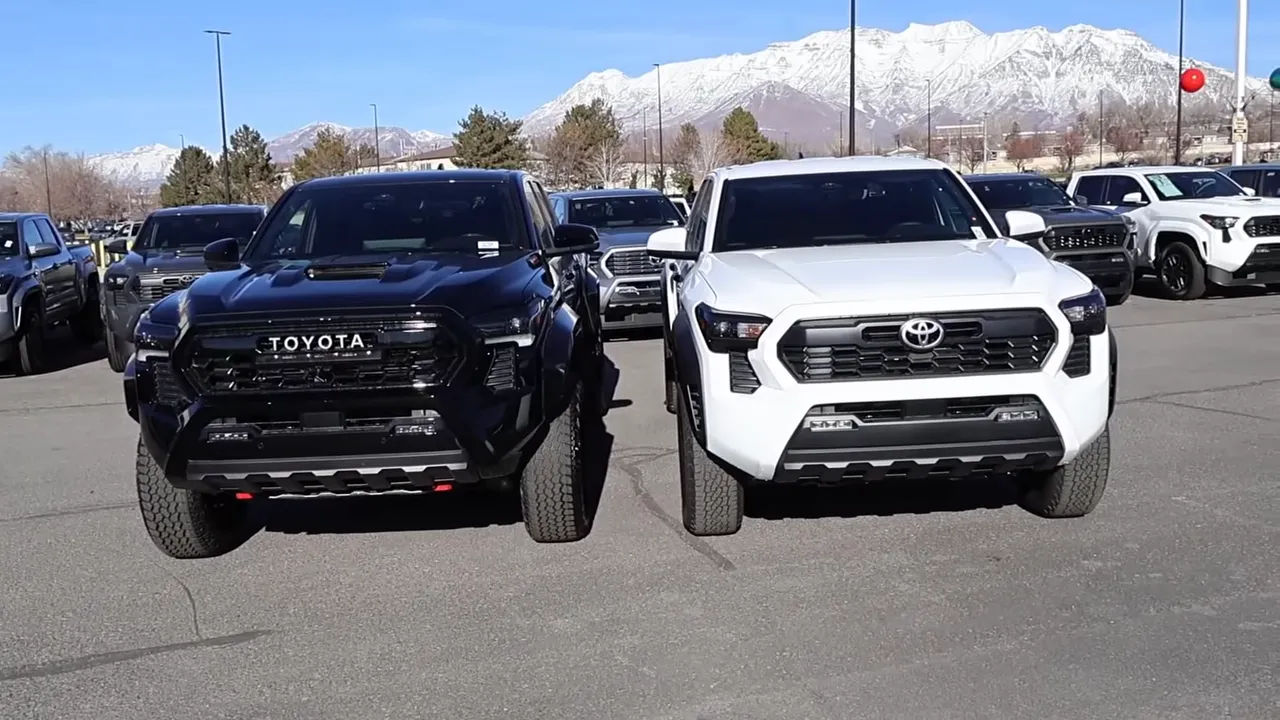
The TRD Off-Road is the stealthier sibling. It retains functional off-road hardware — LED fog lights, frame-mounted recovery points, underbody skid plates — but in a subdued package with unpainted composite fender flares and a cleaner front bumper profile. If you prefer to fly under the radar while maintaining core trail capability, the Off-Road delivers that balance convincingly.
🛞 Wheels, tires, and suspension: where capability hits the details
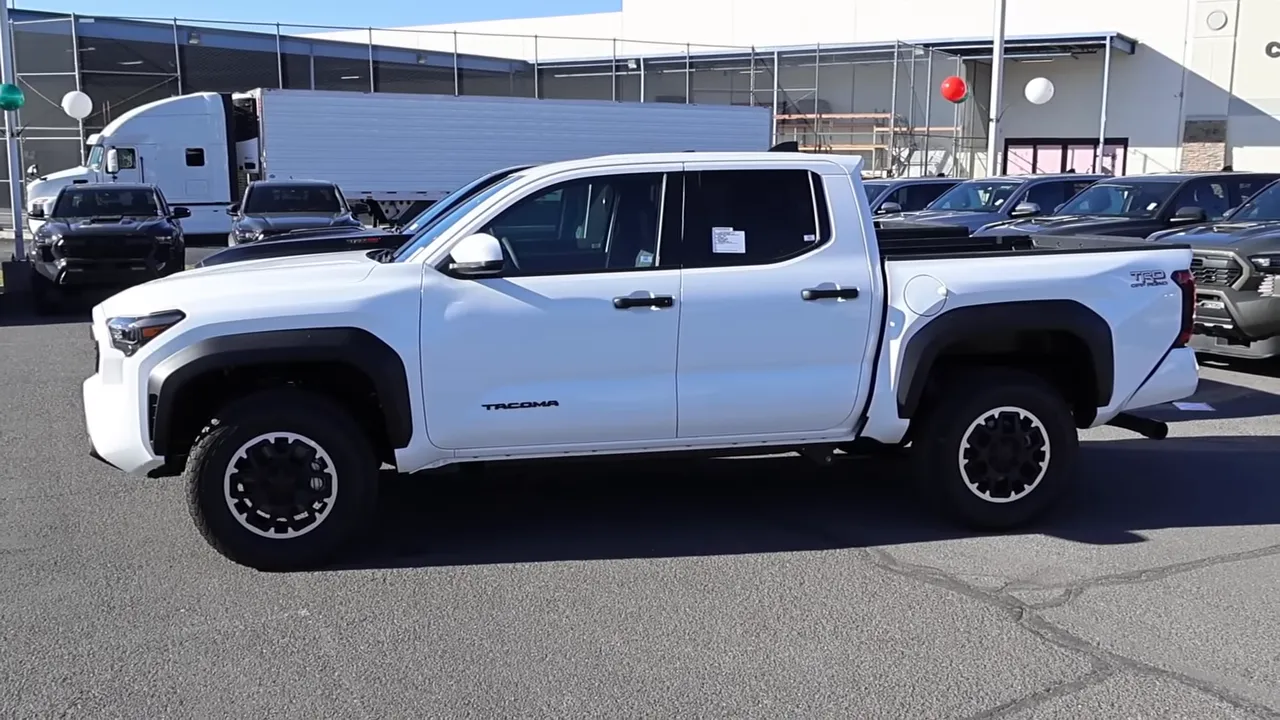
Wheel and tire choices differ significantly between trims, directly impacting both trail capability and highway ride characteristics. The Off-Road comes equipped with 17-inch or 18-inch alloy wheels, wrapping stock tires with a diameter sitting around 32 inches (265/70R17). You can fit 33-inch tires with zero modifications, and 34-inch tires with minor inner liner trimming.
The TRD Pro upgrades to black 18-inch TRD alloy wheels fitted with 33-inch Goodyear Territory RT tires (265/70R18) out of the factory. Combined with a 2-inch front and 1-inch rear factory lift, running 34-inch or 35-inch aftermarket tires is much easier on the Pro.
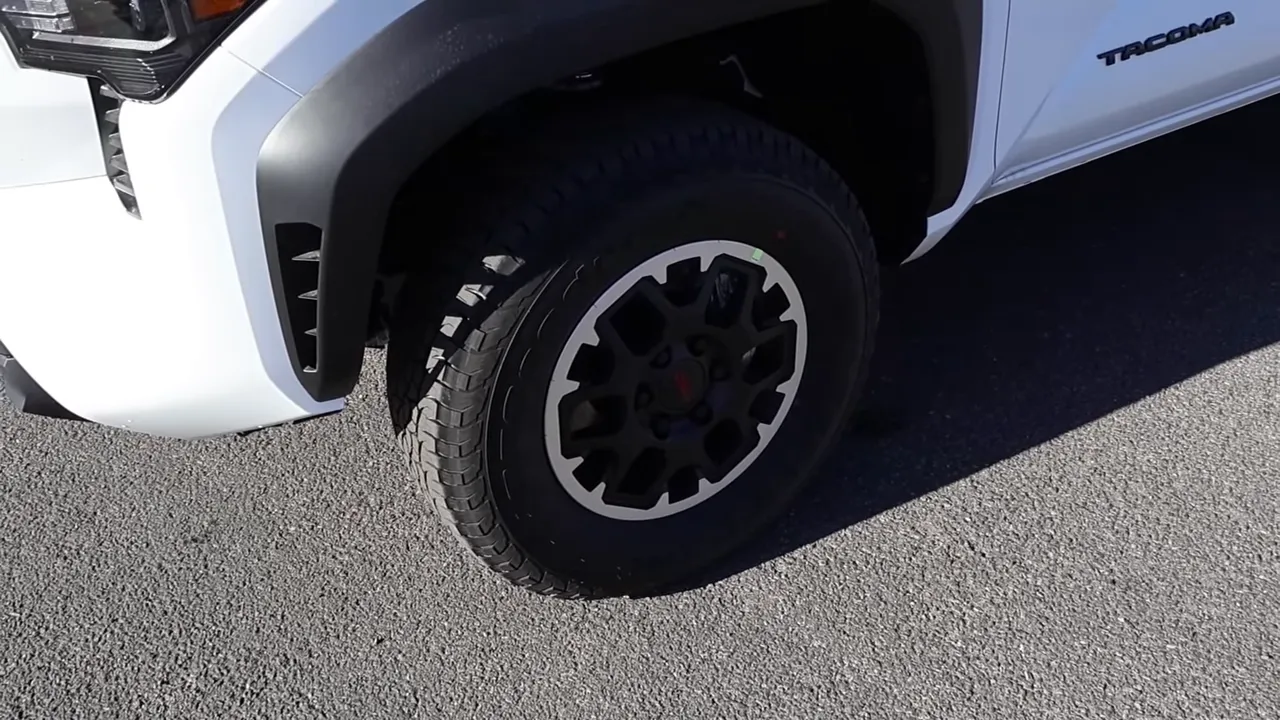
Underneath, the TRD Off-Road utilizes tuned Bilstein monopipe dampers with remote reservoirs in the rear. The TRD Pro upgrades to race-bred FOX 2.5-inch QS3 internal bypass shocks with manual compression adjustment dials, internal bump stops, and red aluminum upper control arms. On the road, the Pro’s suspension is firmer and tuned to absorb high-velocity compression events — it shines over high-speed Whoops and rough fire roads. The Off-Road tracks quietly and comfortably over typical daily pavement, isolating small bumps with ease.
🔧 Bed, rear bumper, and functional hardware
Open the tailgates and functional differences become obvious. The TRD Off-Road’s tailgate is conventional, dampened, and easy to operate manually. It features Toyota’s ultra-durable sheet-molded composite (SMC) bed floor with integrated tie-down cleats. Bed power on the non-hybrid model comes from a 400-watt AC inverter.
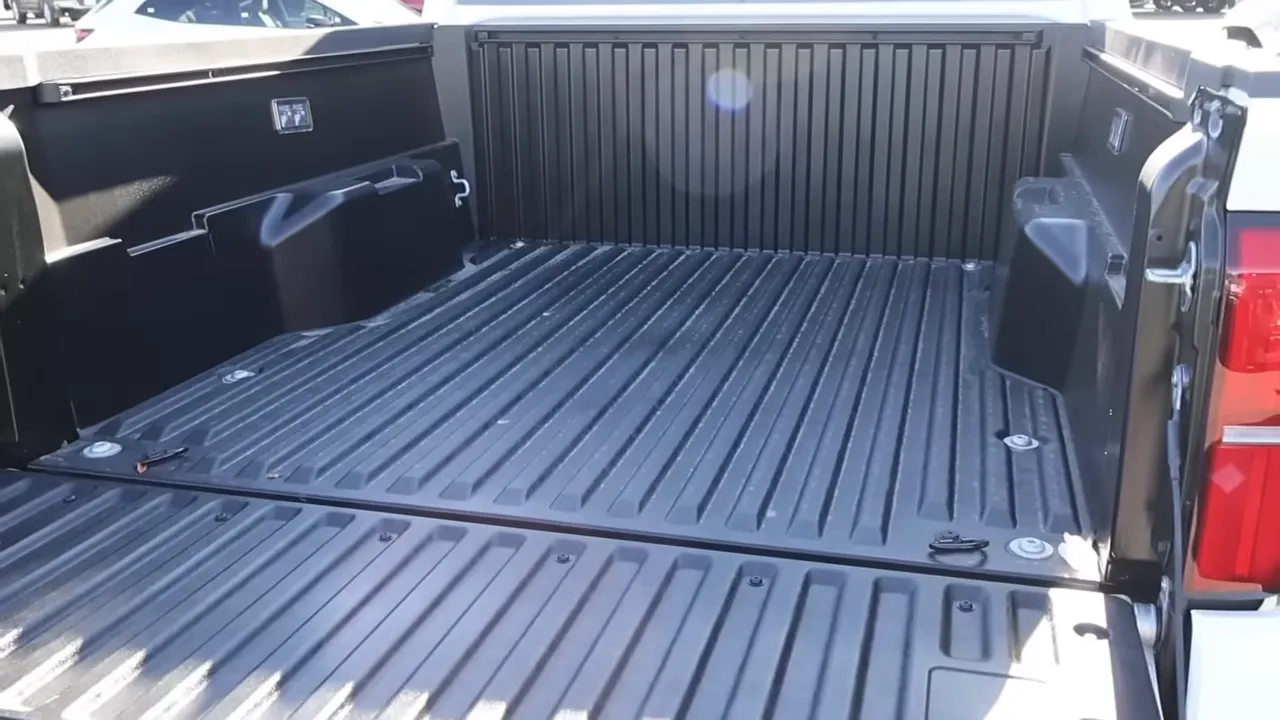
Note: Non-hybrid Tacoma models feature a 400-watt AC bed outlet. Choosing the i-FORCE MAX hybrid powertrain (standard on TRD Pro, optional on TRD Off-Road) upgrades the bed outlet to a high-output 2,400-watt AC inverter capable of running power tools, electric grills, or portable refrigerators while camping.
The TRD Pro brings integrated luxury-utility features: a hands-free power open/close tailgate, an ARB steel rear bumper with red recovery hooks, extra USB-C charging ports tucked under the bed rail, and the high-output 2,400W AC bed outlet standard. If you plan to use the bed as an overlanding campsite or mobile workstation, these factory conveniences add significant daily utility.
🪑 Interior: practicality vs themed performance
Inside the TRD Off-Road you get a functional, highly ergonomic cabin: water-focused cloth or optional SofTex seats, manual or power adjustments, standard rear seat legroom, and an available 14-inch Toyota Audio Multimedia touchscreen. Advanced driver assistance safety features like adaptive cruise control and lane centering are standard across all trims, while Toyota’s Multi-Terrain Select and Crawl Control dials sit within easy reach.
The TRD Pro cabin goes full performance: SofTex seats with red accent stitching, proprietary TRD camo pattern inserts, a HUD head-up display, JBL premium audio with a removable Bluetooth speaker, a 360-degree Multi-Terrain Monitor camera system, dual-zone climate control, ventilated front seats, and a digital rear-view mirror.
However, the TRD Pro’s hallmark interior feature — its IsoDynamic Performance front seats — is polarizing. These driver and passenger seats feature air-over-oil shock absorbers built directly into the seatback frame to damp lateral and vertical body motion during high-speed off-roading.
Warning: Test drive the TRD Pro’s IsoDynamic Performance front seats before buying if you regularly carry rear passengers. The shock absorbers built into the back of the front seats intrude roughly 1.5 inches into rear knee clearance, making the back seat tighter for tall adults or bulky rear-facing child safety seats compared to the standard TRD Off-Road layout.
🚗 On-road impressions and daily driving
Driving both trucks back-to-back highlights distinct personalities. The Pro feels wider and taller, giving you a commanding view over traffic. Its FOX QS3 internal bypass shocks provide composure when crossing railroad tracks, potholes, or large dips at speed. Acoustic double-pane front glass helps suppress wind and tire hum, making long highway commutes surprisingly quiet.
Conversely, the TRD Off-Road often feels more compliant in normal city commuting. Its Bilstein dampers respond smoothly over small road imperfections and expansion joints without transferring vibration into the cabin. The Off-Road’s conventional front seats are cushioned and forgiving, offering more rear passenger legroom and making it arguably better suited for family duty.
⛰️ Off-road capability: how much do you actually need?
Both trucks are top-tier midsize 4x4s equipped with electronic locking rear differentials, lower transfer case gearing, Multi-Terrain Select (MTS), and Crawl Control. The TRD Pro holds a distinct advantage in high-speed desert running thanks to its FOX bypass shocks, hydraulic bump stops, and standard Stabilizer Disconnect Mechanism (SDM), which increases front suspension articulation at the touch of a button.
However, for technical low-speed trail riding, forest tracks, or rock crawling, the TRD Off-Road (which offers SDM as an option) easily navigates the exact same trails. Furthermore, the Off-Road’s narrower fender flares give it an advantage in tight singletrack clearance where wider trucks risk scratching paint.
Pro Tip: If you want TRD Pro levels of technical off-road capability without the $65,000 price tag, order a TRD Off-Road Hybrid with the optional Stabilizer Disconnect Mechanism (~$50,000). Add a $2,500 set of quality aftermarket coilovers and 33-inch tires, and you will match the Pro’s technical trail capability while saving over $12,000.
💸 Sticker shock: how the $20,000 difference breaks down
Base pricing for 2026 models breaks down approximately as follows:
- TRD Off-Road (Non-Hybrid Gas): ~$45,000 MSRP
- TRD Off-Road (i-FORCE MAX Hybrid): ~$49,000 MSRP
- TRD Pro (Hybrid Standard): ~$65,000 MSRP
Where does that $20,000 gap go? Roughly $4,000 pays for the standard i-FORCE MAX hybrid powertrain. The remaining $16,000 covers high-end mechanical and cosmetic hardware: FOX QS3 bypass dampers, IsoDynamic seats, 33-inch Goodyear tires, ARB steel rear bumper, RIGID light bar, power tailgate, JBL audio with removable speaker, 360-degree cameras, HUD, and exclusive styling options.
🔍 Choosing the right Tacoma for you: a practical buying roadmap
- Evaluate your core terrain: If 90% of your driving is on-road with weekend camping, light towing, or forest service roads, the standard non-hybrid TRD Off-Road is the optimal value.
- Assess your power needs: If you tow frequently or live at high elevation, step up to the TRD Off-Road Hybrid to get the full 465 lb-ft of torque and 2,400W bed inverter.
- Determine high-speed off-road demand: If you plan to run fast desert trails, washboard roads, or want a fully loaded, factory-backed performance truck without modifying aftermarket parts, purchase the TRD Pro.
🧰 Practical ownership notes and small annoyances
- Safety Menu Depth: Disabling active driver aids like Lane Trace Assist or Proactive Driving Assist requires navigating through deep multi-level instrument cluster menus.
- Payload Realities: Due to the weight of its hybrid battery, electric motor, and heavy-duty suspension gear, the TRD Pro’s payload capacity (~1,680 lbs) is slightly lower than a non-hybrid TRD Off-Road (~1,705 lbs).
📌 Final verdict: is the TRD PRO worth it?
The TRD Pro is worth the investment if its factory-engineered feature set directly aligns with your lifestyle. If you demand turn-key high-speed off-road performance, premium technology, maximum hybrid torque, and head-turning styling backed by a factory warranty, the Pro is a masterclass in midsize truck engineering.
For the vast majority of truck owners, however, the TRD Off-Road — especially when optioned with the i-FORCE MAX hybrid engine — represents the smarter financial and daily choice. It delivers 90% of the capability, superior rear-seat practicality, excellent daily ride quality, and leaves $15,000 to $20,000 in your bank account for real-world adventures.
❓ Frequently asked questions
How much more powerful is the TRD PRO compared to the Off-Road?
The TRD Pro comes standard with the 2.4-liter i-FORCE MAX turbo hybrid, producing 326 horsepower and 465 lb-ft of torque. The standard non-hybrid TRD Off-Road produces 278 horsepower and 317 lb-ft of torque. That extra 148 lb-ft of torque gives the TRD Pro significantly stronger off-the-line acceleration and low-speed trail grunt, though the hybrid powertrain is also available as an option on the TRD Off-Road.
Can you fit bigger tires on the Off-Road like on the PRO?
Yes. While the TRD Off-Road comes stock with 32-inch tires (265/70R17) and the TRD Pro features 33-inch tires (265/70R18 Goodyear Territory RT), the Off-Road easily accommodates 33-inch tires without rubbing. Fitting 34-inch or 35-inch tires requires a minor leveling kit or aftermarket suspension lift on both trims.
Does the PRO dramatically improve off-road capability?
The TRD Pro excels on fast, high-speed desert terrain due to its FOX 2.5-inch QS3 internal bypass shocks, internal bump stops, and standard front stabilizer bar disconnect. However, for slow technical rock crawling, tight forest trails, or mud, both trucks share the same rear locking differential, Crawl Control, and Multi-Terrain Select systems, making their slow-speed technical capability nearly equal.
Is the Off-Road more comfortable for daily driving?
For most commuters, yes. The TRD Off-Road’s Bilstein monopipe shocks are valved for compliance over small pavement expansion joints and potholed city streets. The TRD Pro’s FOX dampers are tuned for high-speed impact absorption, which can feel slightly firmer or busier over low-speed road imperfections. Additionally, the Off-Road’s conventional seats offer more rear legroom.
Should I buy the hybrid or the non-hybrid version?
Choose the i-FORCE MAX hybrid if you frequently tow, haul heavy loads, or want maximum low-end torque and a 2,400W bed power inverter. Choose the non-hybrid 2.4L turbo if you want a lower purchase price, simpler mechanical layout, potential option for a 6-speed manual transmission, and slightly higher payload capacity.
What’s the best strategy to avoid paying the TRD PRO tax?
Buy the TRD Off-Road with the optional i-FORCE MAX hybrid engine or Upgrade Package. Then selectively add high-quality aftermarket upgrades like 33-inch all-terrain tires, high-clearance skid plates, and custom coilover shocks. You will replicate or exceed the TRD Pro’s performance while saving $10,000 to $15,000 overall.
✔️ Takeaway
If you want a practical, highly capable midsize pickup without paying a steep premium, the TRD Off-Road offers the ultimate value balance in the 2026 Tacoma lineup. If you desire factory-tuned high-speed desert performance, cutting-edge shock technology, and maximum hybrid power straight off the showroom floor, the TRD Pro is an extraordinary machine — as long as you’re prepared to pay the premium.
Sources
- Toyota USA Newsroom — Official 4th Generation Toyota Tacoma Specifications & i-FORCE MAX Powertrain Architecture
- U.S. Environmental Protection Agency (EPA) — Official Fuel Economy Testing & Labeling Standards
- Bilstein Shock Absorbers — Monopipe Remote-Reservoir Damper Technical Specifications
- FOX Factory Racing Shocks — 2.5-inch Internal Bypass QS3 Damper Engineering Data