A stroller wagon can carry children and gear more comfortably than many standard strollers, but safe use depends on more than a child’s birthday. Before using one, confirm the exact model’s minimum age, seat support, harness fit, per-seat weight limit, cargo limit, and total-load limit. Your child must also remain seated in the position the manufacturer intended.
Last updated: July 14, 2026
Quick Answer
A stroller wagon is usually appropriate only when your child meets the exact model’s minimum age, can remain upright in its seat, fits the supplied harness, and stays below both the per-seat and total-load limits. Many models begin at 6 or 12 months, but the manual, not a generic age chart, controls.
Key Takeaways
- The manufacturer’s minimum age is only one requirement. Your child must also have the posture and support needed for that seat.
- Check the per-seat child limit separately from cargo, combined passenger, and total-load limits.
- Use the complete restraint system supplied for the exact model, whether it is a 3-point or 5-point design.
- Infants should use only a manufacturer-approved car seat, bassinet, insert, or infant mode.
- Before using a secondhand wagon, identify the model, check recalls, inspect every restraint and brake, and obtain the correct manual.
| Safety Check | What to Look For |
|---|---|
| Minimum age | Use the manufacturer’s age guidance. Some seats begin at 6 months, while others require 12 months or another minimum. |
| Developmental readiness | Confirm that your child can maintain the posture required by the seat without slumping or losing head control. |
| Infant use | Use only a manufacturer-approved infant car seat, bassinet, insert, or infant configuration. |
| Weight limits | Check the per-seat, combined passenger, cargo, and total-load limits instead of relying on one number. |
| Restraint system | Use every strap and buckle supplied for the child’s seating position. Replace damaged parts only with approved components. |
| Brakes and frame | Confirm that the parking brake holds, the frame locks open, and the wheels do not wobble or detach. |
What Is a Stroller Wagon?
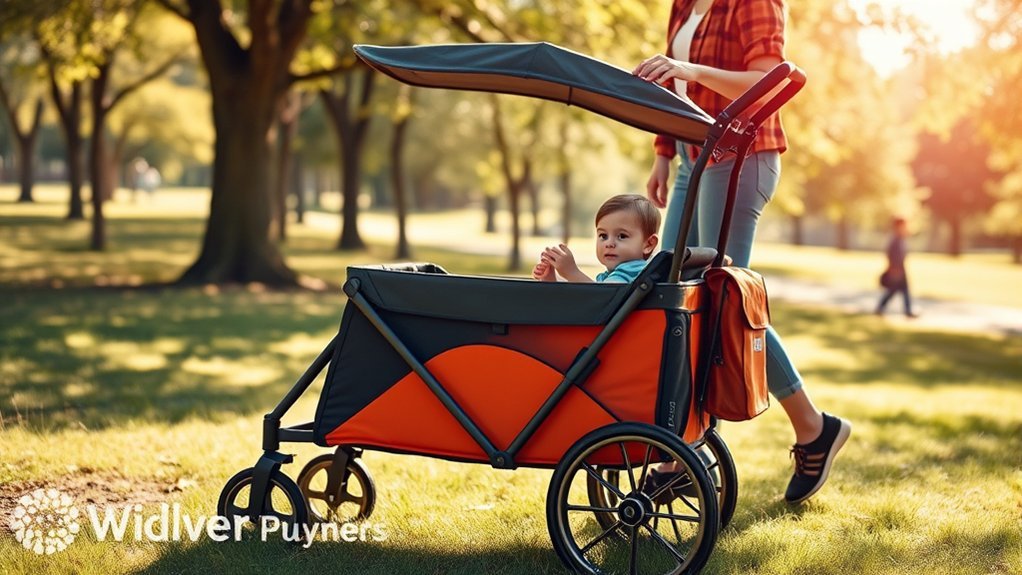
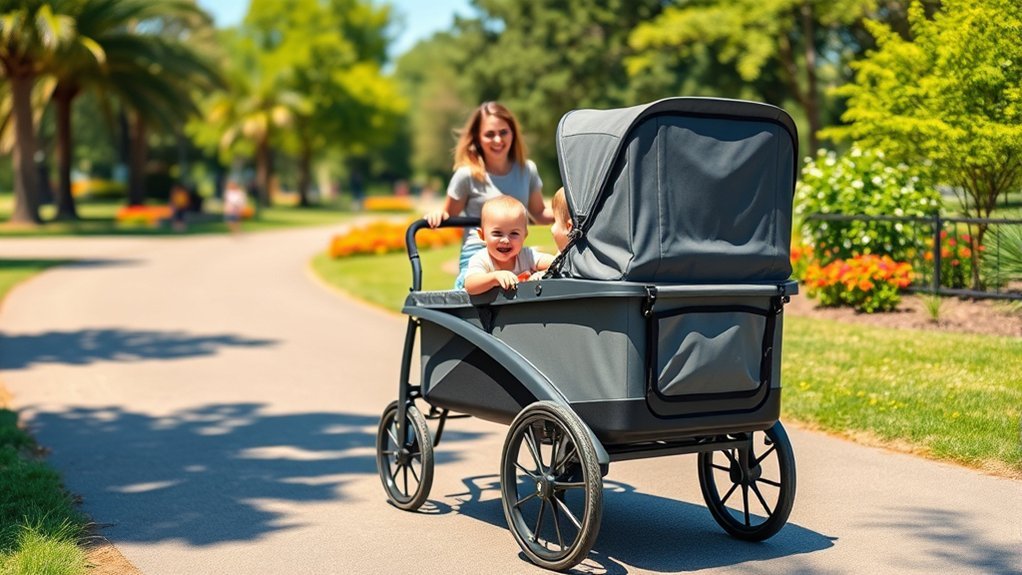
A stroller wagon combines a stroller-style handle and child-restraint system with a wagon-style passenger cabin. It generally offers more room for children, snacks, bags, and outdoor supplies than a compact stroller.
The safety design matters more than the wagon shape. A child-carrying stroller wagon should have designated seating, a restraint system, parking brakes, permanent product labels, and a manual that states its age, weight, height, cargo, and accessory rules. A utility wagon intended only for equipment is not a substitute.
In the United States, 16 CFR Part 1227 establishes the federal safety standard for carriages and strollers and incorporates ASTM F833-21. The related CPSC guidance covers performance areas such as parking brakes, stability, restraint systems, occupant retention, frame openings, and wheel assemblies.
What Age Is Best for a Stroller Wagon?
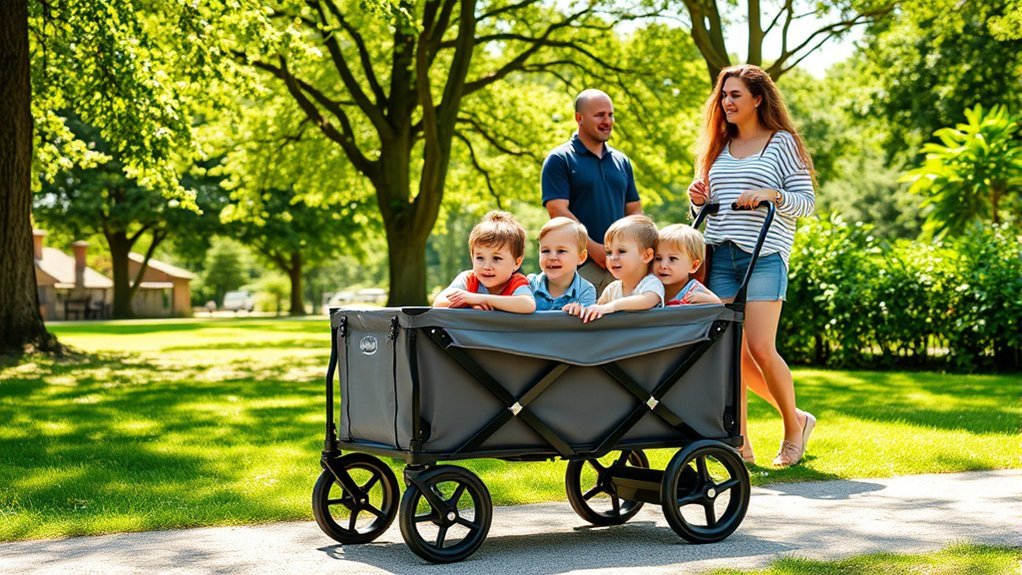
The correct minimum age depends on the exact wagon and seating configuration. Some manufacturers permit direct seat use from 6 months, while other models require 12 months or older. An approved infant car-seat attachment or bassinet may have a different starting age from the wagon’s regular bench seat.
For example, the Evenflo Pivot Xplore currently lists a minimum age of 6 months, an age range through 5 years, and a maximum of 55 pounds for each seat. Those figures apply to that product and should not be copied to another wagon.
Minimum Age Versus Developmental Readiness
A minimum age printed on the label is not a guarantee that every child of that age is ready. The seat must support your child in the position required by the manufacturer, and the harness must fit without the child slumping, folding forward, or sliding beneath the straps.
The CDC’s 6-month milestones include leaning on the hands for support while sitting. Its 9-month milestones include sitting without support. Children develop at different rates, so use these milestones as context rather than a replacement for the product manual or medical advice.
A printed 6-month minimum does not automatically mean that every 6-month-old has the sitting control required by every stroller wagon seat.
Warning: Never place a young infant loose on a wagon bench, floor, or footwell. Do not add pillows, loose bedding, rolled blankets, or an unapproved support to create an infant or sleep position. Use only the infant car seat, bassinet, insert, recline, and adapter combinations approved for your exact wagon.
Most families use stroller wagons most often during the toddler and preschool years. However, a child may outgrow the harness, seat height, legroom, or per-seat limit before reaching the general upper age advertised for the product.
How Much Weight Can a Stroller Wagon Hold?
Stroller wagon capacity varies widely. Do not use a single market-wide weight estimate. Instead, read every applicable capacity label in the manual and on the product.
- Per-seat child limit: the maximum allowed for one passenger position.
- Combined passenger limit: the total allowed for all children.
- Cargo limit: the amount permitted in baskets, pockets, or cargo areas.
- Total-load limit: the combined load of children, bags, food, coolers, toys, and other permitted items.
A wagon may advertise a large overall capacity while setting a much lower limit for each child seat. Never divide the total capacity by the number of seats unless the manual specifically tells you to do so.
Maximum Weight Limits
Treat every listed limit as a hard maximum. The child must also fit the designated seating area with the restraint positioned as shown in the manual. Staying under a weight number does not make an incorrect harness fit or cramped seating safe.
Overloading can increase steering effort, lengthen stopping distance, strain folding joints, affect brake performance, and make the wagon less stable on slopes or uneven surfaces.
Pro Tip: Save a photo of the capacity label and model number on your phone. You can check the limits while packing without searching for the paper manual.
Age and Weight Considerations
Age alone does not show whether a child still fits. A smaller 5-year-old may remain within the seat and harness limits, while a taller preschooler may run out of shoulder space, legroom, or usable harness length sooner.
| Child Stage | What to Check | General Guidance |
|---|---|---|
| Under 6 months | Approved infant car seat, bassinet, or infant configuration | Use only when the exact model and accessory instructions permit it. |
| 6 to 12 months | Minimum age, posture, seat support, and harness fit | Highly model-dependent. Do not use age alone. |
| 12 months to 3 years | Harness position, seated posture, shade, and brake operation | Often a practical stage when the model’s limits are met. |
| 4 to 5 years and older | Height, shoulder space, legroom, restraint fit, and per-seat limit | Continue only while the child fits every stated requirement. |
Safety Guidelines to Follow
Buckle every child before the wagon moves, even during a short walk. Keep passengers seated and stop the wagon before adjusting straps, passing food, or retrieving a dropped item.
Lock the parking brake whenever you load or unload children, stop on a slope, or leave the handle. Keep cargo low and centered. Do not hang a heavy diaper bag, shopping bag, or cooler from the handle unless the manual expressly permits it.
Never use a utility wagon for child transport unless its manufacturer identifies it as a child-carrying product with the required seating and restraint system.
How Do You Know a Child Has Outgrown a Stroller Wagon?
Stop using a passenger position when your child exceeds any listed age, height, or weight limit. A child has also outgrown the seat when the harness cannot be adjusted as directed or the child no longer fits within the designated seating area.
Watch for these signs:
- The child exceeds the per-seat limit, even when the wagon remains below its total-load limit.
- The shoulder, waist, or crotch straps no longer sit in the positions shown in the manual.
- The child’s torso, shoulders, or legs are compressed against the frame or another passenger.
- The child cannot remain seated without leaning over the side or interfering with another rider.
- The manufacturer’s stated height or age limit has been reached.
- Using the seat prevents the footwell, restraint, canopy, or other required component from working correctly.
Do not solve an outgrown fit by loosening the harness beyond the instructions, removing required seat components, or placing the child in the cargo area.
How Can a Stroller Wagon Encourage Independence?
A stroller wagon can give toddlers and preschoolers small choices while the adult retains control of every safety decision. Let your child choose a snack, comfort item, book, or assigned seat before you start moving.
These limited choices can reduce conflict and help children feel involved. The adult should continue to control the route, restraint, brakes, speed, cargo placement, and when children may enter or leave.
Promoting Decision-Making Skills
Offer two simple choices instead of an open-ended question. For example, ask whether your child wants a book or a small toy, or whether the red cup or blue cup should go in the approved cup holder.
| Activity | Skill Developed |
|---|---|
| Choosing an assigned seat | Expressing preferences |
| Packing one snack | Taking ownership |
| Picking a comfort item | Planning ahead |
| Helping remove light items after the ride | Building responsibility |
| Naming landmarks during the trip | Encouraging observation |
Enhancing Physical Coordination
Climbing in and out may support balance and coordination when the wagon is fully stopped, the brake is locked, and an adult remains close. Help your child enter or exit slowly using the method shown in the manual.
Do not allow children to stand, climb on the sides, lean outside the passenger area, or steer while another child is riding. A stroller wagon is a transport product, not climbing equipment.
What Safety Features Should You Look For?
Prioritize functional safety components before cup holders, fabric colors, or decorative accessories. Each passenger position should have an intact restraint system designed for that exact model.
Harness styles vary. Some stroller wagons use 3-point restraints, while others use 5-point restraints. Use every supplied strap and buckle, route them as shown in the manual, and replace damaged parts only with components approved by the manufacturer.
Also look for an effective parking brake, a frame that locks securely in the open position, stable wheel assemblies, permanent model and manufacture-date labels, a clear load label, and seating that keeps children within the passenger area.
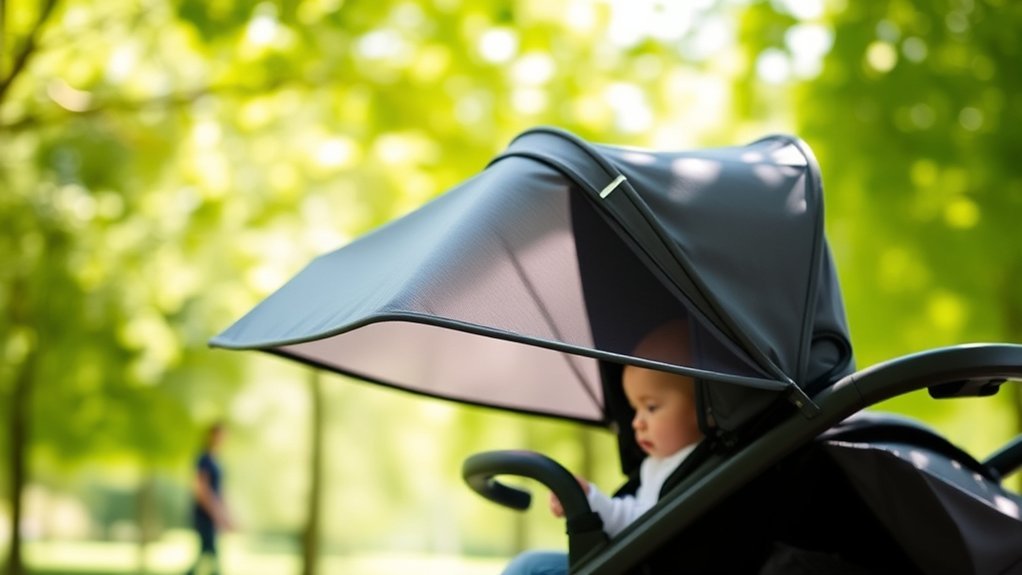
A canopy can provide shade, but it should not block needed ventilation or prevent you from checking your child. “All-terrain” wording does not mean the wagon is suitable for every beach, trail, hill, gravel path, or weather condition. Follow the approved-terrain instructions.
How Do You Choose the Right Stroller Wagon?
Start with the youngest child’s age, posture, and support needs. For an infant, confirm that the wagon accepts a specifically approved infant car seat, bassinet, or infant accessory. Brand compatibility alone is not enough. The exact wagon, adapter, and car-seat models must match the manufacturer’s instructions.
Next, compare seating capacity, per-seat limits, open and folded dimensions, product weight, brake operation, canopy coverage, wheel design, storage limits, and cleaning instructions.
- For infants: verify the complete approved infant configuration and its separate limits.
- For toddlers: prioritize restraint fit, shade, washable surfaces, and simple brake access.
- For preschoolers: check shoulder room, seat height, legroom, and per-seat capacity.
- For siblings of different sizes: confirm how the manual permits you to distribute passengers and cargo.
- For travel: measure your trunk, doorways, elevators, and storage area before buying.
- For destinations: check current venue rules because some attractions, events, and transportation providers restrict wagons or set size limits.
What Should You Check Before Using a Secondhand Stroller Wagon?
Do not use a secondhand wagon until you can identify its manufacturer, model number, and approximate manufacture date. These details are usually printed on a permanent label attached to the frame or seating area.
- Check recalls: Search the model on the CPSC recalls and product-safety warnings page.
- Obtain the correct manual: Confirm the age, weight, restraint, folding, accessory, and cleaning rules.
- Inspect the frame: Look for bends, cracks, corrosion, loose rivets, failed locks, or unauthorized repairs.
- Test the brakes: Make sure the parking brake engages and holds as the manual describes.
- Inspect every wheel: Check for wobbling, damage, missing hardware, or poor attachment.
- Inspect the restraints: Do not use a seat with cut, frayed, stretched, missing, or mismatched straps and buckles.
- Confirm all required parts: Do not substitute generic adapters, seats, fasteners, or restraint components.
Note: If the product label is missing and you cannot identify the exact model or locate its manual, you cannot reliably verify its limits, recall status, or approved parts.
How Do You Use a Stroller Wagon Safely?
Build the same short routine into every trip:
- Read the manual: Confirm the age, height, weight, seating, terrain, and approved-accessory rules.
- Inspect the wagon: Check the frame lock, wheels, brakes, restraints, and required seat parts.
- Lock the brake before loading: Keep the wagon stationary while children enter, exit, or receive harness adjustments.
- Buckle every passenger: Use the complete restraint system before releasing the brake.
- Balance the permitted load: Keep cargo low and centered and remain within every listed limit.
- Keep children seated: Stop before passing snacks, handling spills, or retrieving toys.
- Use appropriate terrain: Slow down for transitions and avoid slopes or surfaces the manual excludes.
- Stay at the handle: Never leave children unattended in a parked or moving wagon.
How Do You Maintain a Stroller Wagon?
Remove crumbs, sand, mud, and spills after outings so debris does not interfere with buckles, wheel assemblies, brakes, latches, or folding joints.
Inspect the tires, wheels, brakes, hinges, frame, canopy, seats, and restraints regularly. Stop using the wagon if a brake slips, a wheel wobbles, a buckle fails, the frame does not lock, or a structural part appears bent or cracked.
Follow the model’s care instructions. For example, Evenflo directs Pivot Xplore users to clean minor spills with cold water and mild soap, air-dry the material, wipe hard parts with a damp cloth, and avoid abrasive cleaners or solvents. Another manufacturer may give different instructions.
Allow fabric and padding to dry completely before folding or storing the wagon. Store it in a dry location and avoid unapproved lubricants, replacement fasteners, or cleaning chemicals.
How Can You Make Outings Easier?
Plan around the route, weather, destination rules, available storage, and your children’s energy levels. Choose paths that match the wagon’s approved terrain and leave enough unused capacity for items added during the outing.
- Measure before leaving: Confirm that the wagon fits your vehicle, doorway, elevator, or destination entrance.
- Pack low and centered: Place permitted heavier items near the bottom instead of hanging them from the handle.
- Keep airflow open: Use the canopy for shade without sealing the passenger area or blocking your view.
- Check passengers often: Watch posture, comfort, temperature, restraint fit, and interactions between children.
- Take movement breaks: Let older children walk in safe areas, then rebuckle them before the wagon moves again.
- Recheck the load: Drinks, purchases, wet clothing, and collected items can increase the total weight during the day.
Sources
- Electronic Code of Federal Regulations: 16 CFR Part 1227 — current federal safety standard for carriages and strollers.
- U.S. Consumer Product Safety Commission: Carriages and Strollers Business Guidance — performance, labeling, testing, and registration requirements.
- U.S. Consumer Product Safety Commission: Recalls and Product Safety Warnings — current recall lookup for new and secondhand products.
- CDC: Developmental Milestones by 6 Months — sitting-support milestone context.
- CDC: Developmental Milestones by 9 Months — unsupported-sitting milestone context.
- Evenflo: Pivot Xplore All-Terrain Stroller Wagon — model-specific example of age, seat-weight, restraint, and cleaning guidance.
Frequently Asked Questions
Can stroller wagons be used for infants under 2 years old?
Yes, some models support children under 2, but the permitted configuration matters. A young infant may need an approved car seat, bassinet, or infant accessory. An older baby may use the regular seat only after meeting the model’s minimum age, support, posture, harness, height, and weight requirements.
Can a newborn ride in a stroller wagon?
Only when the manufacturer approves a newborn-compatible configuration for the exact wagon, such as a listed infant car seat and adapter or an approved bassinet mode. Never place a newborn loose on the bench, wagon floor, or footwell, and do not create an improvised reclined space with pillows or blankets.
How do I know when my child has outgrown the stroller wagon?
Your child has outgrown the passenger position after exceeding any age, height, or per-seat weight limit, or when the restraint no longer fits as directed. Cramped shoulder space, insufficient legroom, incorrect strap placement, or an inability to remain within the seat also indicate that use should stop.
What activities are stroller wagons best suited for?
They can work well for neighborhood walks, parks, zoos, school events, farmers markets, and outdoor trips when the route, surface, passenger load, and destination rules match the model’s instructions. Check venue restrictions and measure entrances before taking a large wagon to a crowded destination.
Are there stroller wagons designed for children with additional support needs?
Some adaptive strollers and mobility products provide more postural support than standard stroller wagons. A regular wagon may not meet a child’s seating, airway, positioning, behavioral, or mobility needs. Review the product instructions and ask the child’s clinician or mobility specialist when additional support is needed.
How do I clean and sanitize my stroller wagon?
Follow the manual and care label. Remove crumbs and sand first, then use only approved cleaning products and methods. Mild soap and water may be allowed for some surfaces, but strong disinfectants, solvents, machine washing, or abrasive cleaners can damage fabrics, coatings, restraints, or plastic parts.
Can stroller wagons handle rough terrain such as sand or gravel?
Some models handle grass, packed dirt, gravel, or firm sand better than standard strollers, but “all-terrain” does not mean every surface is safe. Follow the manual’s terrain guidance, reduce speed, avoid steep slopes, and stop if wheels sink, lift, skid, or become difficult to control.
Can I hang a diaper bag from the stroller wagon handle?
Only when the manufacturer permits that loading method and the bag remains within the stated limit. A heavy handlebar load can change balance and steering. Use approved storage areas and keep heavier cargo low and centered whenever possible.
Conclusion
A stroller wagon can be useful from later infancy through the toddler and preschool years, but no universal age or weight range applies to every product. Safe use begins with the exact manual, the correct seating configuration, a properly fitted restraint, and compliance with every per-seat and total-load limit.
Before each outing, inspect the wagon, lock the brake while loading, buckle every passenger, balance the permitted cargo, and choose terrain the manufacturer approves. Stop using a seat when your child exceeds a limit or no longer fits the restraint and passenger area correctly.